When God Became a Shield: How Krishna Saved Arjuna Again and Again
By Pt. Narendra Sharma
The deeper meaning behind Krishna repeatedly saving Arjuna on the battlefield
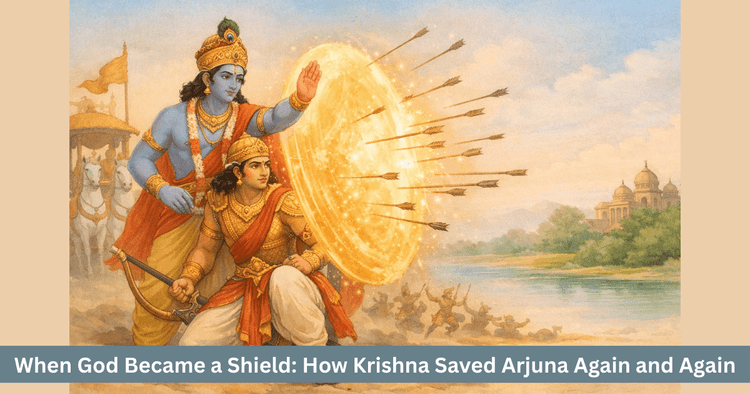
Table of Contents
The Mahabharata is usually remembered as a story of grand battles, intense rivalries and deep philosophy. But if you zoom in on just one figure - Arjuna - another layer appears. How did he survive eighteen days of a war where almost every great warrior fell. How did he walk through moment after moment of certain death and still live to hear the end of the story.
The real answer is simple and profound: Arjuna was never standing alone. Krishna was beside him, not just as a charioteer but as a living shield. Their bond was more than friendship. It was a partnership between human effort and divine guidance, between skill and grace.
Here are some of the most powerful moments when Krishna quite literally saved Arjuna’s life.
1. The Illusion of Sunset: Jayadratha and the Vow That Could Have Killed Arjuna
On the fourteenth day of the war, Arjuna took a terrifying vow. He swore to kill Jayadratha before sunset, to avenge Abhimanyu’s death. If he failed, he would enter the fire and end his own life. The Kauravas knew this was their chance. They hid Jayadratha behind layers of warriors, building a human fortress around him.
All day, Arjuna tore through formation after formation but Jayadratha stayed out of reach. As the sun dipped low, tension grew. From Arjuna’s point of view, the day - and his life - were slipping away. Just when everything seemed lost, something extraordinary happened.
The sky darkened. It looked as if the sun had finally set. The Kaurava side erupted in celebration. Weapons lowered. Guards relaxed. Jayadratha stepped out of hiding, filled with relief and arrogance, ready to mock Arjuna’s failure.
That was the exact moment Krishna was waiting for.
He turned to Arjuna and said, “The sun has not set yet. This is your time. Shoot.” Arjuna lifted the Gandiva and fired a single, precise arrow. Jayadratha’s head flew across the battlefield and landed, as Krishna had planned, in his father’s lap far away - fulfilling a curse without harming Arjuna.
It looked like a miracle of timing. In truth, it was strategy guided by divine intelligence.
2. Taking the Vaishnava Astra on His Own Chest
On the twelfth day, the Kaurava warrior Bhagadatta unleashed the Vaishnava Astra, a terrifying celestial weapon that no ordinary mortal could stop. It raced toward Arjuna’s chest with unstoppable force.
Before Arjuna could even react, Krishna stood up from the driver’s seat and placed Himself between Arjuna and the weapon. The Astra struck Krishna’s chest - and in that instant, it transformed into a harmless garland, the Vaijayanti Mala, resting gently around His neck.
Why. Because the weapon belonged to Vishnu. And Krishna was Vishnu Himself.
This was more than a display of power. It was love in motion - the kind of love that does not hesitate to stand in front of danger when the one you protect still has a purpose to fulfill.
3. Pressing the Chariot Down to Deflect Karna’s Nagastra
On the seventeenth day, during the legendary duel between Arjuna and Karna, death came again - this time as the Nagastra, a serpent-guided arrow aimed straight at Arjuna’s head. If it hit, the result was certain.
The arrow flew.
In that split-second, Krishna pressed His foot down onto the chariot floor. The divine horses bent low. The entire chariot sank just a few inches into the earth. The Nagastra missed Arjuna’s neck and instead ripped off his crown.
A few inches. A fraction of a second. That was the distance between life and death.
Everyone saw an arrow and a near-miss. Only Arjuna truly knew what had happened - that without Krishna’s subtle intervention, the great warrior of the Pandavas would have fallen right then.
4. Saving Arjuna from the Vasavi Shakti by Guiding It Toward Ghatotkacha
If there was one weapon Arjuna absolutely could not survive, it was the Vasavi Shakti - a one-time-use divine spear given to Karna by Indra. Once released, it guaranteed the death of its target. Karna kept it in reserve for only one person: Arjuna.
Krishna knew this. He also knew something else - that even He could not stop this weapon once it was launched at Arjuna.
So He did not wait for that moment. Instead, He shaped the battle.
In a fierce night battle, Ghatotkacha, Bhima’s son, used his immense powers to devastate the Kaurava army. Desperate to stop the destruction, Duryodhana begged Karna to use his ultimate weapon. Cornered by circumstance, Karna released the Vasavi Shakti on Ghatotkacha. The mighty warrior died but in his enormous fall, he crushed many Kaurava forces as well.
Later, Krishna told Arjuna quietly, “Today, I am more relieved than ever. If that weapon had been used on you, even I could not have saved you.”
What looks like a tragic loss from one angle becomes a deeper protection from another. Sometimes in our own lives, a loss, breakup or failure that feels unjust in the moment may be the very thing that keeps us safe from something far worse.
5. The Chariot That Burned Only After Krishna Stepped Down
After the war ended, when the dust settled and the silence felt heavier than the sound of battle, Krishna and Arjuna returned to their camp in the same chariot that had carried them through days of carnage.
As they approached, Krishna told Arjuna, “You get down first.” Arjuna obeyed and stepped onto the ground. Then Krishna stepped down.
The very moment Krishna left the chariot, it burst into flames.
Shocked, Arjuna looked at the burning remains of the vehicle that had carried him to victory. Krishna explained that many powerful weapons had struck the chariot during the war. By their nature, they should have destroyed it on the spot. The only reason it had stayed intact was His presence. Once He left, the accumulated force of those astras finally released and the chariot met the destruction it had been holding off all along.
This final scene is like a divine footnote: Krishna had not just saved Arjuna in five or six dramatic moments. He had been shielding him constantly, in ways invisible to human eyes.
A Friendship That Was Really a Sacred Partnership
It is tempting to look at all this and say, “Krishna was biased toward Arjuna.” But the deeper tradition gives a different reading. Krishna was not protecting Arjuna out of favoritism. He was protecting Dharma and at that moment, Arjuna was its chosen instrument.
Their relationship shows how grace and effort work together:
- Arjuna Fought with all his skill, courage and discipline
- Krishna Watched, guided, protected and intervened when human limits were reached
- Arjuna Asked questions, admitted fear and stayed open to guidance
- Krishna Offered clarity, strategy and support but never removed Arjuna’s responsibility to act
For someone today, balancing career pressure, emotional struggles and big life decisions, the story of Krishna and Arjuna is more than mythology. It is a reminder that:
- You Are expected to show up and do your best
- You Are not carrying everything alone, even if it feels that way
- Some Of the “narrow escapes” in your life may not be random luck but a quiet form of protection you only understand in hindsight
Frequently Asked Questions
1. Are all these incidents explicitly found in the Mahabharata
Yes. The eclipse-like darkness during Jayadratha’s death, the Vaishnava Astra on Krishna’s chest, the Nagastra missing Arjuna’s head, the Vasavi Shakti used on Ghatotkacha and the burning chariot are all part of the traditional narrative in various retellings and commentaries.
2. Could Krishna have saved Arjuna from every possible weapon
In the case of the Vasavi Shakti, Krishna Himself says that if it had been used on Arjuna, even He could not have protected him. That is why He arranged for it to be used on Ghatotkacha instead.
3. What does this say about divine grace and human effort
It shows that grace does not replace effort. Arjuna had to fight, struggle and risk himself. Grace stepped in when his best was not enough, not instead of his effort.
4. Does Krishna only protect special people like Arjuna
The tradition suggests that Krishna protects Dharma through whoever is sincerely trying to live by it. In modern terms, anyone who acts with honesty, courage and sincerity can experience this kind of subtle support in their own way.
5. How is this relevant to everyday life today
Whenever you push through fear to do what feels right, whenever help appears at the last moment or when something “just works out” against the odds, you might be living a small echo of Arjuna’s story - your effort meeting a grace you cannot always see but often feel.
Get your accurate Kundali
Generate KundaliDid you like it?
Author
Pt. Narendra Sharma (63)
Experience: 20
Consults About: Family Planning, Career
Clients In: Punjab, Haryana, Delhi
Share this article with friends and family
About ZODIAQ
ZODIAQ is an online Vedic Astrology platform. It connects clients seeking astrological advice to experienced astrologers with deep knowledge. Our users also generate kundali and perform kundali milan for free. ZODIAQ also offers services to the Astrologers. Astrologers utilize various offerings by ZODIAQ to serve their clients effectively.
If you are a User
Consult with experienced astrologers and seek their guidance. You can also order handwritten Janm Patrika report with life prediction prepared by experienced astrologers. Generate accurate Kundali, perform Kundali Matching and check horoscope and muhurat. Utilize our online library for all the necessary astrological and spiritual information.
If you are an Astrologer
Create accurate kundali for your clients and perform Kundali Matching for up to 5 people at a time. Write comprehensive Janm Patrika report for your clients with ZODIAQ. Check client details anytime by saving it in client directory. Become more productive by tracking how many clients you guide every day.
WELCOME TO
ZODIAQ
Right Decisions at the right time with ZODIAQ
