When Maya Made the Gods Forget Who They Were
By Pt. Sanjeev Sharma
The Deeper Meaning of an Ancient Story on Maya and Consciousness
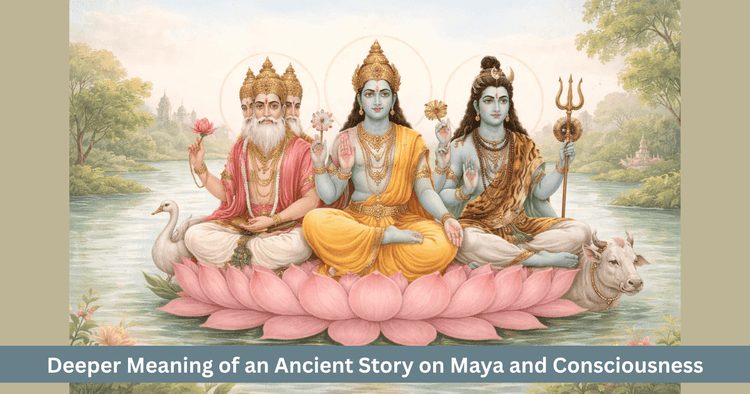
Table of Contents
Long before time began to move in cycles, before stars appeared or rivers found their paths, there was only a vast stillness. Nothing rose, nothing fell. There was no “before” or “after,” only one seamless presence, like a sky without horizon and without clouds.
In that immeasurable silence, a subtle longing stirred. It was as if the ocean wished to see itself as a wave, as if a lamp wished to witness its own light on a distant wall. From that gentle longing, the story of creation began to unfold.
Awareness took on three luminous functions. As Brahma, it began to create. As Vishnu, it began to sustain what was created. As Shiva, it began to dissolve what had completed its time. Worlds appeared, forms emerged, lives began their journeys. Yet even in this grand unfolding something was incomplete.
Awareness was present in everything, yet it remained too close to itself. To truly “see” itself, it needed distance. To truly taste its own nature, it needed a veil. From this need, the power called Maya arose.
The First Appearance of Maya
Maya was not born as an enemy. She did not arrive with a sword in her hand. She emerged more like an artist with a palette of colors, standing before a blank canvas. Her purpose was not to destroy truth but to give truth a way to appear as story, as relationship, as experience.
Maya did not say, “I will hide the truth.” She said, “I will dress the truth in such beauty, such texture, that those who see it will need to look more deeply to remember what lies beneath.”
The gods watched this with curiosity. They saw how humans forgot their real nature and clung to names, bodies, families, titles. They saw demons blinded by hunger and pride. From their higher seat, they felt safe. Illusion, they thought, was for those below.
One day, they approached Brahma. In the light of his presence, they spoke with certainty. “We understand, Lord,” they said, “that humans fall under illusion. They forget who they are. But we are gods. Maya cannot touch us, can she?”
Brahma listened quietly. Instead of a sermon, he offered them an invitation. “You have seen the world from above,” he said. “If you wish, you may step inside the play and see for yourselves how Maya works.”
Their confidence did not allow hesitation. They agreed.
The Gods Step into Maya
Stories say that with Brahma’s silent consent, the gods entered a realm woven entirely of Maya. They did not notice the exact moment it happened. That is how Maya works. She does not knock loudly. She changes the light little by little until a new reality seems completely natural.
At first, the gods remembered everything. They knew they were divine. They knew this was an experiment. They laughed among themselves, amused that humans took such passing scenes so seriously. They felt certain they would not forget.
Then time began.
Morning and evening arrived like two gentle tides. The gods felt hunger. They tasted food and discovered how pleasure can cling to the tongue and not let go. They felt exhaustion and rest, attraction and aversion. They found themselves caring about outcomes, just a little at first, then more.
They took on roles. One became a king in a small kingdom. Another became a poet. Another was born as a child in a simple family. Love entered their lives. So did fear. They worried about those they called “mine.” They planned. They dreamed. They felt jealous. They felt proud of their achievements.
The memory of their divine origin dimmed, not all at once but like the fading of stars in the light of dawn. It was still there somewhere, yet daily concerns burned brighter. The story became more important than the source.
They no longer said, “I am a god playing a role.” They said, “I am a ruler. I am a father. I am a husband. I am someone who must protect what belongs to me.”
Maya did not need to shout. She only needed them to care deeply about their roles. That alone was enough.
The Moment of Inner Disturbance
Time flowed. The roles progressed. There were festivals and victories, arguments and reconciliations. Then, as it happens in every life, something unexpected occurred.
One lost a kingdom he had believed would last forever. Another watched a loved one walk away and never return. Another fell ill and faced the real possibility of death.
In those raw moments something stirred deep within them, something older than fear and older than the roles they had been living.
“Is this where I end?” a voice whispered in one heart.
“Was I truly born only to lose what I love?” another heart asked.
“Who is it that is watching this suffering?” a third voice wondered.
These questions did not come from the character. They came from the awareness behind the character. That awareness had been quiet, patiently observing. Now, through pain and shock, it found a small opening to speak.
The gods, still wrapped in their human identities, tried to push those questions aside. There were duties to attend to, reputations to protect, stories to complete. Yet the questions kept returning, especially in the quiet moments when no one else was around.
“Who am I really, when all of this changes?
What remains when my name, my body, my status fall away?”
A thin crack appeared in the solid wall of their identification.
The Return of Memory
In that crack, something gentle and familiar entered. It was not a thundering sound, not a miracle in the sky. It was the same presence they had once known as Brahma’s voice - a remembrance without words.
They did not suddenly see themselves in celestial form again. That would have been too easy. Instead, they began to sense that they had been living in a dream so convincing that they treated it as absolute.
They realised that every role they had played had felt completely real while it lasted. The joy had been real. The grief too. Yet something in them had remained untouched, merely witnessing.
One by one, like lamps being lit in a dark hall, memories returned. Not as detailed visions of another world but as a deep knowing - “I am more than this story.”
When they finally stood once again before Brahma, with full awareness of what had happened, they did not boast that they had passed the test. They bowed their heads.
Maya had not changed the truth of who they were. She had changed their experience of themselves. Through her they understood that knowledge is not the same as constant wakefulness. To know “I am divine” and to remember it in every situation are two very different things.
They saw that Maya was not a cheap trick. She was a sophisticated teacher.
Maya and Our Everyday Life
The story of the gods sounds grand, yet its echo is heard in ordinary days. We too are born with a kind of quiet knowing. As children we move with natural presence. Slowly names, comparisons and expectations wrap around us.
We become student, professional, spouse, parent, success, failure. We say, “I am this,” and “I am that,” as if those passing descriptions were our permanent face.
When work praises us we feel expanded. When it criticises us we feel shrunk. When we gain something we longed for we feel complete. When we lose it, we feel broken. In all this our identity swings like a pendulum. This swinging is Maya's rhythm.
Somewhere, in the background, a steady awareness watches our thoughts and emotions rise and fall. Yet we are so caught in the movement that we hardly notice the watcher.
Then life, in its own time, gives us moments like the gods faced in their roles - unexpected loss, deep confusion or a sudden stillness that makes us see how restless we have been. In those moments if we pause, even briefly, we can sense that there is more to us than the changing storyline.
The story of Maya is not asking us to hate the world or abandon it. It is asking us to see it as a play in which we participate without forgetting the actor behind the role.
The Gentle Understanding at the End
In the end, the gods did not ask Brahma to destroy Maya. They did not demand a world without illusion. They had seen something precious in their forgetting and remembering.
Without illusion, they realised, there would be no journey. Without journey, there would be no depth. Awakening would have no taste if there had been no dream at all.
So they did something simple and profound. They bowed to Maya.
Not in surrender to confusion but in gratitude for the experience that allowed them to rediscover what they already were. They saw that it is possible to live in the world, to feel fully, to act wholeheartedly and still keep a quiet thread of remembrance alive.
Perhaps that is what this story invites us to do as well - to live our lives completely, to love, to strive, to create, to lose, to learn. And yet, every now and then, to ask in silence, “Who is the one living all of this?”
In that question, Maya softens her grip. The dream is still there. The story continues. But the fear of losing ourselves in it begins to fade.
Frequently Asked Questions
1. Is Maya simply another word for falsehood?
No. Maya is not pure falsehood. It is a changing appearance that allows the unchanging truth to be experienced through stories and roles.
2. Do the gods really forget themselves in this story?
The story shows that even highly evolved awareness can become absorbed in experience and temporarily lose clear remembrance of its source.
3. Should Maya be fought or rejected?
No. The teaching suggests that Maya is to be understood, not hated. Through understanding, her illusions lose their power to bind.
4. Can humans truly see through Maya while living in the world?
Yes. By observing thoughts and emotions without clinging to them and by remembering that identity is deeper than any role, one can loosen Maya’s hold.
5. What is the central lesson of this tale for daily life?
To play every role sincerely, yet not forget the silent awareness beneath all roles. That remembrance turns life from a prison of illusion into a meaningful journey.
Get your accurate Kundali
Generate KundaliDid you like it?
Author

Pt. Sanjeev Sharma (63)
Experience: 20
Consults About: Family Planning, Career
Clients In: Punjab, Haryana, Delhi
Share this article with friends and family
About ZODIAQ
ZODIAQ is an online Vedic Astrology platform. It connects clients seeking astrological advice to experienced astrologers with deep knowledge. Our users also generate kundali and perform kundali milan for free. ZODIAQ also offers services to the Astrologers. Astrologers utilize various offerings by ZODIAQ to serve their clients effectively.
If you are a User
Consult with experienced astrologers and seek their guidance. You can also order handwritten Janm Patrika report with life prediction prepared by experienced astrologers. Generate accurate Kundali, perform Kundali Matching and check horoscope and muhurat. Utilize our online library for all the necessary astrological and spiritual information.
If you are an Astrologer
Create accurate kundali for your clients and perform Kundali Matching for up to 5 people at a time. Write comprehensive Janm Patrika report for your clients with ZODIAQ. Check client details anytime by saving it in client directory. Become more productive by tracking how many clients you guide every day.
WELCOME TO
ZODIAQ
Right Decisions at the right time with ZODIAQ
