Who Really Made the Rules of Chausar
By Pt. Narendra Sharma
The Untold Truth Behind Shakuni Yudhishthira and the Deadliest Game of Dharma
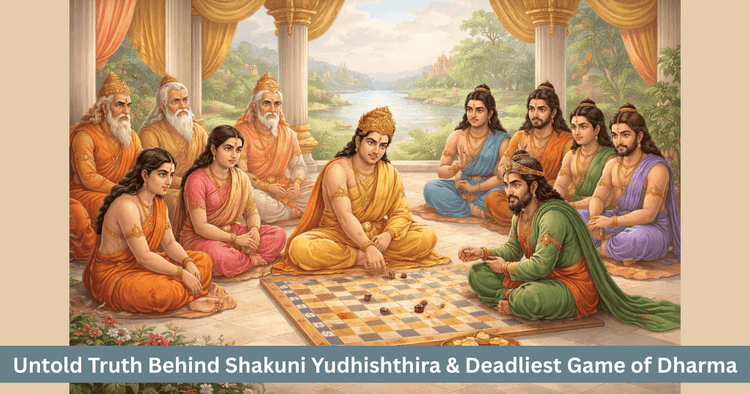
Table of Contents
In the epic Mahabharata battles roar across fields. Chariots thunder. Maces clash. Arrows darken the sky. Yet the pivot on which the entire history turns is not a battlefield. It is a polished floor in the royal hall of Hastinapur. Upon that floor lies a board. Upon that board fall dice. Around that board sit kings, sages and warriors. That game of Chausar quietly shapes the destiny of kingdoms.
There Yudhishthira, the upholder of dharma, begins to lose everything. There Draupadi's honor is dragged into a wager. There mighty elders choose silence. That game was not casual gambling. It was a staged experiment in morality, power, psychology and fate.
So the deeper question is this. Who really made the rules of this game. Were they the simple rules of a traditional board game. Or was the framework crafted by Shakuni. Or was it destiny using Shakuni as its instrument.
The Stage of Chausar: Sabha and Its Design
After the Rajasuya sacrifice, the fame of the Pandavas spread in all directions. Their palace at Indraprastha dazzled visitors. Duryodhana's humiliation in that hall wounded his pride. From that wound the plot of the dice game was born. Returning to Hastinapur he poured out his hurt before Dhritarashtra and Shakuni.
Shakuni proposed a field where brute strength would not matter. A game where chance could be controlled. Dhritarashtra, torn between affection and fear, finally agreed. An invitation was sent to Yudhishthira. Vidura warned clearly that the invitation concealed danger. Yet Yudhishthira felt bound by royal decorum and the duty of a son toward a father-king. He accepted knowing the risk. This tension between inner reluctance and outer duty is crucial to understanding what followed.
Shakuni: More Than a Player, A Tactical Mind
Shakuni is remembered as the villain. Yet a closer reading shows a mind of sharp strategy and deep psychological insight. As prince of Gandhara and later advisor in Hastinapur he watched the Pandavas for years. He knew how each brother thought. He recognised that Yudhishthira's uncompromising commitment to dharma could become a chain.
Yudhishthira could not bear the thought of refusing a formal challenge issued in a royal court, that too under Dhritarashtra's name. Shakuni built the entire plan around this compulsion. He turned the hall into a battlefield where dice replaced weapons and manipulation replaced direct confrontation. Shakuni's genius lay not only in throwing dice but in reading minds and bending situations.
Loaded Dice: Myth and Deeper Symbolism
Stories say Shakuni's dice were carved from the bones of his father and obeyed his will. Whether taken literally or symbolically they carry a clear message. The game was rigged.
The dice symbolise any system where rules appear neutral, yet outcomes are controlled. In the Sabha Parva description the game proceeds in such a way that Shakuni wins every round despite Yudhishthira's hope of recovery. From a psychological view the dice embody hidden power, unseen advantage and the illusion of fairness. Yudhishthira thinks he is testing his luck. In truth he has entered a structure designed to make him fall.
Yudhishthira's Core Mistake: Trusting Rules Without Discernment
Yudhishthira's flaw was subtler than simple love of gambling. At heart he believed that if an act follows formal rules it cannot be entirely wrong. He entered the game not out of greed but out of obedience and formal duty. Yet he failed to recognise that dharma is not limited to written rules. Dharma also demands awareness of context and the character of those involved.
He assumed that because the setting was royal, because elders were present, because rules were announced, fairness must prevail. That assumption was fatal. Righteousness collapses when it expects honesty from those who have no intention of being honest. In each round he staked more, driven by the hope that one victory would restore all losses. This pattern, familiar even today in addiction psychology, dragged him from wealth to kingdom to brothers to self and finally to Draupadi.
Beyond One Man's Loss: A Collective Moral Breakdown
The dice game outcome cannot be seen as Yudhishthira's personal failure alone. It exposed the moral failure of almost everyone in the hall. When Draupadi was summoned, insulted and dragged, mighty elders were present. Bhishma, Drona, Kripa, Karna, Dhritarashtra, all sat in silence. Only Vidura spoke in clear protest. The rest allowed injustice to unfold in the name of royal protocol.
Draupadi's question, whether a man who has lost himself can stake his wife, is one of the sharpest in all literature. It pierced the façade of ritual propriety. Dharma did not speak through rules that day. Dharma spoke through her voice. The assembly's silence in the face of that voice defined the deeper guilt of the kingdom. The Kurukshetra war was born in that silence long before chariots rolled onto the field.
Who Truly Framed the Rules of the Game
At the surface level the rules of Chausar existed long before Shakuni. It was a known game. Yet the specific conditions of this match - who would play for whom, what could be staked, who would throw the dice, who would oversee the game, when it would stop - all these were shaped by Shakuni and Duryodhana with Dhritarashtra's consent.
From a philosophical angle, it is said that destiny framed an invisible set of rules underneath. Every character acted according to their nature and previous actions. Yudhishthira through rigid righteousness. Shakuni through cunning. Duryodhana through jealousy. Dhritarashtra through weakness. Bhishma through misplaced loyalty. The game thus becomes a mirror in which each one's inner law is revealed.
Shakuni: Villain, Victim or Instrument of Fate
Shakuni certainly represents deception, resentment and revenge. His manipulation destroyed the Kuru house. Yet he himself came from a background of hurt and perceived injustice towards Gandhara. Some traditions suggest he had vowed to make the Kurus pay for that wrong, using intellect where he lacked military might.
In that sense he becomes both villain and instrument. Without his schemes the hidden cracks in the Kuru family might have stayed unseen for longer. The game forced everyone to reveal their alignment. Who stood for justice. Who stayed silent. Who enjoyed the humiliation. This exposure was necessary for the later war to be clearly seen as a struggle between dharma and adharma rather than a mere dispute over land.
Chausar: Karma, Psychology and Collective Responsibility
The dice game offers a layered lesson in karma. Yudhishthira's choice to obey Dhritarashtra, Shakuni's decision to gamble with lives, Dhritarashtra's refusal to stop the game, Bhishma's silence, Duryodhana's hatred - every choice generated its own karmic ripple.
Psychologically Yudhishthira embodies sunk-cost thinking, hoping one win would undo previous losses. The elders illustrate moral paralysis before power. Draupadi shows the courage to question even those she calls her own. The epic thus teaches that karma is not only about obvious actions. Failing to act when justice calls is also an action with consequences.
How the Dice Game Redefines Dharma
Before the Sabha Parva, dharma for many characters meant obedience to role and hierarchy - a son obeys father, subject obeys king, younger obeys elder. The dice game exposes the limits of this view. If obedience sustains injustice it ceases to be dharma.
Dharma in Mahabharata emerges as that which protects dignity, fairness and truth, even if it means challenging authority. In the game Yudhishthira clings to formal dharma and loses inner dharma. Draupadi breaks expected silence and restores the voice of true righteousness. Through this contrast the epic teaches that dharma without conscience becomes a mask for weakness.
Key Facts of the Chausar Game
| Fact | Description |
|---|---|
| Location | Kuru Sabha, royal hall of Hastinapur |
| Main Players | Yudhishthira vs Shakuni (for Duryodhana) |
| Stakes Escalation | Wealth, royal attendants, kingdom, brothers, self, Draupadi |
| Immediate Outcome | Pandavas exiled 12 years plus 1 year incognito |
| Deeper Outcome | Moral authority of Kuru elders collapses, war becomes inevitable |
Frequently Asked Questions
1. Did Shakuni actually make the rules of Chausar?
The basic game rules pre-existed, yet Shakuni designed the match conditions and controlled the dice, effectively shaping the real rules.
2. Could Yudhishthira have refused the invitation to play?
Yes. Spiritually he was free to refuse but he allowed duty to father-king and rigid formal dharma to override his inner warning.
3. Were the dice truly magical or cursed?
Tradition calls them cursed bones but spiritually they symbolise hidden manipulation and unequal power under the illusion of fairness.
4. Was the dice game essential for the Mahabharata war to happen?
It exposed injustice, cowardice and cruelty so starkly that a later reconciliation without war became almost impossible.
5. Is Shakuni only to blame for the disaster?
No. He was the sharpest catalyst but Dhritarashtra's weakness, Duryodhana's envy, Yudhishthira's rigidity and the elders' silence all shared responsibility.
Get your accurate Kundali
Generate KundaliDid you like it?
Author

Pt. Narendra Sharma (63)
Experience: 20
Consults About: Family Planning, Career
Clients In: Punjab, Haryana, Delhi
Share this article with friends and family
About ZODIAQ
ZODIAQ is an online Vedic Astrology platform. It connects clients seeking astrological advice to experienced astrologers with deep knowledge. Our users also generate kundali and perform kundali milan for free. ZODIAQ also offers services to the Astrologers. Astrologers utilize various offerings by ZODIAQ to serve their clients effectively.
If you are a User
Consult with experienced astrologers and seek their guidance. You can also order handwritten Janm Patrika report with life prediction prepared by experienced astrologers. Generate accurate Kundali, perform Kundali Matching and check horoscope and muhurat. Utilize our online library for all the necessary astrological and spiritual information.
If you are an Astrologer
Create accurate kundali for your clients and perform Kundali Matching for up to 5 people at a time. Write comprehensive Janm Patrika report for your clients with ZODIAQ. Check client details anytime by saving it in client directory. Become more productive by tracking how many clients you guide every day.
WELCOME TO
ZODIAQ
Right Decisions at the right time with ZODIAQ
