Why Brahma Is Less Worshipped Than Vishnu and Shiva
By Aparna Patni
The Great Cosmic Paradox and Religious Priorities
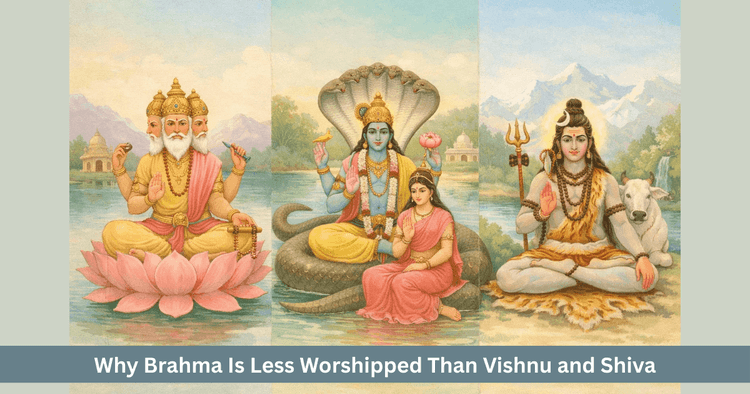
Table of Contents
The Great Cosmic Paradox
Within the Hindu theological framework stands one of spirituality's most intriguing paradoxes: the Creator receives far less worship than the Preserver and the Destroyer. This contradiction challenges our assumptions about what deserves reverence and reveals profound truths about how religion responds to human needs, spiritual goals and the nature of existence itself.
Brahma, positioned as the first member of the sacred Trimurti trinity alongside Vishnu and Shiva, holds theoretical supremacy as the cosmic architect who brings all existence into being. Yet walk through any Indian city and you will find thousands of temples dedicated to Vishnu and Shiva for every single temple honoring Brahma. Chant the names invoked in daily prayers and Brahma's name appears rarely, eclipsed by the mantras devoted to the other two.
This is not a recent phenomenon nor a regional peculiarity. Across centuries and throughout India, the worship of Brahma has remained conspicuously minimal while his cosmic counterparts flourished. To understand why requires delving into philosophy, mythology, psychology and the fundamental structures of how humans relate to divinity.
One Creation Is Temporary The Problem of Finitude
The Impermanence of the Created
At the heart of Hindu philosophy lies a radical teaching: everything that is created is temporary. This is encoded in the concept of anitya, impermanence, one of the foundational insights of all Hindu and Buddhist philosophy. Brahma represents the beginning of manifestation, the moment when the infinite potential of unmanifest reality crystallizes into specific forms. But this beginning necessarily implies an ending. Everything Brahma creates will eventually dissolve.
The Psychological Weight of Impermanence
This truth creates a psychological problem for worship. Brahma's domain feels incomplete. Creation without preservation is mere chaos. Creation without eventual dissolution is stagnation. Brahma's work alone is insufficient. He creates but then what? The universe requires Vishnu's sustenance to persist and Shiva's dissolution to complete the cycle.
Transience diminishes reverence. Spiritually, humans tend to worship what feels permanent, eternal and reliable. Brahma presides over the temporary and provisional. Vishnu, who maintains what is created, feels more fundamental. Shiva, who governs the ultimate transformation, feels more ultimate.
Creation feels less urgent. In daily life, we don't pray for creation to occur. The world is already created. Instead, we pray for protection within the created world, Vishnu's domain or for liberation from the cycle, Shiva's domain. Brahma's role feels already complete, making ongoing worship seem unnecessary.
The Philosophical Hierarchy
This reveals a hidden theological hierarchy: what is permanent and eternal is considered more important than what is temporary. In this framework, creation, being inherently temporary, ranks below preservation and transformation which address the deeper structural issues of existence.
Two Connection With Rajas Guna The Restless Quality
The Three Gunas
Hindu philosophy teaches that the universe is governed by three fundamental qualities: Sattva, balance, harmony, illumination, wisdom, peace. Rajas, activity, desire, restlessness, passion, striving. Tamas, inertia, heaviness, darkness, delusion, dissolution.
Brahma's Association With Rajas
Brahma is intrinsically linked with Rajas, the quality of activity, desire and restlessness. This association makes spiritual sense. Creation requires action. Brahma must actively bring forth the universe. Creation expresses desire. It manifests the cosmic impulse toward manifestation and expression. Creation generates restlessness. The universe, once created, is in constant flux and change. however this association presents a spiritual problem.
Why Rajas is Considered Inferior
In spiritual development, practitioners are taught to transcend Rajas. The reasoning is that Rajas perpetuates suffering. Rajas is the quality of endless striving, wanting and craving. These create the very dissatisfaction and suffering that spiritual practice aims to overcome. Rajas obscures liberation. The restless activity of Rajas distracts consciousness from perceiving its own eternal nature. It keeps awareness externalized, focused on acquiring and achieving rather than realizing deeper truths. Rajas must be transcended. The spiritual path involves progressively moving beyond Rajas toward Sattva and eventually beyond form altogether.
Brahma vs Vishnu and Shiva
Vishnu is associated with Sattva. Preservation, protection and dharma represent a higher quality than mere activity. Shiva is associated with transcendence. His role in dissolution and transformation points beyond the gunas altogether. therefore worshipping Brahma, who embodies Rajas, feels spiritually counterproductive. It seems like praying to the very quality you're trying to transcend.
In contrast, worshipping Vishnu elevates you toward Sattva and worshipping Shiva facilitates transcendence of all qualities. This explains why Brahma receives less spiritual attention from those pursuing liberation.
Three Mythology as Justification The Stories That Diminished Him
The Curse of the Infinite Pillar
The Shiva Purana contains a famous narrative explaining Brahma's reduced prominence. According to this story, Shiva manifested as an infinite pillar of light, Jyotirlinga and challenged Brahma and Vishnu to find its top and bottom. Vishnu honestly admitted he could not find the bottom. Brahma, however lied, claiming he had found the top when he had not.
Shiva's response was to curse Brahma that he would never be worshipped widely on Earth. This mythological narrative provided theological justification for what was already becoming historical reality: Brahma's declining worship.
The Problem of Shatarupa
Another Puranic story involves Brahma's inappropriate attraction to his own creation, Shatarupa, the first woman. When Brahma repeatedly turned his head to gaze at her, he created four more heads for himself to continue watching or in some versions, Shiva punished him by breaking one of his heads off. The implication is that these stories portrayed Brahma as dishonest, willing to deceive even cosmic forces. Lustful, unable to maintain proper boundaries with his creations. Subject to punishment, diminished by more powerful deities.
How Mythology Shaped Worship
These narratives, preserved in widely-read Puranic texts, shaped cultural attitudes toward Brahma. Parents taught children that Brahma was not a model to emulate. Priests incorporated these stories into temple recitations, reinforcing negative associations. Theologians cited these myths as justification for why temples should focus on Vishnu and Shiva. Over centuries, repeated storytelling crystallized into cultural conviction that Brahma was less worthy of worship.
The Self Fulfilling Prophecy
Remarkably, the mythological curse created its own fulfillment. By telling stories about why Brahma wouldn't be worshipped, the tradition ensured that he wouldn't be worshipped. The myth became a mechanism for institutionalizing theological preference into religious practice.
Four A Limited Lifespan The Problem of Mortality
Brahma's Finite Existence
While Vishnu and Shiva are portrayed as eternal and indestructible, Brahma is described as having a finite lifespan. According to Hindu cosmology, Brahma lives for one hundred Brahma years. Each Brahma year equals three hundred sixty divine days. Each divine day equals one thousand yugas. This translates to approximately three hundred eleven trillion human years, an almost incomprehensibly vast span. Yet it has a limit. After one hundred Brahma years, Brahma dies and the entire universe dissolves. A new Brahma then emerges to create a new universe.
The Psychological Impact
This finitude creates a profound spiritual problem. Transient deities inspire less devotion. Humans naturally worship what feels eternal and unchanging. The idea that even Brahma, the creator of universes, eventually dies creates a subtle psychological distance. If the god himself is mortal in cosmic terms, how can his blessing provide permanent protection?
Permanence attracts reverence. Vishnu and Shiva, portrayed as eternal, inspire greater confidence that their blessings transcend time. Worshippers seeking permanence in an impermanent world naturally gravitate toward eternally existing deities.
The cosmic hierarchy. The teaching that Brahma is mortal while other deities are not implicitly establishes a hierarchy where permanence equals superiority. This makes Brahma seem lower in the cosmic order despite his creative role.
The Theological Irony
This is ironic: the one who creates universes is himself subject to mortality while those who manage his creations are eternal. This inverts normal hierarchies, suggesting that the management of existence is more important than its origination.
Five No Large Religious Movement The Institutional Factor
The Rise of Vaishnavism and Shaivism
History reveals that religious prominence correlates strongly with institutional support. Both Vishnu and Shiva became centers of massive organized religious movements. Vaishnavism, a comprehensive tradition encompassing multiple schools of philosophy, countless temples across India, major festivals like Diwali and Holi, saints and poets who produced devotional literature, theological texts justifying Vishnu's supremacy and networks of monasteries and institutions.
Shaivism, similarly comprehensive, with sophisticated philosophical schools, widespread temple networks, major festivals like Maha Shivaratri, tantric traditions and ascetic orders, extensive scriptural justification and organized priesthoods maintaining continuity.
Brahma's Institutional Vacuum
By contrast, Brahma never attracted a comparable movement. There is no major Brahmaism tradition. Several factors explain this. Theological inconvenience. Brahma's limited role and cosmic mortality made him less useful for constructing comprehensive spiritual paths. Both Vaishnavism and Shaivism could present their respective deities as offering paths to liberation. But Brahma, being neither preserver nor dissolver, offered less theologically.
Lack of charismatic saints. Great religious movements are often launched by charismatic saints and teachers who experience divine encounters and inspire followers. Brahma attracted no comparable figures who founded schools or wrote major theological treatises.
Absence of written justification. While Vaishnavism and Shaivism produced voluminous texts justifying their deities' supremacy, no comparable body of literature emerged defending Brahma's worship.
Institutional momentum. Once Vaishnavism and Shaivism became established, they had institutional momentum: temples, priesthoods, textual traditions, festivals and networks that perpetuated themselves. Brahma had no such infrastructure, making his worship difficult to sustain.
The Role of Patronage
Religious institutions require patronage to survive. Wealthy rulers and merchants typically funded temples for deities they favored, sponsored festivals for gods they worshipped, supported priesthoods maintaining their cults and commissioned texts glorifying their chosen deities. Brahma never attracted comparable patronage networks. Most major rulers chose to be Vaishnavites or Shaivites, directing their resources accordingly. This created a self-reinforcing cycle: without patronage, Brahma temples couldn't compete with those of Vishnu and Shiva. Without prominent temples, attracting patronage became impossible.
Six Symbolism Feels Less Relevant The Problem of Distance
Abstract vs Immediate
Creation feels abstract and distant compared to the concerns of daily life. Consider what typically prompts prayer. For Vishnu devotees: protection during difficulty, success in endeavors, health and prosperity, guidance through life's challenges. These are immediate, pressing concerns that feel directly relevant to Vishnu's preserving function.
For Shiva devotees: liberation from suffering, spiritual transformation, transcendence of ego, release from the cycle of rebirth. These address ultimate concerns and are deeply relevant to Shiva's role in dissolution and transformation.
For Brahma: the universe's creation is already complete. Most people never think about cosmic creation in daily life. Praying for creation to occur seems irrelevant. The world is already created. His symbolic domain feels outside the sphere of daily concern.
Psychological Distance
The psychological distance between worshipper and deity affects devotion. Vishnu feels proximately relevant. He sustains the world you inhabit moment to moment. His protection is needed daily. Shiva feels ultimately relevant. He addresses the deepest questions of existence and liberation. Brahma feels historically relevant. He did something important once, at the beginning but his ongoing involvement seems minimal.
The Mismatch Between Symbol and Need
For worship to flourish, there must be a match between what the deity symbolizes and what the worshipper needs. When this match fails, worship withers. Brahma's symbolic domain, creation origination, beginning, doesn't align well with typical spiritual needs: protection, guidance, liberation.
Seven The Physical Absence Temple Scarcity
The Critical Importance of Temples
Temples are more than buildings. They are institutional anchors for religious traditions. They preserve continuity across generations. They create gathering places where communities reinforce shared beliefs. They employ priests who maintain knowledge and practice. They host festivals that keep traditions alive. They provide visual reminders of what is sacred. They generate resources through offerings that sustain religious institutions.
Brahma's Temple Poverty
The disparity is stark. Temples dedicated to Vishnu: tens of thousands across India with multiple temples in most cities and villages. Temples dedicated to Shiva: similarly vast numbers with Shiva temples appearing in virtually every neighborhood. Temples dedicated to Brahma: only a handful across the entire Indian subcontinent with the Brahma Temple in Pushkar, Rajasthan being the most famous and even this temple is not densely populated with pilgrims compared to major Vishnu or Shiva sites.
The Absence of Festivals
Religious traditions are reinforced through festivals. Diwali celebrates Vishnu, specifically Rama's victory, observed by hundreds of millions. Holi celebrates Krishna, a Vishnu avatar, similarly massive observance. Maha Shivaratri celebrates Shiva, draws millions of pilgrims to temples. Navratri celebrates the goddess Durga, major festival with temple rituals. Brahma festivals: essentially non-existent. There is no major pan-Indian festival celebrating Brahma or commemorating his cosmic role.
The Vicious Cycle
This creates a self-reinforcing negative cycle. Few temples dedicated to Brahma. Without temples, no institutional structure to maintain worship. Without worship, no community reinforcement of belief. Without community reinforcement, younger generations learn less about Brahma. Without knowledge or community precedent, fewer people choose to worship Brahma. This maintains the low number of temples. The cycle continues. By contrast, Vishnu and Shiva temples create positive cycles where infrastructure generates worship which attracts new devotees and resources which build more temples.
Eight Liberation Lies Beyond Creation The Spiritual Hierarchy
The Ultimate Goal of Hindu Spirituality
The fundamental goal in Hindu practice is moksha, liberation from the cycle of birth, death and rebirth. This is understood as ultimate release from worldly existence.
The Cosmic Cycle and Spiritual Goals
Understanding where different deities fit in this cosmic cycle reveals why some are more relevant to spiritual liberation. Brahma represents the beginning of the cycle, the origination point from which all suffering potentially flows. Vishnu represents the middle of the cycle, sustaining the created world where beings live, suffer and practice spiritual disciplines. Shiva represents the end of the cycle, the dissolution that leads to liberation and transcendence.
The Spiritual Trajectory
A seeker's spiritual journey typically progresses: recognize suffering within the created world, Vishnu's realm. Practice discipline to cultivate wisdom and detachment, Vishnu's support. Seek liberation through transcendence, Shiva's domain. Achieve dissolution of individual ego into universal consciousness, Shiva's ultimate role. In this trajectory, Brahma's role at the beginning feels least relevant to the liberating goal.
The Redundancy Problem
Once you understand that the goal is to escape the cycle of creation, preservation and destruction, Brahma, who perpetuates the cycle by creating anew, seems counterproductive to worship. Why pray to the one who initiates the very cycle from which you're trying to escape? By contrast, Vishnu helps you navigate the cycle with greater wisdom and dharma. Shiva facilitates the transcendence of the cycle itself. This explains why seekers oriented toward liberation naturally gravitate toward Shiva and why Brahma receives minimal attention from those pursuing ultimate spiritual goals.
Nine The Cumulative Effect How Factors Intersect
The Reinforcing Pattern
These eight factors don't operate in isolation. They reinforce each other. Mythology diminishes Brahma's character, reducing cultural respect. This reduction makes institutional patronage less likely. Without patronage, temples cannot be built and maintained. Without temples, festivals don't develop. Without festivals, community involvement diminishes. This reduces the relevance of Brahma's symbolism to daily spiritual life. The association with Rajas makes him spiritually unattractive. His temporary nature conflicts with the eternal nature worshippers seek. No major religious movement develops to counter these trends. The goal of liberation makes his role seem obsolete. Each factor alone might be overcome. Together, they create an overwhelming convergence that has maintained Brahma's marginalization for centuries.
Ten The Theological Message What Brahma's Neglect Reveals
The Hierarchy of Cosmic Functions
Brahma's relative neglect reveals a hidden theological hierarchy in Hindu thought. Preservation is greater than creation. Maintaining what exists is considered more important than originating it. Transcendence is greater than preservation. Facilitating liberation from the cycle is more important than sustaining it. Permanence is greater than temporality. The eternal is valued more highly than the temporary. Ultimate goals are greater than cosmic functions. Spiritual liberation takes precedence over cosmic management.
What This Teaches
This hierarchy reveals that Hindu spirituality, while acknowledging all cosmic functions, ultimately prioritizes liberation over all other concerns. The universe exists primarily as a testing ground for spiritual development, not as an end in itself. therefore the deity who facilitates liberation, Shiva, receives more worship than the one who inaugurates the cycle, Brahma.
Conclusion Understanding Divine Hierarchy
The relative neglect of Brahma compared to Vishnu and Shiva is not accidental, capricious or mysterious. Rather, it flows logically from multiple philosophical, theological, mythological and institutional factors that have accumulated over centuries.
Brahma represents creation, the beginning of a cycle that spirituality seeks to transcend. Meanwhile, Vishnu and Shiva represent preservation and liberation, functions more aligned with human spiritual needs and goals.
Understanding why Brahma receives less worship is ultimately about understanding the priorities of Hindu spirituality itself: the ultimate goal is not to celebrate cosmic creativity but to achieve liberation from the cycle that creativity initiates. In this framework, Brahma, while cosmic in scope, becomes peripheral to the central spiritual quest.
Yet there remains a certain poignancy in Brahma's diminishment. He is the only member of the Trimurti who has been actively discouraged from worship through myth and theology, leading to his virtual disappearance from religious practice. His story suggests that even cosmic importance cannot guarantee reverence when theological and institutional factors align against it, a reminder that religious prominence is not inevitable but contingent on multiple interlocking factors that societies construct and maintain.
Frequently Asked Questions
What is the main reason Brahma is less worshipped than Vishnu and Shiva?
Brahma's reduced worship is not due to a single cause but multiple interconnected factors. Philosophically, creation is temporary and spirituality values the eternal. Brahma is associated with Rajas guna which spiritual seekers must transcend. Mythology portrayed him as dishonest and flawed. Brahma is considered mortal while Vishnu and Shiva are eternal. Institutionally, there is no major Brahmaism movement while Vaishnavism and Shaivism flourished. His symbolic domain, creation, feels less relevant to daily spiritual needs. He has very few temples and no major festivals. Most importantly, the ultimate goal of Hindu spirituality is moksha, meaning escape from the cycle of creation, not celebration of it. All these factors reinforce each other, leading to Brahma's sustained marginalization.
How did mythology diminish Brahma's worship?
Mythology played a significant role in reducing Brahma's worship. The Shiva Purana contains a story where Brahma lied, claiming he found the top of Shiva's infinite pillar when he had not. Shiva cursed him that he would not be widely worshipped. Another story involves Brahma showing inappropriate attraction to his creation, Shatarupa. These narratives portray Brahma as dishonest, lustful and subject to punishment. Preserved in widely-read Puranic texts, these stories shaped cultural attitudes. Parents taught children that Brahma was not a model to emulate. Priests incorporated these stories into temple recitations. Theologians cited these myths to justify why temples should focus on Vishnu and Shiva. Thus, mythology became a mechanism for institutionalizing theological preference into religious practice. Remarkably, the curse created its own fulfillment: by telling stories about why Brahma wouldn't be worshipped, the tradition ensured he wouldn't be worshipped.
How does Brahma's association with Rajas guna affect his worship?
In Hindu philosophy, there are three gunas: Sattva, balance and wisdom; Rajas, activity and desire; and Tamas, inertia and darkness. Brahma is associated with Rajas because creation requires active action, desire and continuous activity. however this creates a spiritual problem. In spiritual development, seekers are taught to transcend Rajas because it is the quality of endless craving and striving that perpetuates suffering. Rajas keeps consciousness externalized, distracted from realizing deeper spiritual truths. The spiritual path involves moving beyond Rajas toward Sattva and eventually beyond all gunas. therefore worshipping Brahma, who embodies Rajas, feels spiritually counterproductive. It's like praying to the very quality you're trying to transcend. In contrast, Vishnu is associated with Sattva, a higher quality and Shiva is associated with transcendence of all gunas. This explains why liberation-seekers prefer to worship Vishnu and Shiva rather than Brahma.
Why is the lack of temples and festivals for Brahma so significant?
Temples and festivals are institutional anchors for religious traditions. They preserve continuity across generations, gather communities, employ priests who maintain knowledge and provide visual reminders of what is sacred. Vishnu and Shiva have tens of thousands of temples across India and major festivals like Diwali, Holi and Maha Shivaratri. Brahma has only a handful of temples, with Pushkar, Rajasthan being the most famous and virtually no major festivals. This absence creates a vicious cycle: without temples, there's no structure to maintain worship. Without worship, there's no community reinforcement. Without community reinforcement, younger generations learn less about Brahma. Without knowledge, fewer people choose to worship him. This maintains the low number of temples. In contrast, Vishnu and Shiva temples create positive cycles where infrastructure generates more devotion and resources. This is why institutional presence is so critical for religious prominence.
Does Brahma's reduced worship mean he is less important?
No, Brahma's reduced worship does not negate his cosmic importance. He remains an essential member of the Trimurti and without creation, nothing would exist. however his reduced worship reveals the priorities of Hindu spirituality. Hinduism acknowledges cosmic functions but ultimately prioritizes moksha, liberation. Since the spiritual goal is to escape the cycle of creation, not initiate it, Brahma becomes less relevant to that goal. Vishnu helps within the cycle while Shiva facilitates liberation from it. This is a functional hierarchy, not a hierarchy of value but one of relevance. Brahma is important but his role feels more distant from both daily spiritual needs and ultimate liberation goals. Understanding why Brahma receives less worship is about understanding how religion responds to human needs, spiritual goals and cosmic functions.
Can Brahma's worship be revived?
Theoretically, Brahma's worship could be revived but it would be extremely challenging. It would require addressing multiple interlocking factors: significant institutional support and patronage to build and maintain temples; new religious literature that reframes mythology to portray Brahma positively; establishment of festivals and community-building activities; a charismatic movement or saint who could inspire followers; and most difficult, a shift in theological perspective to value creation over liberation. All of these happening together is extremely unlikely. Additionally, Vishnu and Shiva traditions already have centuries of institutional momentum, making competition nearly impossible. While localized or limited revivals might be possible, a widespread return of Brahma worship seems highly improbable. That said, religion is fluid and the future could bring unexpected changes. But present factors strongly favor maintaining Brahma's minimal worship.
Get your accurate Kundali
Generate KundaliDid you like it?
Author

Aparna Patni (63)
Experience: 20
Consults About: Family Planning, Career
Clients In: Punjab, Haryana, Delhi
Share this article with friends and family
About ZODIAQ
ZODIAQ is an online Vedic Astrology platform. It connects clients seeking astrological advice to experienced astrologers with deep knowledge. Our users also generate kundali and perform kundali milan for free. ZODIAQ also offers services to the Astrologers. Astrologers utilize various offerings by ZODIAQ to serve their clients effectively.
If you are a User
Consult with experienced astrologers and seek their guidance. You can also order handwritten Janm Patrika report with life prediction prepared by experienced astrologers. Generate accurate Kundali, perform Kundali Matching and check horoscope and muhurat. Utilize our online library for all the necessary astrological and spiritual information.
If you are an Astrologer
Create accurate kundali for your clients and perform Kundali Matching for up to 5 people at a time. Write comprehensive Janm Patrika report for your clients with ZODIAQ. Check client details anytime by saving it in client directory. Become more productive by tracking how many clients you guide every day.
WELCOME TO
ZODIAQ
Right Decisions at the right time with ZODIAQ
