Why Brahma Was Punished With Four Heads Instead of Blessed
By Pt. Nilesh Sharma
When the Creator Himself Became the Most Neglected Deity in His Own Creation
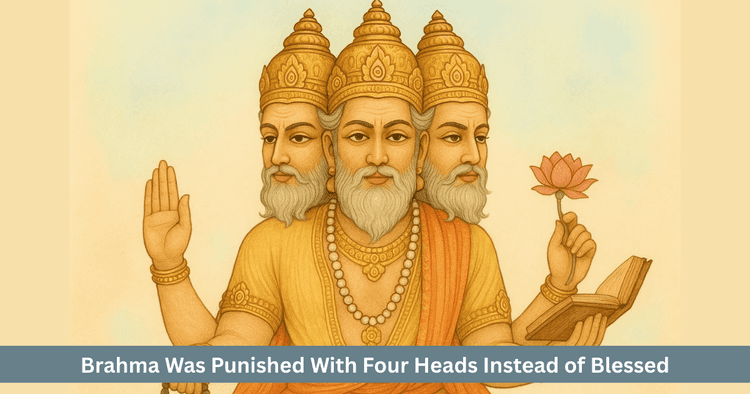
Table of Contents
When the Creator Himself Became the Most Neglected Deity in His Own Creation
In the intricate hierarchy of Hindu mythology, Brahma occupies the paradoxical position of supreme creator yet neglected deity. As one-third of the cosmic triumvirate-alongside Vishnu the Preserver and Shiva the Destroyer-Brahma should command universal reverence as the architect of existence itself. Yet today, while thousands of temples honor Vishnu and Shiva across India, Brahma remains conspicuously absent from popular worship, with barely a handful of temples dedicated to his name. This profound neglect is not accidental but the direct consequence of a curse that transformed what should have been divine attributes into marks of spiritual failure. Brahma's four heads, often interpreted as symbols of omniscience and cosmic vision, actually tell a darker story-one of unchecked desire, wounded pride and divine punishment that serves as a cautionary tale about how even gods can fall when inner discipline collapses. The four faces that crown Brahma's form are not blessings of divinity but perpetual reminders of his disgrace-a punishment that echoes through eternity, explaining why the Creator himself became the most forgotten god in his own creation.
The Origins of Multiplied Vision: Desire Incarnate
To understand Brahma's curse, we must return to the very beginning of creation. After manifesting the physical universe, Brahma realized that life needed a feminine principle to continue and flourish. From his own divine essence, he created Shatarupa-literally meaning "she of a hundred forms"-the first woman, embodying beauty, grace and the power of procreation. Shatarupa was not merely beautiful; she was beauty itself made manifest-the archetypal feminine that would serve as the template for all women to come. She represented the creative potential that, when united with masculine consciousness, would populate the universe with countless life forms.
The Fatal Gaze and Fragmentation of Consciousness
What happened next reveals the tragic flaw in even divine consciousness. When Shatarupa appeared before Brahma, he could not look away. As she moved gracefully around him-as was proper for a creation honoring its creator-Brahma found himself unwilling to lose sight of her even for a moment. Rather than controlling his fascination or maintaining the dignity appropriate to his cosmic role, Brahma allowed desire to literally reshape his physical form.
When Shatarupa moved to his right, Brahma grew a second head facing right. This symbolized consciousness fragmenting to follow desire. When she moved to his left, a third head emerged facing left. Mental energy scattered outward. When she moved behind him, a fourth head grew facing backward. This was complete loss of centered awareness. When she rose skyward in shame, a fifth head emerged facing upward. Desire reached even toward the heavens. This was a spiritual catastrophe.
What appeared to be an expansion of divine vision was actually consciousness fragmenting under the pressure of attachment. Each new head represented the multiplication of want rather than the amplification of wisdom. Awareness scattered outward instead of focused inward toward the Self. The ego's desperate attempt to possess what it desires rather than transcend desire itself. Divine nature compromised by the very human failing of uncontrolled longing.
In spiritual philosophy, kama (desire) is recognized as the primary force that binds consciousness to samsara-the endless cycle of birth, death and rebirth. For Brahma, the very source of creation, to be consumed by desire represented a cosmic catastrophe: the Creator himself had become enslaved by his own creation.
The Severing: When Divine Pride Met Divine Wrath
The story of Brahma's humiliation reaches its climax in his encounter with Lord Shiva, recorded most vividly in the Shiva Purana. Drunk on his role as Creator, Brahma made a fatal error in judgment: he decided to challenge Shiva's supremacy.
Brahma's Claim and Shiva's Response
Brahma declared that he was the Creator of all that exists. Every being, every world, every reality flows from his consciousness. What had Shiva created but destruction? This was more than mere cosmic boasting-it was a fundamental misunderstanding of the nature of divinity. Brahma had confused his role in the cosmic process with ultimate reality itself, forgetting that creation, preservation and destruction are merely functions of a deeper, undifferentiated divine consciousness.
Shiva's reaction was swift and terrible. Your pride has made you forget your place in the cosmic order. You are not the ultimate reality but merely its agent. Since your fifth head, facing the heavens, dares to claim equality with the Supreme, let it be removed forever. With a single flaming fingernail from his left hand, Shiva severed Brahma's upward-facing head. The act was not merely physical but karmic-a cosmic adjustment that restored proper hierarchy and reminded Brahma of his true position.
From that moment forward, Brahma was left with exactly four heads-no more, no less. These four faces became permanent marks of his humiliation rather than symbols of expanded awareness. Reminders of desires that led to disgrace rather than wisdom that leads to liberation. Evidence of pride punished rather than devotion rewarded. A curse he could never escape.
The Four Faces of Fragmented Consciousness
In Vedantic philosophy, the head represents consciousness itself-the seat of awareness, discrimination and spiritual realization. A single head points toward unity of consciousness-the ideal state where awareness is completely focused, undivided and self-contained. Brahma's four heads, therefore represent the exact opposite of spiritual attainment.
Scattered attention where instead of the one-pointed awareness praised in all spiritual traditions, Brahma's consciousness became divided into four separate streams. External fixation where rather than the inward focus that leads to self-realization, all four heads look outward-toward the material creation rather than the spiritual source. Ego multiplication where each head represents a separate center of identity and desire. Loss of integration where true spiritual development involves integrating all aspects of consciousness into a unified whole.
| Direction | Traditional Meaning | Brahma's Curse Interpretation |
|---|---|---|
| East | New beginnings, dawn, hope | Desire for fresh objects of attachment |
| South | Power, transformation | Pride in creative accomplishments |
| West | Completion, sunset, wisdom | Regret over lost opportunities for possession |
| North | Stability, preservation | Fear of losing what has been created |
Rather than mastering these aspects of existence, Brahma became enslaved by them-his four heads constantly turning to monitor, desire, possess and control rather than transcend. Most significantly, none of Brahma's four heads looks inward. In spiritual practice, the ultimate goal is to discover the eternal Self (Atman) that exists beyond all external phenomena.
The Creator Who Lost Worship
Perhaps no aspect of Brahma's curse is more striking than its practical consequences in human religious life. Despite being the Creator-theoretically deserving of the highest reverence-Brahma receives virtually no worship in contemporary Hinduism.
While India contains thousands of temples dedicated to Vishnu and Shiva, fewer than a dozen significant temples honor Brahma as the primary deity. Daily prayers, major festivals and life-cycle ceremonies rarely invoke Brahma's name or seek his blessings. Bhakti (devotional) movements that have swept India for centuries have largely ignored Brahma, focusing instead on Krishna, Rama, Shiva or the Divine Mother.
The Pushkar Exception is the most famous exception to Brahma's neglect-the Brahma Temple at Pushkar in Rajasthan. Yet even this temple's existence comes with a story of marital discord. According to legend, Brahma was performing a crucial cosmic yajna (fire sacrifice) that required his wife Saraswati's presence. When she delayed her arrival, Brahma married a local maiden named Gayatri to complete the ritual. When Saraswati finally arrived and discovered her replacement, she cursed Brahma to be worshipped only at this one location. Even his single temple, therefore commemorates another failure-this time in the realm of divine marriage and family responsibility.
This universal neglect is cosmic justice. While Brahma creates the world of forms and phenomena, spiritual seekers ultimately desire liberation from that very world. Worshipping the Creator of bondage seems counterproductive to those seeking freedom from it. Brahma's creation is cyclical and temporary-universes are created, maintained and destroyed in endless repetition. Devotees prefer to focus on the eternal principles represented by Vishnu (preservation and love) and Shiva (transformation and wisdom).
Knowledge Corrupted: The Burden of Unintegrated Wisdom
Each of Brahma's four heads is traditionally associated with one of the four Vedas-the foundational scriptures of Hindu spiritual knowledge. The first head embodies Rig Veda, hymns and praise but corrupted into pride in creative power. The second carries Sama Veda, sacred music and rhythm but distorted into aesthetic attachment to beauty. The third holds Yajur Veda, sacrificial formulas but perverted into ritualistic ego and superiority. The fourth contains Atharva Veda, practical wisdom and magic but degraded into manipulation and control.
Knowledge Without Transformation
Brahma's tragedy illustrates a profound spiritual truth: possessing knowledge and embodying wisdom are entirely different attainments. Brahma has perfect access to all sacred texts, cosmic principles and spiritual teachings. His four heads contain the complete library of divine knowledge. Yet his behavior-consumed by desire, inflated by pride, humiliated by his own attachments-demonstrates that he has failed to transform this knowledge into actual realization.
This represents the scholar's trap, a danger faced by all spiritual seekers: becoming so fascinated with accumulating spiritual information that one forgets the goal is spiritual transformation. Knowledge that doesn't purify the heart becomes a burden rather than a blessing. Brahma embodies the ultimate irony-he knows everything about spiritual practice but fails to practice spiritually. He understands all paths to liberation but remains bound by his own desires. He teaches others about transcendence while remaining trapped in ego. He creates vehicles for spiritual evolution while remaining spiritually stagnant himself.
This serves as a warning to all seekers: spiritual knowledge must be integrated into life and practice, not merely stored in the mind. Otherwise, even perfect knowledge becomes a curse rather than a blessing.
Faces Bound to Time: The Creator Trapped by Creation
Hindu cosmology describes time as moving in great cycles called yugas (ages), each with distinct spiritual characteristics. Satya Yuga, the golden age of truth and virtue lasting 1,728,000 years, is reflected in Brahma's first head representing original purity. Treta Yuga, the silver age with declining virtue lasting 1,296,000 years, corresponds to his second head showing growing attachment. Dvapara Yuga, the bronze age where virtue and vice are balanced lasting 864,000 years, manifests in his third head where desire overwhelms wisdom. Kali Yuga, the iron age of predominant darkness lasting 432,000 years, is embodied in his fourth head representing complete spiritual degradation.
The Curse of Temporal Bondage
Brahma's four heads facing these temporal directions reveal another aspect of his curse: he is eternally bound to the very time cycles he creates. Unlike the eternal consciousness that transcends time, Brahma's awareness is locked into temporal cycles that repeat endlessly. Unable to escape the creation-preservation-destruction sequence. Condemned to witness the degradation of consciousness through the yugas. Powerless to prevent the cosmic decline his heads observe.
This temporal bondage reveals a profound truth: creation itself is a form of limitation. By bringing forth the world of forms, time and change, Brahma bound himself to those very limitations. To create a universe of infinite diversity and complexity, consciousness must divide and fragment itself. Brahma's four heads represent this necessary but spiritually costly fragmentation.
The Shame That Sanctifies: Divine Disgrace as Spiritual Teaching
In several versions of the story, Brahma's humiliation comes not from Shiva's wrath alone but from the rejection of his own consort, Saraswati-the goddess of wisdom, learning and spiritual knowledge. When Brahma, intoxicated by his creative power and inflamed by desire for Shatarupa, turned his attention to Saraswati herself, she was horrified by his spiritual degradation.
Wisdom Rejecting Ego
Saraswati represents pure wisdom and discrimination (viveka). Her rejection of Brahma symbolizes how true wisdom naturally withdraws from ego-driven consciousness, no matter how seemingly powerful or accomplished. In some traditions, Saraswati cursed Brahma to be abandoned by wisdom itself-explaining not only his lack of worship but his separation from his own divine nature.
The Fifth Head's Significance
The severed fifth head holds particular symbolic importance. The head facing upward should represent spiritual aspiration and connection to higher consciousness. Instead, it became a symbol of pride claiming equality with the Supreme. The fifth head embodied ego's most dangerous delusion-that the individual self is identical to or equal to ultimate reality, without having actually realized that truth through spiritual practice. Shiva's severing of this head restored cosmic order by reminding Brahma (and all consciousness) that roles in creation should not be confused with identity with the absolute.
Paradoxically, Brahma's disgrace serves multiple spiritual purposes. His story warns all beings-human and divine-about the dangers of unchecked desire and pride. His diminished status ensures that creation doesn't become an object of ultimate worship, keeping spiritual focus on transcendence rather than temporary manifestation. Sometimes the most powerful teachings come through witnessing the consequences of spiritual failure rather than examples of success. Brahma's permanent humiliation demonstrates that spiritual growth requires humility at every level of existence-even for gods.
The Four Directions of Distraction: Unity Lost in Multiplicity
All genuine spiritual traditions emphasize ekagrata (one-pointed concentration) as essential for realization. Buddhist meditation seeks single-pointed focus that transcends the wandering mind. Raja Yoga defines concentration as binding the mind to one place, object or idea. Bhakti traditions cultivate exclusive devotion to one chosen form of the divine. Vedantic inquiry requires unwavering focus on the question "Who am I?"
Brahma's Opposite Achievement
Brahma's four heads represent the exact opposite of this spiritual ideal. Instead of one-pointed awareness, consciousness splits into four separate streams of attention. Rather than inward concentration, all four heads look outward toward objects of desire and attachment. While normal consciousness can at least focus on one thing at a time, Brahma's heads create permanent simultaneous distraction. The four heads institutionalize mental restlessness-the very condition that spiritual practice aims to overcome.
Consider the practical impossibility of Brahma achieving meditative states. Pratyahara (withdrawal of senses) is impossible when four faces continuously engage with external stimuli. Dharana (concentration) cannot occur when attention is permanently divided four ways. Dhyana (meditation) cannot be achieved without single-pointed awareness with multiple observation points. Samadhi (absorption) cannot transcend individual consciousness when ego is multiplied by four. Brahma's form physically prevents the very practices that lead to spiritual liberation-making his punishment both poetic justice and cosmic irony.
The Eternal Warning: Why Brahma Remains Unforgiven
Unlike many mythological punishments that eventually expire or can be overcome through further penance, Brahma's four heads appear to be permanent. This eternal quality of his curse suggests several interpretations.
The Permanence of the Curse
Perhaps Brahma cannot be spiritually liberated because his cosmic role as Creator requires him to remain involved with and attached to the phenomenal world. Perfect detachment would make creation impossible. Brahma's disgrace serves as an eternal cautionary tale-if his punishment were temporary, its teaching value would diminish over cosmic time. At the deepest level, Brahma's curse may be self-imposed-the ego-consciousness punishing itself for its spiritual failures, unable to forgive what it perceives as ultimate humiliation.
Perhaps Brahma willingly accepts his diminished status as a cosmic service-demonstrating through his own failure what all beings must avoid on their spiritual journeys. Brahma's story suggests that creation itself may require spiritual sacrifice. To bring forth multiplicity, consciousness must fragment itself. To maintain the world, the Creator must remain engaged with temporal processes. To serve cosmic evolution, even divine beings must accept limitation. The very act of creating may necessitate spiritual compromise.
This interpretation transforms Brahma's punishment into a cosmic tragedy-the Creator accepting spiritual diminishment as the price paid for universal manifestation.
Conclusion: The God Who Teaches Through Failure
Brahma's four heads ultimately tell a story more profound than simple divine punishment. They represent the spiritual victory of cosmic order over individual ego, even at the divine level. The punishment re-established proper cosmic hierarchy, ensuring that creation doesn't become confused with the ultimate reality. Through his disgrace, Brahma became the universe's greatest teacher about spiritual dangers-more effective than thousands of positive examples. His humiliation represents ego death on the largest possible scale-showing that even divine ego must eventually surrender to higher truth. By accepting his curse without rebellion, Brahma transformed personal punishment into universal spiritual service.
The Four Heads as Spiritual Practice
For contemporary seekers, Brahma's four heads can be reinterpreted as meditation on spiritual dangers. The first head reminds us of awareness of how desire multiplies when indulged rather than transcended. The second head offers recognition that knowledge without practice becomes spiritual pride. The third head provides understanding that creative power can corrupt consciousness if misidentified with ego. The fourth head ensures remembering that external achievement means nothing without inner realization.
The Final Teaching
Perhaps Brahma's greatest gift to spiritual seekers is this: he shows us what not to become. In a tradition often focused on positive role models-liberated saints, realized sages, divine incarnations-Brahma provides the necessary counterpoint. He demonstrates that spiritual failure is possible at any level of existence. No attainment provides permanent security against ego and desire. True humility recognizes the ongoing need for vigilance and self-discipline. Even cosmic gods must choose between ego satisfaction and spiritual realization.
The Eternal Mirror
Today, as we look upon images of four-headed Brahma in temples and texts, we are invited not to worship but to examine ourselves. Where do our own heads multiply in following desires? How does our knowledge remain unintegrated with our behavior? When does our creative power feed our ego rather than serve cosmic harmony? What punishments are we unconsciously creating for ourselves through spiritual negligence?
In this way, Brahma's disgrace becomes our potential grace-a divine mirror reflecting not what we should aspire to become but what we must vigilantly avoid becoming on our journey back to the undivided consciousness from which we all ultimately emerge. The Creator with four heads teaches the ultimate spiritual truth: to create the universe is one thing; to conquer the self is infinitely greater. Only when vision turns into clarity, knowledge into liberation and creation into a conscious path back to the eternal does consciousness reclaim its original unity-beyond the need for multiplication, beyond the reach of desire, beyond the curse of spiritual failure that binds even gods to the wheels of their own making.
Frequently Asked Questions
Why does Brahma have four heads and why is this a punishment rather than a blessing?
Brahma's four heads are the result of a curse, not a blessing. When Brahma created Shatarupa, the first woman, he became so infatuated with her beauty that as she moved around him, he continuously generated new heads to keep watching her. This demonstrated uncontrolled desire and attachment, not divine wisdom. The fifth head, which faced upward, was severed by Lord Shiva because Brahma had claimed in arrogance to be equal to the Supreme. The remaining four heads are permanent marks of his humiliation and show how consciousness fragments when control over desire is lost. These heads look outward, never inward, which represents spiritual blindness.
Why is Brahma worshipped in so few temples despite being the Creator?
Brahma's neglect is a direct consequence of his curse. While India has thousands of Vishnu and Shiva temples, there are barely a dozen temples for Brahma, with the Pushkar temple being the most famous. This neglect occurs for several reasons. First, Brahma's failures of desire and ego made him unworthy. Second, spiritual seekers desire liberation, not bondage to creation, so worshipping the Creator of the world seems counterproductive. Third, higher spiritual practice involves transcending form and realizing the formless, while Brahma is intrinsically connected to form and manifestation. Fourth, Brahma's own consort Saraswati also cursed him to limited worship.
Why did Shiva sever Brahma's fifth head?
Shiva severed Brahma's fifth head because Brahma claimed in arrogance that he was equal to or superior to Shiva. Intoxicated by his role as Creator, Brahma forgot that creation, preservation and destruction are all functions of a deeper divine consciousness. The fifth head facing upward symbolized his proud claim of equality with ultimate reality. Shiva cut it off with a flaming fingernail from his left hand, which was not merely a physical act but a karmic one. This restored cosmic hierarchy and reminded Brahma of his true position. It demonstrates that ego, no matter how powerful, must ultimately bow before higher truth.
What is the spiritual significance of Brahma's four heads?
Brahma's four heads are profound symbols of spiritual failure. In Vedantic philosophy, the head represents consciousness and one head is the ideal of integrated awareness. Brahma's four heads show the fragmentation of consciousness when desire goes out of control. Each head is associated with one of the four Vedas but this demonstrates the difference between possessing knowledge and living it. All four heads look outward, never inward, showing that Brahma has lost self-realization. They also represent the four directions where Brahma is bound by desire, pride, fear and regret. This is the opposite of the concentration essential for all spiritual practice.
What lessons do we learn from Brahma's story?
Brahma's story offers numerous profound spiritual teachings. First, uncontrolled desire can corrupt consciousness no matter how advanced. Second, possessing knowledge and living it are different things-Brahma has knowledge of all the Vedas yet failed spiritually. Third, creative power and achievements can inflate ego if there is no humility. Fourth, internal focus is necessary for spiritual progress, not external achievements. Fifth, even gods need humility and self-discipline. Sixth, one should not identify with their role. Brahma's example is negative teaching that shows what not to become-a warning more powerful than positive examples in demonstrating the consequences of spiritual negligence.
What does Nakshatra reveal about me?
My NakshatraDid you like it?
Author

Pt. Nilesh Sharma (63)
Experience: 20
Consults About: Family Planning, Career
Clients In: Punjab, Haryana, Delhi
Share this article with friends and family
About ZODIAQ
ZODIAQ is an online Vedic Astrology platform. It connects clients seeking astrological advice to experienced astrologers with deep knowledge. Our users also generate kundali and perform kundali milan for free. ZODIAQ also offers services to the Astrologers. Astrologers utilize various offerings by ZODIAQ to serve their clients effectively.
If you are a User
Consult with experienced astrologers and seek their guidance. You can also order handwritten Janm Patrika report with life prediction prepared by experienced astrologers. Generate accurate Kundali, perform Kundali Matching and check horoscope and muhurat. Utilize our online library for all the necessary astrological and spiritual information.
If you are an Astrologer
Create accurate kundali for your clients and perform Kundali Matching for up to 5 people at a time. Write comprehensive Janm Patrika report for your clients with ZODIAQ. Check client details anytime by saving it in client directory. Become more productive by tracking how many clients you guide every day.
WELCOME TO
ZODIAQ
Right Decisions at the right time with ZODIAQ
