Why Did Hanuman Forget His Power
By Aparna Patni
The deep story of Hanuman’s childhood curse, Jambavan’s reminder and the awakening of hidden strength
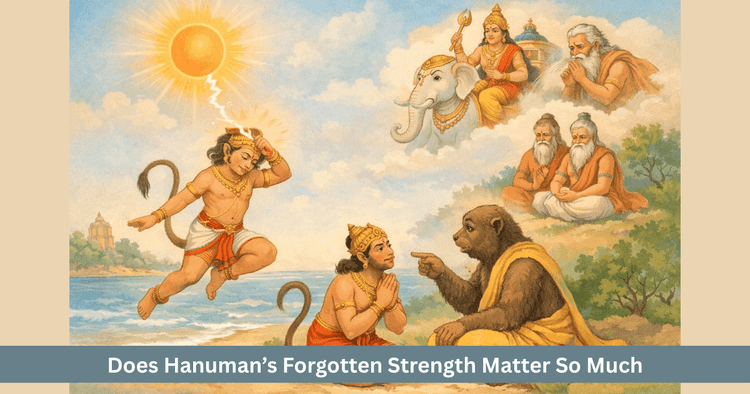
Table of Contents
Why Does Hanuman’s Forgotten Strength Matter So Much
In the Ramayana, Hanuman stands as a symbol of immense strength, fearless courage and pure devotion to Rama. People remember him lifting mountains, burning Lanka and turning the tide of the war. Yet the tradition also tells us that for a long time he did not even remember the full extent of his own power.
A playful leap towards the sun, the anger of Indra, the breath of Vayu withdrawing from the world, the boons of the gods and then the quiet curse of the sages, all come together to create a story with many layers. Later, on the shore of the ocean, one sentence from Jambavan awakens what lies hidden. This is not only a tale about a divine monkey. It is a mirror for the hidden potential in every human being.
The Divine Child With Unimaginable Strength
The birth of Hanuman already hints at his unusual nature.
- mother Anjana’s tapas
- father Kesari’s valour
- the special grace of Vayu
- and the touch of Shiva’s energy
all flow into this one child. From the beginning, his body carried power far beyond normal measure. In childhood that power expressed itself in play.
The most famous incident is the one in which young Hanuman mistook the rising sun for a ripe fruit. Seeing the glowing orb, he leapt up to seize it. The leap itself spoke of what he carried within. A small body covering the sky in a single bound is more than a prank. It is a glimpse of a future hero.
The Leap Towards The Sun And The Gods’ Intervention
Hanuman’s playful act did not stay a private event.
- the sun is the source of light and energy for the world
- any disturbance there touches every living being
Indra, king of the gods, saw this act as dangerous and responded with his thunderbolt, the Vajra.
- the blow struck Hanuman
- the child fell back to earth
- his body lay unconscious
Vayu, his father, was filled with sorrow and anger.
- he withdrew air from the world
- without breath, creatures began to suffer
Panic spread among gods and beings alike. A single impulsive act by a child had revealed how deeply everything in creation is linked together.
The Boons That Made Hanuman Even Stronger
To calm Vayu and restore balance, the gods gathered around the fallen child. One by one they offered blessings.
These boons included
- immense physical strength
- great speed and agility
- fearlessness in the face of many dangers
- protection from weapons and long life
Ironically, the one wounded by the thunderbolt emerged not broken but greatly empowered. The very crisis that seemed disastrous opened the door to something higher.
Here lies a quiet insight. Sometimes an event that feels like a hard blow becomes the seed for greater capability. Under divine guidance, even a fall can turn into a rise, if it leads to deeper preparation and right direction.
Why Did The Sages Place A Curse On Hanuman
Even after receiving such boons, Hanuman was still a child.
- his energy overflowed
- his curiosity ran wild
- his play knew no boundaries
In the forests and ashrams, sages tried to meditate, chant and perform rites. The little Hanuman, in his innocent enthusiasm, sometimes
- jumped across their fires
- pulled at their seats
- or scattered their materials
He did not wish to hurt them. He simply did not understand the impact of his games. After many disturbances, the sages decided that a limit was needed. They uttered a curse
“You will indeed possess immense strength,
but you will forget it.
You will remember it only when someone reminds you at the right time.”
This curse was not driven by revenge. It was a safeguard. With so much power in such a small child, some protection was needed so that it would not be misused, even in play.
Table: The Curse On Hanuman As Protection
| Level | How it looks on the surface | Inner meaning |
|---|---|---|
| Action | Sages curse a naughty child | Wise elders place a check on uncontrolled power |
| Effect | Hanuman forgets his own greatness | Power is hidden until maturity and right need |
| Condition | Memory returns only when reminded | True strength awakens through guidance |
When Did The Curse Lift In The Ramayana
Years passed. Hanuman grew up strong, intelligent and devoted, yet inwardly simple. He served Sugriva loyally and met Rama as a humble messenger.
After Sita’s abduction, a great problem stood before Rama’s allies.
- Sita was in Lanka
- a vast ocean lay in between
- the army stood on the shore with little idea how to cross
The warriors around discussed their abilities. Some said they could leap a certain distance, some said they could go farther but no one claimed to reach Lanka. Hanuman remained quiet. Under the veil of the curse, he saw himself as only one more servant in the group. Then Jambavan spoke.
Jambavan’s Role: One Sentence That Changes Everything
Jambavan, the wise old bear, had seen much of the world.
- he knew Hanuman’s origin
- he remembered the boons of the gods
- he understood that this was the moment for that strength to rise
He addressed Hanuman and reminded him of who he really was.
- born of Anjana and Kesari
- blessed by Vayu and Shiva
- armed with boons beyond counting
As Jambavan spoke, something stirred in Hanuman’s heart. The curse had stated that memory would return when someone reminded him. That condition was now fulfilled.
Hanuman’s form expanded. He grew to a gigantic size, voice resonant, mind steady. He declared that he would cross the ocean and in one mighty leap he rose into the sky. That jump did not only cross water. It crossed the distance between doubt and conviction.
What Does Forgetting And Remembering Symbolise Spiritually
This story carries rich symbolism beyond its literal events.
Hidden Potential
Most people live with far more capacity than they use. Fear, habit, social pressure and past experiences act like a mist over the mind. The story of Hanuman’s forgotten strength reflects this gap between what we are and what we remember ourselves to be.
Need For A Guide
Jambavan’s reminder stands for the role of the guru, mentor or wise friend, who sees our capacity when we cannot. Sometimes a single timely word, a challenge or a crisis can awaken buried strength.
Power And Humility Together
The curse ensured that Hanuman did not grow up arrogant. He served others without constantly thinking of his own greatness. Only when dharma required full power did it shine forth. This balance between might and modesty is central to his character.
Right Time For Full Expression
Strength that shows itself too early can harm more than help. The lifting of the curse at the moment of Sita’s search shows that destiny has a timing. When the task is ready and the person is prepared, the two meet.
Table: Life Lessons From Hanuman’s Forgotten Powers
| Point | In Hanuman’s story | In our lives |
|---|---|---|
| Forgotten strength | Curse hides his divine power | Low self belief hides real abilities |
| Jambavan’s reminder | Elder recalls his true nature | Teacher, friend or event awakens confidence |
| Crossing the ocean | One leap to Lanka | Bold step towards a goal that seemed impossible |
| Lasting humility | Calls himself “Rama’s messenger” even after great feats | Staying grounded after success |
What Does This Story Teach Us About Our Own Strength
When devotees chant “Bajrangbali ki Jai” they are not asking only for physical power. They are also calling on the inner Hanuman.
The story suggests that
- our real identity is higher than our passing doubts
- the soul carries far more courage and capacity than the mind accepts
- with right guidance and devotion, that capacity can awaken
The curse shows that power without wisdom is risky. The remembrance shows that when strength combines with devotion and service, it can alter the course of events for the better. Hanuman never claims glory for himself. He repeatedly calls himself only the servant and messenger of Rama. That is why his might inspires trust rather than fear.
In this sense Hanuman becomes a timeless symbol of
- energy disciplined by humility
- courage guided by faith
- and talent offered in service of a higher cause
Such strength does not threaten the world. It protects and uplifts it.
Frequently Asked Questions
Was the curse on Hanuman an act of anger or compassion
On the surface it arose from disturbance, yet at a deeper level it worked as protection. It prevented a powerful but playful child from causing major harm by accident. It also kept his strength reserved for moments when dharma truly needed it.
Why is Jambavan given so much importance in this episode
Without Jambavan’s reminder, Hanuman’s power might have remained hidden. He represents the elder who knows both the person and the situation well enough to say, “Now is your time, rise.” His role shows the value of wise encouragement.
Did Hanuman literally forget his powers or is it symbolic
The tradition presents it as a real event and many accept it as such. Symbolically it matches the human tendency to underestimate oneself. Both readings can sit side by side and enrich each other.
What can young people learn from this story today
That raw talent is not enough. Self control, the right purpose and good guidance are equally vital. It also tells them not to despair if their abilities are not yet fully visible. With patience and the right call, their “ocean leap” moment can still come.
What deeper meaning lies in calling out “Bajrangbali ki Jai”
It can be heard as a call to awaken one’s own hidden courage and devotion. The words honour Hanuman’s willingness to use strength only for noble work. They also remind the heart to place its energy in service of something higher, just as he did for Rama.
Get your accurate Kundali
Generate KundaliDid you like it?
Author

Aparna Patni (63)
Experience: 20
Consults About: Family Planning, Career
Clients In: Punjab, Haryana, Delhi
Share this article with friends and family
About ZODIAQ
ZODIAQ is an online Vedic Astrology platform. It connects clients seeking astrological advice to experienced astrologers with deep knowledge. Our users also generate kundali and perform kundali milan for free. ZODIAQ also offers services to the Astrologers. Astrologers utilize various offerings by ZODIAQ to serve their clients effectively.
If you are a User
Consult with experienced astrologers and seek their guidance. You can also order handwritten Janm Patrika report with life prediction prepared by experienced astrologers. Generate accurate Kundali, perform Kundali Matching and check horoscope and muhurat. Utilize our online library for all the necessary astrological and spiritual information.
If you are an Astrologer
Create accurate kundali for your clients and perform Kundali Matching for up to 5 people at a time. Write comprehensive Janm Patrika report for your clients with ZODIAQ. Check client details anytime by saving it in client directory. Become more productive by tracking how many clients you guide every day.
WELCOME TO
ZODIAQ
Right Decisions at the right time with ZODIAQ
