Why Did the Sisters of Heaven Turn Enemies? The Untold Tale of Kadru and Vinata
By Pt. Abhishek Sharma
When Jealousy Built a Wall of Enmity Between Sisters, Serpents and Garuda Were Born
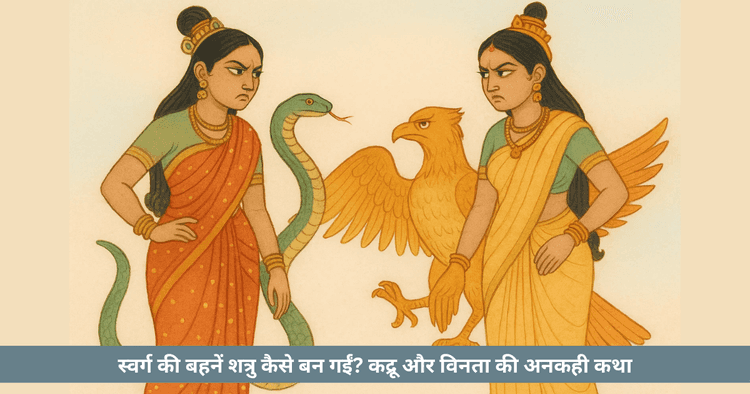
Table of Contents
When Jealousy Built a Wall of Enmity Between Sisters, Serpents and Garuda Were Born
In the vast and mysterious world of Hindu mythology, where divine events extend from heaven to earth, the story of Kadru and Vinata presents the complexity of human emotions with profound depth. These two celestial sisters, who were co-wives of the great sage Kashyapa, watched the bonds of their mutual affection crumble under the heavy weight of jealousy, ambition and deceit. From these two divine women emerged two of the most iconic creatures in mythological tales: the Nagas (serpents) and Garuda, the mighty mount of Lord Vishnu. This tale is not merely an origin story but rather a profound exploration of how jealousy corrupts relationships, how impatience brings dire consequences, how deceit may triumph temporarily but never permanently and how patience and righteousness ultimately lead to liberation. Within this ancient narrative lies a mirror reflecting timeless truths about human nature, karma and the intricate workings of destiny.
The Sage and His Beloved Wives
Sage Kashyapa, one of the Saptarishis (seven great sages) and a Prajapati (progenitor of creation), occupied a position of immense cosmic importance. Through his marriages to the daughters of Daksha Prajapati, he became the father of gods, demons, animals, birds and all manner of creatures populating the universe. His lineage literally shaped the diversity of existence itself. Among his numerous wives, Kadru and Vinata held special places. These two sisters, born of Daksha and sharing the same parentage and upbringing, became co-wives in a polygamous household, which was a common arrangement in ancient Indian society. Both were devoted to their husband and sought his blessings with genuine reverence.
Initially, their relationship was harmonious, unmarred by any rivalry that would later consume them. This stage was set not in conflict but in unity-two sisters who loved the same man, lived in the same household and approached their shared husband with a common desire: the blessing of children. Peace and harmony prevailed in their lives but fate had planned something different for them. They did not know that their desire for offspring would become the cause of eternal enmity between them.
The Moment of Boons: Seeds of Future Rivalry
When Kadru and Vinata approached Sage Kashyapa with their heartfelt longing for offspring, the sage-pleased by their devotion-offered to grant each a boon according to her deepest wish. This moment, seemingly benign, contained within it the seeds of all events that would follow. This was a moment when the different natures and aspirations of the two sisters became clearly evident.
The Ambitious Request of Kadru
Kadru, driven by ambition and a desire for overwhelming power, asked for one thousand sons who would be mighty, influential and capable of ruling the world with strength and authority. Her request revealed that she valued quantity over quality. There was special emphasis on worldly power and dominion. Pride was inherent in the idea of becoming the mother of an entire race. An underlying competitiveness was also present, though no overt rivalry had emerged yet. Kadru's wish emphasized numerical strength, which reflected the expansionist aspect of her personality.
The Humble Desire of Vinata
Vinata, characterized by patience and humility, requested only two sons but with the specific condition that they would be so extraordinarily powerful that they would surpass all of Kadru's thousand children combined. Her request demonstrated that she believed in quality over quantity. There was trust in the power of focused excellence rather than overwhelming numbers. A quiet but unmistakable competitive spirit was also present, revealing that even the humble heart harbored comparison. There was faith that true greatness could manifest in small numbers.
| Aspect | Kadru | Vinata |
|---|---|---|
| Number of children | One thousand sons | Two sons |
| Emphasis on quality | Collective strength | Individual supremacy |
| Motivation | Dominion and pride | Excellence and patience |
| Nature of character | Ambitious, quantitative | Humble yet competitive |
| Perspective on power | Broad expansion | Deep centralization |
Sage Kashyapa, bound by his word and pleased by both requests, granted their wishes. Soon afterward, both wives laid eggs. Kadru laid one thousand eggs and Vinata laid two. Thereafter began the waiting period, which would prove to be long and difficult.
The Hatching: Triumph and Tragedy
Time passed at its own pace, indifferent to mortal or divine impatience. Eventually, Kadru's thousand eggs began to hatch, releasing radiant serpent sons. Each Naga glowed with supernatural beauty and power. They slithered forth into the world, filling their mother's heart with pride and satisfaction. Kadru's home resonated with the presence of her offspring. Her serpent sons were of diverse forms and abilities but all possessed divine radiance. Kadru's motherhood was fulfilled and she began to look upon her sister with a sense of superiority.
But Vinata's two eggs remained unbroken, silent and still, showing no signs of the life within. Days turned to weeks, weeks to months and Vinata watched as Kadru basked in maternal glory while she remained childless, her promise unfulfilled. This waiting became unbearable torture for her. Each day she would look at her eggs, converse with them, hold them in her lap but there was no movement. Gradually, impatience began to take root in her mind.
The Consequence of Fatal Impatience
Unable to bear the waiting any longer, consumed by anxiety and perhaps wounded pride at seeing her sister's triumph while she remained empty-handed, Vinata committed a grievous error. She broke open one of her eggs prematurely, forcing birth before its destined time. This act was against the laws of nature, a violation of cosmic order. When the egg broke, Aruna (the Dawn) was born, radiant yet incomplete. Glowing with divine brilliance but only half-formed, his lower body was underdeveloped because his cosmic gestation had been prematurely ruptured.
Aruna looked upon his mother with eyes containing both compassion and sorrow. He understood her pain, yet he also understood the cosmic law she had violated. In a voice that carried the weight of fate itself, he said that her impatience had cost him his full form. He had not been ready to be born, yet she had forced him into existence before his time. He cursed his mother that she would live as a slave to her sister Kadru until her second son was born with the power to free her. With these words, Aruna ascended to the heavens and took his destined position as the charioteer of Surya, the Sun God-heralding each dawn, his radiant yet incomplete form forever reminding the world of the cost of impatience.
Vinata, now bearing the dual burden of shame and hope, guarded her second egg with renewed patience, praying fervently for redemption through the child yet to come. She vowed that she would never again violate the laws of nature, no matter how long the wait.
The Birth of Garuda: Dawn of Divine Power
When the cosmically appointed time finally arrived-not a moment sooner, not a moment later-the second egg cracked open of its own accord. From within emerged a being of such overwhelming majesty that the very fabric of reality seemed to tremble. The arrival of Garuda was an event that shook all three worlds.
The Manifestation of the Divine Eagle
The birth of Garuda was unprecedented. His wings stretched across the sky, casting shadows over mountains and valleys. His body glowed like molten gold, radiating divine energy that illuminated the three worlds. His roar echoed through heaven and earth, announcing the arrival of a force that would reshape cosmic history. His eyes blazed with intelligence and power, marking him as no ordinary creature but a being of supreme consciousness.
The gods themselves-Indra (king of gods), Agni (fire god), Varuna (water god)-trembled in awe and uncertainty, feeling insecure about whether this magnificent being was friend or cosmic threat. His power was so immense, his presence so overwhelming that even the celestial hierarchy felt unstable. Garuda's abilities seemed limitless. He could fly at unimaginable speeds, lift massive mountains and his radiance was like the sun.
The Destiny and Purpose of Garuda
From the moment of his birth, Garuda's fate was sealed. He was destined to become the vahana (mount) of Lord Vishnu, the supreme preserver. He would embody courage, speed and divine wisdom. He would become the eternal enemy of serpents, the children of his mother's sister. He would symbolize the triumph of dharma (righteousness) over adharma (unrighteousness), truth over deceit. But before all this glory could manifest, Garuda discovered a painful truth that his mother Vinata had already been enslaved by her deceitful sister Kadru. The circumstances of this enslavement form one of mythology's most compelling illustrations of how lies can temporarily overcome truth.
The Deceptive Wager: When Deceit Conquered Truth
The relationship between Kadru and Vinata, already strained by the differences in their children's births, deteriorated completely through an act of calculated deception that would bind Vinata in slavery and set the stage for cosmic conflict. This event demonstrates how lies and deception can temporarily suppress dharma.
The Vision of the Divine Horse
One day, when the sisters were gazing upon Uchchaihshravas (meaning "long-eared" or "neighing loudly"), the magnificent seven-headed white horse that had emerged during the Samudra Manthan (churning of the cosmic ocean), a seemingly innocent disagreement arose. Kadru declared that this magnificent horse's tail was black. Vinata disagreed, stating that the tail was pure white, bright and luminous as moonlight. There was no darkness in it. This was a simple difference of opinion but Kadru saw it as an opportunity.
The Proposal of the Wager
What began as a simple disagreement escalated when Kadru, perhaps already harboring resentment or seeing an opportunity to gain advantage, proposed a wager. She said they should make a bet and tomorrow they would examine the horse more closely. Whoever was proven wrong would become the other's servant. Vinata, confident in the truth of what she had seen and perhaps naive about her sister's capacity for deception, accepted the challenge. After all, truth was on her side-how could she lose? She did not know that truth could also be concealed by lies.
The Night of Deceit and Vinata's Defeat
That night under cover of darkness, Kadru summoned her thousand serpent sons and issued a command that would forever taint their reputation. She said their future depended on a simple task. They would have to go and coil themselves around the divine horse's tail and completely cover its white hairs so that it would appear black. Some of the Nagas, possessing greater dharmic sense, refused to participate in such obvious deceit. But many others, loyal to their mother or indifferent to ethical concerns, obeyed the command. They slithered through the night and wrapped themselves around Uchchaihshravas's brilliant white tail, creating the illusion of darkness where only light had been.
The next morning, when the sisters approached to settle their wager, the horse's tail indeed appeared dark. This was not because Vinata had been wrong but because deceit had manufactured a false reality. Bound by her word, despite the injustice of the situation, Vinata became Kadru's slave. This was not because truth had failed but because truth was temporarily obscured by lies and she was bound by the sacred nature of her vow. From here began Vinata's difficult time, where she was compelled to live as a servant to her own sister.
Deeper Meanings: What the Story Reveals
This ancient narrative operates on multiple levels simultaneously, offering insights into human psychology, cosmic law and spiritual truth. Each aspect is filled with profound teachings that remain relevant even today.
Teaching on Jealousy and Competition
The rivalry between the sisters demonstrates that even love between siblings can be poisoned by comparison and competition. Ambition untouched by ethics leads to moral compromise. Jealousy transforms relationships from support to exploitation. The desire to be better than another corrupts natural affection. It teaches that:
- Comparison is toxic and destroys relationships
- Ego and pride kill love
- Competition divides families
- Jealousy born of insecurity leads to tragic consequences
Lessons on Impatience and Consequences
Vinata breaking the first egg teaches that impatience violates natural timing, causing harm to self and others. Every action has consequences that ripple through time. Suffering often results from our inability to trust the process. Redemption is possible but may require enduring the consequences first. It also shows that:
- Nature has its own time which cannot be forcibly changed
- Decisions made in haste cause permanent damage
- Patience is a virtue that is rewarded
- Faith and surrender are necessary
Instruction on Deceit and Truth
The wager episode illustrates that lies can temporarily obscure truth but never permanently destroy it. Integrity demands honoring commitments even when deceived. Deception creates karmic debt that must eventually be repaid. Truth ultimately prevails, though patience may be required. It teaches that:
- The empire of lies is short-lived
- The power of truth eventually manifests
- Standing firm on dharma is crucial
- Victory obtained through deceit is not real victory
Wisdom on Destiny and Liberation
The overall arc of the tale reveals that bondage is temporary, even when imposed through injustice. Redemption comes through righteousness, embodied in Garuda eventually freeing his mother. Patience and faith sustain us through periods of unjust suffering. Divine justice operates on timescales beyond immediate perception.
| Area of Teaching | Main Message | Practical Application |
|---|---|---|
| Relationships | Comparison is poison | Do not compare yourself to others |
| Patience | Nature's time is best | Learn to wait |
| Truth | Lies are temporary | Stand firm on truth |
| Karma | Karma is inevitable | Remain righteous |
| Liberation | Suffering is temporary | Maintain faith |
The Legacy: Eternal Opposition Between Serpents and Eagles
From this family conflict emerged one of mythology's most enduring enmities: the eternal opposition between serpents (Nagas) and Garuda and his descendants. This opposition extends beyond mere natural predation-it represents:
The conflict between earthly attachment and spiritual liberation. It illustrates the tension between collective power and individual excellence. It reveals the ongoing battle between deception and truth. It demonstrates karmic consequences extending across generations.
Characteristics and Symbolism of the Nagas
The Nagas, born of Kadru's ambition, are bound to the earth. They are numerous in number, dwelling in land and water. They symbolize kundalini energy (spiritual energy coiled at the base of the spine) and transformation. They bear the karmic consequence of their mother's deceit. Some among them are righteous while others are unrighteous.
Characteristics of Garuda and His Lineage
Garuda and his lineage, born of Vinata's patience, dwell in the sky. They are few in number but immense in power. They symbolize freedom, excellence and divine service. They are instruments of justice and liberation. They are protectors of truth and dharma.
Concluding Essence: Timeless Lessons from Celestial Sisters
The tale of Kadru and Vinata, though ancient, speaks directly to contemporary human experience. In their story we find the danger of comparing ourselves to others, even those we love, which breeds resentment and rivalry rather than celebration of different paths. The cost of impatience, which forces outcomes before their natural time and creates suffering that could have been avoided through trust. The temporary nature of injustice, which may triumph in the moment but cannot withstand the ultimate reckoning of cosmic law.
The power of patience and integrity, which sustain us through periods of unjust bondage until liberation inevitably arrives. The persistence of consequences across generations, as the conflict between these sisters manifested in eternal enmity between their descendant species. From Kadru's thousand serpents slithering through the earth to Garuda soaring through the heavens carrying Vishnu on his back, from Vinata's patient suffering in slavery to her ultimate liberation through her righteous son, this story reminds us that our choices echo through time. Our relationships shape destinies. Our virtues-or lack thereof-create worlds.
In the end, the sisters of heaven became enemies not through fate's cruelty but through the very human failings of jealousy, ambition and deceit. It reminds us that even in celestial realms, it is character that determines destiny and patience that ultimately triumphs over pride. This tale remains relevant in every age because it touches the universal truths of human nature. It teaches that truth, dharma and patience ultimately triumph over any deceit, unrighteousness and impatience.
Frequently Asked Questions
Who were Kadru and Vinata and how were they related to Sage Kashyapa?
Kadru and Vinata were daughters of Daksha Prajapati and biological sisters who became wives of Sage Kashyapa. Kashyapa was one of the Saptarishis (seven great sages) and a Prajapati from whom gods, demons, animals, birds and other creatures originated. The Nagas were born from Kadru while Vinata became the mother of Aruna and Garuda. Initially there was a harmonious relationship between both sisters but the desire for children and subsequent events created eternal enmity between them. Their story demonstrates how jealousy and competition can destroy even loving relationships.
How did Vinata become a slave to her sister Kadru?
A disagreement arose between Vinata and Kadru regarding the color of the tail of Uchchaihshravas, the divine horse that emerged from the churning of the cosmic ocean. Kadru claimed the tail was black while Vinata stated it was white. They made a wager that whoever was proven wrong would become the other's servant. Kadru commanded her serpent sons at night to coil around the horse's white tail so it would appear black. Due to this deception, Vinata became bound by her word and became Kadru's slave. This episode shows that lies can temporarily triumph over truth but ultimately dharma prevails.
Why did Vinata break her first egg prematurely and what was the consequence?
Vinata broke her first egg prematurely due to impatience because all of Kadru's thousand eggs had hatched and her sister was experiencing maternal joy while her eggs were still closed. The consequence of this impatience was that Aruna was born in incomplete form with his lower body underdeveloped. Aruna cursed his mother that she would remain Kadru's slave until her second son freed her. This incident teaches that violating the laws of nature brings serious consequences and patience is an essential virtue. Aruna later became the charioteer of Surya, the Sun God and heralds each dawn.
Why was the birth of Garuda so special and what was his destiny?
The birth of Garuda occurred at the cosmically appointed time and was so powerful and impressive that all three worlds trembled. His wings were expansive across the sky, his body glowed like molten gold and his roar shook heaven and earth. Even the gods felt fearful and experienced awe and uncertainty at his power. Garuda's destiny was to become the vahana of Lord Vishnu, to be a symbol of courage and divine wisdom and to become the eternal enemy of serpents. He resolved to free his mother Vinata from slavery and stood on the side of dharma and truth. Garuda symbolizes the importance of patience and righteousness.
What key teachings do we receive from this tale that remain relevant today?
This tale provides numerous timeless teachings that are extremely relevant even today. First, comparison and jealousy poison relationships and destroy love. Second, impatience violates natural order and brings serious consequences therefore patience is necessary. Third, deceit and lies may temporarily succeed but ultimately truth and dharma triumph. Fourth, the consequences of our actions extend across generations just as the conflict between Kadru and Vinata created eternal enmity between Nagas and Garuda. Fifth, injustice is temporary and liberation definitely comes through faith and righteousness. These teachings provide guidance in modern life as well.
What does Nakshatra reveal about me?
My NakshatraDid you like it?
Author

Pt. Abhishek Sharma (63)
Experience: 20
Consults About: Family Planning, Career
Clients In: Punjab, Haryana, Delhi
Share this article with friends and family
About ZODIAQ
ZODIAQ is an online Vedic Astrology platform. It connects clients seeking astrological advice to experienced astrologers with deep knowledge. Our users also generate kundali and perform kundali milan for free. ZODIAQ also offers services to the Astrologers. Astrologers utilize various offerings by ZODIAQ to serve their clients effectively.
If you are a User
Consult with experienced astrologers and seek their guidance. You can also order handwritten Janm Patrika report with life prediction prepared by experienced astrologers. Generate accurate Kundali, perform Kundali Matching and check horoscope and muhurat. Utilize our online library for all the necessary astrological and spiritual information.
If you are an Astrologer
Create accurate kundali for your clients and perform Kundali Matching for up to 5 people at a time. Write comprehensive Janm Patrika report for your clients with ZODIAQ. Check client details anytime by saving it in client directory. Become more productive by tracking how many clients you guide every day.
WELCOME TO
ZODIAQ
Right Decisions at the right time with ZODIAQ
