Why Does Hanuman Appear Only To Those In Deep Pain
By Pt. Sanjeev Sharma
When identity collapses and the heart stands bare Hanuman’s grace awakens within
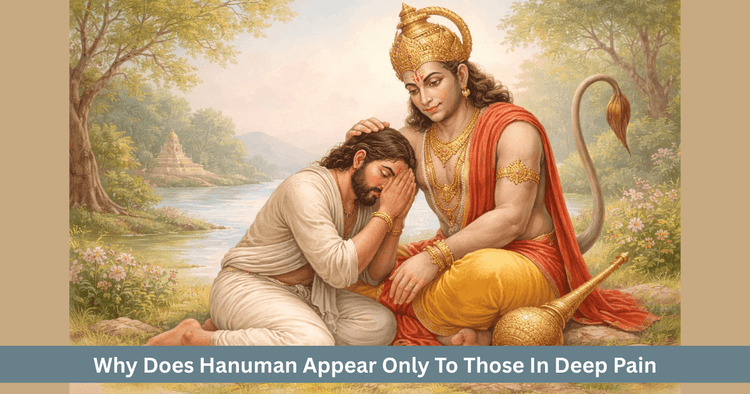
Table of Contents
There is a quiet insight that runs through devotion to Hanuman he belongs to everyone, yet people usually feel him most vividly when their life is cracking open. In ordinary times, the mind is full of plans, ambitions and small irritations, so the divine remains an idea or a ritual. When pain grows so deep that identity itself begins to shake, the usual masks fall away and the heart stands exposed. It is in that raw exposure that many devotees say Hanuman does not just exist in stories he feels present.
The well known line “Nase rog hare sab peera, japat nirantar Hanumat beera” speaks not only of curing physical ailments but of easing the inner ache that reaches down to the core. It hints that his grace becomes most visible when suffering has broken through the surface and turned into an honest cry. In that sense, Hanuman is not a distant figure who sometimes decides to visit the unlucky but the very strength and compassion that rise up when our own strength has collapsed.
1 When pain shakes your whole world
Daily life contains many minor and moderate hurts. A failed plan, a difficult boss, a quarrel at home, financial pressure all of these hurt but often we can still manage them with distraction, rationalization or sheer willpower. Underneath, the basic story we tell ourselves about who we are and how life works remains intact.
Deep pain is different. It is the kind that makes you question everything not just “Why did this happen” but “How do I live now, who am I without what I lost, what is really holding me.” It may come through a betrayal that cuts to the bone, the death of someone central to your life, a long illness, repeated failures or a sense of emptiness that no success can fill. At such times, the mind’s old tricks stop working. The smile becomes hard to fake. The sense of control falls apart.
Tradition says it is exactly here that Hanuman’s presence becomes more tangible. Not because he was absent before but because the inner noise has finally been interrupted. When the heart says without pretense, “I cannot do this alone,” a new kind of listening opens and into that listening his strength can be felt.
2 Surface problems versus existential suffering
One kind of suffering clashes mainly with our desires. We wanted recognition, comfort or a particular result and did not get it. We feel angry, disappointed, hurt, yet underneath we still believe “I will find another way, I will sort this out.” This can lead to complaint and bargaining with the divine but rarely to surrender.
Existential suffering touches the roots. It brings us to the point where we no longer trust our own strategies. The mind meets the limits of its control. When you have tried everything you know and nothing changes, when the person you relied on most breaks your trust, when your body or mind is so weary that you do not know how to keep going, the old identity starts to crumble.
At that point, there are two main directions. One is bitterness, cynicism and closing down. The other is a strange humility in which you finally admit you are not the center, not the sole controller and you turn toward a higher presence with your whole being. The second path is where Hanuman devotion comes alive. The pain is not denied but instead of hardening around it, you carry it to him as honestly as you can.
3 The depth of “Nase rog hare sab peera”
The line “Nase rog hare sab peera, japat nirantar Hanumat beera” is often taken very literally as a promise that disease and pain will disappear if one repeats his name. Looked at more deeply, it points to a change not only in circumstances but in consciousness.
Rog includes bodily disease, mental disturbance and habitual patterns that keep us trapped. Peera includes fear, shame, helplessness, loneliness and the sense that life has lost meaning. When the verse says that these are destroyed through continuous remembrance, it is describing how a mind saturated with Hanuman’s qualities begins to loosen its grip on these burdens.
Continuous remembrance is not just mechanical repetition. It is a gradual tuning of the heart in which more and more ordinary moments become connected with his presence. A brief name on waking, a silent call before a difficult conversation, a few lines of prayer at night over time, these turn the mind from a place of complaint into a place of trust. When that inner movement becomes strong, Hanuman is no longer just a heroic figure in a book. He is experienced as a quiet, steady strength inside your own chest.
4 His grace responds to truth, not perfection
Many people secretly believe “I will deserve divine help when I become morally pure, disciplined and spiritually advanced.” That belief itself is often driven by pride the idea that we can earn grace as if it were a salary. The stories around Hanuman point to something else. What moves him is not boasting or self image but naked honesty.
When a person comes to him with all their failures, fears and confusion and says, “I do not know what to do but I do not want to fall into hatred or despair, please hold me,” that plea itself becomes a powerful prayer. There is no performance in it. There is pain, yes but also humility and a willingness to be guided. In such a state, the heart becomes like soft clay rather than baked stone and into that softness his influence can sink.
This is why so many devotional accounts describe his help arriving at the moment when someone thought everything was over. The visible circumstances may not change overnight but the inner flavor of experience shifts. Where there was only panic, a small thread of courage appears. Where there was only isolation, a sense of being accompanied begins to grow.
5 From pain to hymn when suffering turns into prayer
When a poet saint or a simple devotee composes or recites verses to Hanuman in the middle of intense pain, what is happening is more than poetry. Each line is an attempt to turn raw feeling into dialogue instead of monologue. The person is no longer talking only to themselves about their misery. They are talking to someone they trust.
In that movement, two things happen together. The suffering is fully acknowledged instead of denied. At the same time, it is offered to a presence that is seen as wiser and kinder than the limited self. The pain does not vanish immediately but it begins to lose its power to define the entire identity. It becomes part of a larger story in which the devotee is being reshaped, not simply punished or abandoned.
For Hanuman devotees, such hymns are not just literature. They are maps drawn in tears, showing how a human being can walk through fire without letting that fire turn them into ash.
6 Modern forms of pain and Hanuman’s relevance
In contemporary life, many battles are fought quietly. A person may be well dressed, constantly online and outwardly functioning, yet feel deeply broken inside. Comparison on social media, pressure to perform, family expectations and unresolved childhood wounds all combine into a heaviness that is hard to put into words.
For one person, the breaking point may be repeated career setbacks that make them feel worthless. For another, it might be a divorce or the end of a long relationship that leaves them feeling as if the ground has disappeared. For someone else, it could be chronic anxiety or depression that no one around them takes seriously. In all these situations, the common thread is a sense of being trapped inside one’s own mind.
When such a person, perhaps late at night, whispers “If you are real, help me stand up tomorrow,” that may be their first genuine prayer. It is not polished. It is not based on ritual. It is simply true. If they then begin to bring that same honesty into a simple daily practice a few lines of prayer, a quiet remembrance, a willingness to act with integrity even when no one is watching they often find that something subtle but real starts to change.
7 Preparing the inner ground consciously
If deep pain is one way that life forces us inward, it is wise to work on the inner ground before the earthquake hits. This does not mean trying to avoid all suffering, which is impossible but learning to relate to it differently from the start.
One practical step is to build a habit of honest self reflection. Instead of immediately distracting yourself from discomfort, you pause and quietly admit “I am jealous,” or “I am scared,” or “I am lonely today,” and you bring that state into Hanuman’s presence rather than hiding it. That habit makes it easier to turn to him when bigger storms arrive.
Another step is to set aside a small daily space for remembrance without asking for anything specific. That time can be used simply to thank, to sit with his name or to visualize his qualities of courage, loyalty and humility. A third step is to choose at least one small act of service each day helping someone without expectation, listening to someone’s pain or doing a duty thoroughly even when unseen. These practices slowly reshape the heart into something more like his.
8 How inner identity changes when he is truly felt
When a person begins to truly feel Hanuman inside, the first shift is in how they see themselves. Earlier, they may have defined themselves mainly as a victim: the one to whom bad things always happen. With his presence, they start to see themselves as a seeker and servant: someone who, even in pain, has something meaningful to live for and something to offer.
Their language also changes. “Why is this happening to me” slowly gives way to “How can I walk through this in the right way.” Anger that was pointed only outward starts to be tempered by a desire not to become cruel or unjust in response. The person finds that even when they fall, they rise a little faster and with a bit more wisdom.
Gradually, brokenness stops feeling like a final verdict and begins to feel like a passage. The old, narrow self may be shattered but through the cracks a larger sense of self begins to shine not a grand ego but a quieter identity rooted in being held and helped. Hanuman, in this light, is not just a fixer of problems but a guide through the transformation that deep pain can trigger.
Frequently Asked Questions
1 Does Hanuman really come only to those in deep pain
He is available to everyone but people perceive him most sharply when suffering has stripped away their distractions and forced them into honesty. That is why so many devotional stories and personal testimonies arise from times of crisis rather than times of comfort.
2 If my life is currently stable, can I still be close to him
Yes. Closeness is not measured only by how much you suffer but by how truthful and open you are. Regular remembrance, honest self examination and small acts of selfless help can build a deep bond even in relatively peaceful phases of life.
3 Does deep pain always lead to devotion
No. The same pain can harden someone into bitterness or open them into surrender. The turning point is what you do with your hurt hide it, project it or bring it as it is into a relationship with something higher, asking not just for escape but for guidance.
4 If I feel completely broken right now, what is one concrete first step
One step is to speak your situation out loud in simple words as if Hanuman is listening, without editing or pretending. Another is to take up a very small, regular practice a few lines of prayer at a fixed time daily and one small act of kindness for someone else, even while you are hurting.
5 How can I tell whether what I feel is truly his grace or just my imagination
Look at the long term effects. If what you call his presence gradually makes you more truthful, more compassionate, more responsible and a little more peaceful in the middle of difficulty, it is working in the same direction as his own character and stories. That alignment matters more than trying to prove anything intellectually.
Get your accurate Kundali
Generate KundaliDid you like it?
Author

Pt. Sanjeev Sharma (63)
Experience: 20
Consults About: Family Planning, Career
Clients In: Punjab, Haryana, Delhi
Share this article with friends and family
About ZODIAQ
ZODIAQ is an online Vedic Astrology platform. It connects clients seeking astrological advice to experienced astrologers with deep knowledge. Our users also generate kundali and perform kundali milan for free. ZODIAQ also offers services to the Astrologers. Astrologers utilize various offerings by ZODIAQ to serve their clients effectively.
If you are a User
Consult with experienced astrologers and seek their guidance. You can also order handwritten Janm Patrika report with life prediction prepared by experienced astrologers. Generate accurate Kundali, perform Kundali Matching and check horoscope and muhurat. Utilize our online library for all the necessary astrological and spiritual information.
If you are an Astrologer
Create accurate kundali for your clients and perform Kundali Matching for up to 5 people at a time. Write comprehensive Janm Patrika report for your clients with ZODIAQ. Check client details anytime by saving it in client directory. Become more productive by tracking how many clients you guide every day.
WELCOME TO
ZODIAQ
Right Decisions at the right time with ZODIAQ
