Why Krishna Supported War Despite Teaching Non Violence
By Pt. Nilesh Sharma
A Deep Exploration of the Gita Most Difficult Moral Question
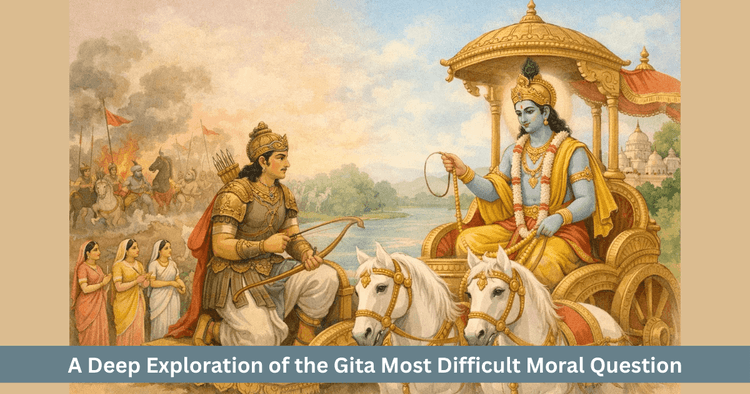
Table of Contents
Krishna is remembered as the embodiment of harmony, compassion and inner balance. Images of Vrindavan, the soft sound of his flute and his playful love with the gopis shape the collective idea of peace in Indian thought. Krishna appears as the one who simplifies complexity, who turns fear into faith and despair into courage.
This is why the scene of Kurukshetra feels so unsettling. The same Krishna stands as Arjuna's charioteer, urging him not to withdraw but to fight. On one side stands non violence, empathy and tenderness. On the other stands bloodshed, destruction and grief. At first glance it feels like a contradiction.
Yet the Mahabharata war was not a sudden outburst of anger. It was the result of long standing injustice, systemic abuse of power, humiliation of the righteous and repeated rejection of peaceful solutions. Krishna personally went as a peace messenger. He offered compromises so minimal that only stubborn ego could refuse them. When even the offer of five small villages was rejected with contempt, war became not a choice but a consequence.
Non Violence: The Most Misunderstood Ideal
Non violence is often reduced to the simple idea of avoiding physical harm. As long as no one picks up a weapon, people think they are non violent. This view is incomplete. In the Indian spiritual framework, ahimsa includes responsibility. It asks not only "do I hurt" but also "do I allow hurt to continue."
A society that watches oppression silently is not peaceful. It is paralyzed. A person who hides behind the word "peace" to avoid discomfort is not compassionate. He is afraid of the cost of truth.
Krishna's teaching reveals a hard edge:
refusing to act when dharma demands action can itself become a subtle form of violence.
Some key clarifications:
- Silence in front of injustice strengthens the oppressor
- Avoidance of conflict can enable greater harm later
- Abandoning one's duty wounds one's own integrity
Krishna does not glorify war. He accepts war as the last remaining path when every other door has been deliberately closed by adharma.
Arjuna’s Crisis Was Attachment, Not Cowardice
Arjuna was no stranger to war. He had fought countless battles before Kurukshetra. His hands did not tremble at the sight of weapons. His heart trembled at the sight of those who stood across from him - his grandsire Bhishma, his teacher Drona, his relatives and elders.
His compassion merged with attachment. He mistook his emotional pain for moral superiority. He told Krishna that it would be better to live by begging than to kill his own. He thought withdrawal was righteous. Krishna shows him that this emotion was not pure compassion, it was attachment mixed with confusion.
Krishna reminds Arjuna that dharma is not built on personal comfort. It is built on responsibility.
Better to fall while fulfilling one's own duty than survive by ignoring it.
Kurukshetra as a Symbol, Not Just a Field
Kurukshetra was a real battlefield. Yet the Gita makes it much more - a map of the inner human conflict.
- The Kauravas represent ego, greed, insecurity and the refusal to change
- Arjuna represents the moment of honest doubt, where heart and duty seem opposed
- Krishna represents inner wisdom, the voice of clarity that sees beyond fear
Every person stands on their own Kurukshetra when faced with decisions that demand sacrifice of comfort for the sake of truth. In such moments, doing nothing is rarely neutral.
The Illusion of Innocence Through Inaction
Many believe that by stepping away from conflict they remain pure. Krishna dismantles this illusion. He tells Arjuna that no one can truly remain inactive even for a moment. Thoughts, choices and silence are all forms of action.
If one sees injustice and chooses silence, that silence is not empty. It becomes support for the wrong side. If someone knows the truth yet refuses to stand by it, they share part of the responsibility for the harm that follows.
Krishna's message is clear.
avoiding action is not automatically moral. Sometimes it is a more dangerous form of participation.
Karma Yoga: Action Without Poison
At the heart of Krishna's guidance stands the doctrine of Karma Yoga. He does not simply say "fight." He explains how to act without poisoning oneself.
Act fully.
Do your duty.
Drop the obsession with outcome.
War in the Gita is not demanded as a celebration of power. It is accepted as dharma only when:
- it is fought to defend justice, not to expand ego
- it is free from hatred, revenge and cruelty for pleasure
- it is entered after sincere attempts at peace have been rejected
When action is taken in this spirit, it becomes Karma Yoga - a path of inner purification rather than just external victory.
Layers of Arjuna’s Doubt and Krishna’s Answers
Arjuna raises deep questions:
- If everything is governed by destiny, why should he act
- If the soul is immortal, why grieve or struggle
- If loved ones stand on the opposite side, is withdrawal more noble
Krishna answers step by step:
- By teaching that the soul is immortal, he removes the fear of death
- By explaining swadharma, he anchors Arjuna in his unique duty
- By revealing Karma Yoga, he frees him from the chain of expectation
- By opening the path of bhakti, he replaces ego with surrender
Through these layers, the Gita turns a confused warrior into a conscious instrument of dharma.
The Gita Does Not Glorify War
A shallow reading may suggest that the Gita justifies violence. A careful reading reveals something else. The Gita uses a war setting to address the timeless struggle between clarity and confusion, courage and escape, duty and attachment.
The core teaching is:
- Peace built on suppressed injustice is unstable
- Compassion that abandons victims is incomplete
- True spirituality does not hide from difficult responsibilities
Krishna sends Arjuna into battle only after cleaning his heart of revenge, pride and personal agenda. What remains is a warrior who acts because it is right, not because it is pleasant.
Krishna’s Message for the Modern World
Today battles rarely involve swords and chariots. They appear as ethical dilemmas at work, corruption in institutions, injustice in society and dishonesty in relationships. Yet the inner question is the same.
- Do we stay silent to keep our comfort intact
- Do we ignore wrong because the wrongdoer is "our own"
- Do we misuse the idea of peace to escape difficult conversations
Krishna's guidance remains relevant. Choosing comfort over conscience weakens character. Choosing truth, even quietly and steadily, strengthens both the individual and the world around them.
Frequently Asked Questions
1. Did Krishna really support violence?
No. He supported necessary, disciplined action when all peaceful means had failed and injustice had crossed its limits.
2. Is non violence opposed to all forms of conflict?
No. True non violence refuses cruelty yet does not permit injustice to grow unchecked in the name of comfort.
3. Was Arjuna morally right to fight in the war?
Yes, within the framework of dharma. His role as a warrior was to protect justice once every other path was rejected.
4. Is the Bhagavad Gita still relevant in modern life?
Yes. Whenever a person faces a conflict between comfort and conscience, the Gita offers language, clarity and inner strength.
5. What is Krishna’s central teaching in this context?
To act with courage and clarity, to perform one’s duty without ego or hatred and to leave the final result in higher hands while remaining true to dharma.
Get your accurate Kundali
Generate KundaliDid you like it?
Author

Pt. Nilesh Sharma (63)
Experience: 20
Consults About: Family Planning, Career
Clients In: Punjab, Haryana, Delhi
Share this article with friends and family
About ZODIAQ
ZODIAQ is an online Vedic Astrology platform. It connects clients seeking astrological advice to experienced astrologers with deep knowledge. Our users also generate kundali and perform kundali milan for free. ZODIAQ also offers services to the Astrologers. Astrologers utilize various offerings by ZODIAQ to serve their clients effectively.
If you are a User
Consult with experienced astrologers and seek their guidance. You can also order handwritten Janm Patrika report with life prediction prepared by experienced astrologers. Generate accurate Kundali, perform Kundali Matching and check horoscope and muhurat. Utilize our online library for all the necessary astrological and spiritual information.
If you are an Astrologer
Create accurate kundali for your clients and perform Kundali Matching for up to 5 people at a time. Write comprehensive Janm Patrika report for your clients with ZODIAQ. Check client details anytime by saving it in client directory. Become more productive by tracking how many clients you guide every day.
WELCOME TO
ZODIAQ
Right Decisions at the right time with ZODIAQ
