Why Lakshmi Never Stays In One Place For Too Long
By Aparna Patni
Chanchala Lakshmi reminds us that wealth is never permanent and stays only where dharma purity and generosity are alive
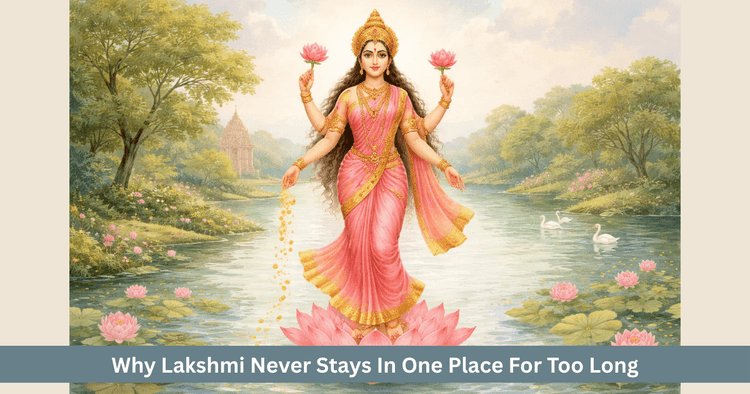
Table of Contents
In Hindu philosophy Lakshmi personifies wealth, prosperity and auspiciousness, yet she is called Chanchala the restless one who does not stay in a single place for long. This image teaches that fortune is never permanently owned by anyone. Money, position and success are tied to conditions and conduct and when those change, fortune also shifts.
Lakshmi’s association with Vishnu shows how this works. Vishnu embodies preservation, balance and order, while Lakshmi expresses movement, growth and manifestation. When wealth supports the qualities of Vishnu protection, justice, stability it tends to bring peace. When it serves only vanity, exploitation or excess, it becomes unstable and her presence feels less like blessing and more like pressure.
Wealth as flow, not frozen possession
Scriptures repeatedly compare wealth to water. Water kept flowing irrigates fields and sustains life, while water locked and stagnant begins to rot. In the same way, hoarded wealth often breeds fear and hardness, whereas wealth that is wisely circulated through fair dealings, family support and charity becomes life giving. Seeing Lakshmi as Chanchala reminds a person to guide money like a stream rather than clutch it like a stone.
Her restlessness also warns against confusing oneself with one’s fortune. A person may be rich today and poor tomorrow or the opposite. Character, courage and kindness are more reliable measures of real richness. Lakshmi, in this sense, is less attached to individual ego and more to how wealth is being used.
The kind of life in which Lakshmi lingers
Traditional teachings describe qualities and environments that invite Lakshmi to “stay longer”
- Honesty in earning and dealing, avoiding obvious exploitation.
- Self control in spending, habits and emotional reactions.
- Generosity in sharing money, time, skills and attention.
- Cleanliness and order in the home, with calm and respectful speech.
- Respect and care for women, elders, children and those who depend on you.
Where these qualities are strong, prosperity shows up not just as money but as peace of mind, mutual support, good reputation and a sense of inner sufficiency. Where lying, greed, cruelty and constant conflict dominate, fortune may appear for a while but rarely feels stable or satisfying.
Alakshmi and the shadow of fortune
Alakshmi is the name given to the shadow side of wealth misfortune, barrenness, constant quarrel and inner dryness. She is said to dwell where
- Harsh, insulting speech is common.
- Jealousy, gossip and blame dominate conversations.
- Cheating, addiction, laziness and abuse are normalized.
- Dirt, clutter and neglect are allowed to accumulate.
This symbolism clarifies that having money is not the same as having Lakshmi. When the atmosphere is dominated by these patterns, money tends to slip away through crises, waste and hidden costs and even when it stays, it does not bring joy.
Tulsi, purity and the energy of a home
Tulsi is honored as a sacred plant closely linked with purity and devotion. Caring for Tulsi, lighting a lamp and spending a few quiet moments near it each day is a way of tuning the subtle atmosphere of a home. Such practices steady the mind and soften the heart, creating a space where Lakshmi’s presence feels natural.
By contrast, constant disrespect for nature, careless destruction of plants and cruelty toward animals generate a hard, restless field that is inhospitable to subtle grace. The link between Tulsi and Lakshmi points to a larger truth honoring life itself is part of honoring prosperity.
What her restlessness asks from us
Lakshmi’s Chanchala nature offers clear guidance
- Accept that outer circumstances can and will change.
- Rely less on hoarding and more on healthy circulation of money.
- See yourself not as an absolute owner but as a temporary trustee of resources.
- Align earning and spending with values you would not be ashamed to explain to a child.
In doing so, a person shifts from chasing fortune to cooperating with it, turning temporary wealth into an opportunity for lasting growth.
Frequently asked questions
1. Does Lakshmi literally move from one house to another
The idea is symbolic. It expresses how certain ways of living naturally attract stability and support, while others invite loss and confusion. Saying “Lakshmi left” is a poetic way of saying that unhealthy patterns are weakening the base of prosperity.
2. If someone is poor, does it always mean Lakshmi has rejected them
Not always. Poverty can arise from unfair systems, disaster, illness or lack of opportunities. Lakshmi’s grace is also seen in inner strength, love, health and resilience, not only in financial comfort.
3. What can a family do if there is both financial struggle and constant tension at home
A helpful first step is to reduce shouting, sarcasm and insults and to bring more basic respect into daily speech. Alongside this, making an honest budget, cutting unnecessary spending and slowly clearing debts sends a clear inner and outer signal of responsibility.
4. Is ritual worship of Lakshmi enough to secure her blessings
Rituals have real value because they purify and focus the mind but without matching honesty and kindness in action, their effect remains limited. Lighting lamps and chanting mantras are strongest when daily choices also reflect fairness and compassion.
5. Does giving charity guarantee that wealth will increase
Charity is not a business contract. Its main purpose is to loosen fear and selfishness around money and to align it with a wider good. Sometimes material returns come, sometimes not but in both cases the giver becomes inwardly richer and freer.
6. How is respect for women connected to Lakshmi
Women are often honored as the Lakshmi of the home, carriers of emotional, cultural and practical wealth. When women are demeaned, unsafe or silenced, the very energy that sustains families and communities is damaged. Real devotion to Lakshmi shows in how women are treated every day.
7. Do these principles really matter in modern business and investing
Yes. Transparency, fair pay, responsible use of resources and contribution to society are contemporary expressions of Lakshmi’s values. Organizations that ignore these for short term gain tend to face crises later, reflecting the same truth fortune is Chanchala and responds to how it is used.
Get your accurate Kundali
Generate KundaliDid you like it?
Author

Aparna Patni (63)
Experience: 20
Consults About: Family Planning, Career
Clients In: Punjab, Haryana, Delhi
Share this article with friends and family
About ZODIAQ
ZODIAQ is an online Vedic Astrology platform. It connects clients seeking astrological advice to experienced astrologers with deep knowledge. Our users also generate kundali and perform kundali milan for free. ZODIAQ also offers services to the Astrologers. Astrologers utilize various offerings by ZODIAQ to serve their clients effectively.
If you are a User
Consult with experienced astrologers and seek their guidance. You can also order handwritten Janm Patrika report with life prediction prepared by experienced astrologers. Generate accurate Kundali, perform Kundali Matching and check horoscope and muhurat. Utilize our online library for all the necessary astrological and spiritual information.
If you are an Astrologer
Create accurate kundali for your clients and perform Kundali Matching for up to 5 people at a time. Write comprehensive Janm Patrika report for your clients with ZODIAQ. Check client details anytime by saving it in client directory. Become more productive by tracking how many clients you guide every day.
WELCOME TO
ZODIAQ
Right Decisions at the right time with ZODIAQ
