Why Vishnu Became Rama Before Krishna
By Pt. Abhishek Sharma
How the Gods Planned the Order of Rama and Krishna
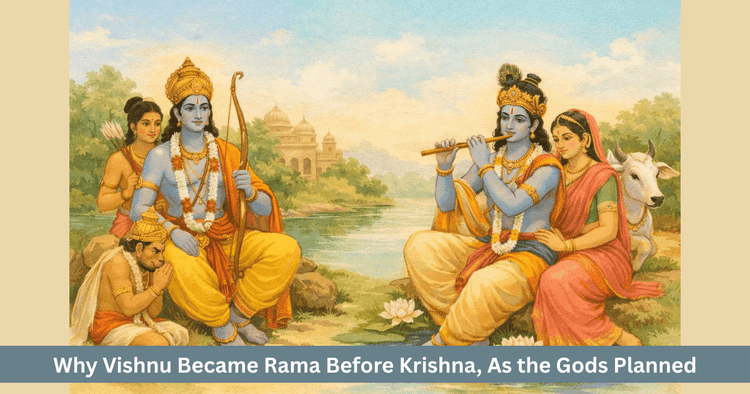
Table of Contents
The verse from the Gita,
“For the protection of the good, the destruction of the wicked
and for the establishment of Dharma, I manifest Myself, age after age,”
is more than a poetic promise. It is a blueprint. In every age, when the world drifts away from balance, Vishnu descends as an avatar. Yet one question carries a special depth. When both Rama and Krishna are Vishnu, why did Rama come first and Krishna later. Was it random or part of a deliberate design crafted by the gods.
Rama and Krishna are two expressions of the same divine source but they speak to different stages of human growth. Rama comes when humanity needs structure. Krishna comes when humanity needs insight. In simple words, Rama teaches how to live rightly. Krishna later reveals why to live at all.
The Divine Question: Order First or Understanding First
Ancient wisdom describes that before the ages fully unfolded, the gods reflected on a single dilemma. They knew Vishnu would descend whenever Dharma weakened. This time the question was subtler. Should humanity first be given strong outer order or should it be given deep inner understanding.
If pure philosophy came before discipline, people might twist it into an excuse to avoid responsibility. If only rules came without inner meaning, society could become rigid and fearful. The solution the gods chose was sequential. First an avatar who would live Dharma perfectly. Then an avatar who would interpret and transcend it.
Rama and Krishna thus are not just two characters in different epics. They are two stages of the same inner curriculum.
Treta Yuga: When the World Needed an Ideal Human
In Treta Yuga, people still respected elders, vows, relationships and rituals. Kings cared about their image as protectors, families tried to live by values and Dharma was honoured. Yet selfishness had begun to seep in. Temptation grew stronger and holding on to righteousness felt harder.
In that era, the world did not need a philosopher standing on a battlefield. It needed a human example walking through forests, palaces and pain with unshaken integrity. That example was Rama.
He:
- Gave up his throne to honour his father’s word
- Risked his life and army to protect his wife and truth
- Placed his people’s expectations above his personal comfort
Rama’s life is about commitment to roles - as son, husband, brother, king. For someone in their twenties or thirties today, trying to balance career, marriage and family, Rama shows what it looks like to stand firm even when every choice costs something. He embodies the strength to do the right thing even when no one claps for it.
Dvapara Yuga: When Questions Grew Louder Than Rules
By the time Krishna appeared, the world had changed. Politics had woven itself into every decision. Alliances were complex, motives mixed and morality often conveniently interpreted. Dharma was still spoken about but frequently used as a tool to justify personal gain.
In such a world, simply saying “follow the rules” was no longer enough. People were asking deeper questions, whether they voiced them or not. “What is my duty when everyone is compromised. Is obedience always right. What happens when my heart and my role pull in different directions.”
Krishna steps into this climate. He is playful and profound, a cowherd and a statesman, a charioteer and a teacher. On the battlefield of Kurukshetra, he meets not just a warrior but a human being in collapse. Arjuna is not afraid of arrows. He is terrified of the emotional price of doing his duty.
Krishna does not push him into silence. He allows the questions to come out, one by one and then answers them with a clarity that still speaks to minds today - minds torn between ambition and peace, between pleasing others and being true to oneself.
Rama Before Krishna: The Inner Logic
Look at your own life. As a child, someone first taught you to follow a routine - get up on time, go to school, do your homework. Only later did you understand why education matters and how it shapes your freedom. Imagine if someone started with “Nothing is permanent, detach from results” when you were five. It would not liberate you. It would confuse you.
In the same way, Rama represents the building of strong outer and inner habits - responsibility, reliability, sacrifice, commitment. Only after such a foundation can Krishna safely introduce ideas like detachment, surrender and witnessing.
Without Rama’s grounding, Krishna’s wisdom could easily be misused as an excuse. “Results do not matter” can become “Effort does not matter.” “Detach from relationships” can become “Do not invest in anyone.” The gods placed Rama first so that humanity would learn to stand before learning to let go.
From Bow to Flute: Two Languages of the Divine
Rama’s symbol is the bow. Krishna’s is the flute. Both belong to Vishnu, yet they address different needs.
The bow:
- Demands discipline
- Focuses on a clear target
- Protects through strength and boundaries
It fits an age where outer justice must be restored and lines must be drawn. When a Ravan rises in any form - oppression at work, abuse in family, corruption in systems - a bit of Rama’s bow is needed in us to say, “This is not acceptable.”
The flute:
- Compels no one
- Attracts instead of forcing
- Changes hearts through melody, not fear
It fits an age where people are tired of rules shouted at them and slowly open only to love, understanding and inner resonance. In relationships, friendships and even leadership today, the flute’s language works where the bow’s command often fails.
The gods chose to give the world the bow first and the flute later, so that structure would be in place before softness entered. Too much bow becomes harshness. Too much flute without bow becomes chaos. Together they form a complete music.
Outer Order First, Inner Clarity Next
Rama’s mission was largely in the visible world. He fought an external enemy, re-established rightful rule and returned stability to kingdoms and homes. He shows us how to build a life that is dependable - good work, strong relationships, trustable character.
Krishna’s mission reaches into the invisible. He sits with Arjuna’s trembling mind, with his guilt, confusion, emotional fatigue and fear of judgement. He does not just say “Do your duty.” He explains the layers underneath duty - intention, attachment, identity and the nature of the soul.
In your twenties and thirties, you might feel exactly this split:
- Outside, you are expected to perform, marry, earn, support, decide
- Inside, you may feel unsure, drained or quietly questioning what all this is for
Rama helps you honour your roles. Krishna helps you not lose yourself within them.
What If Krishna Had Come First
Imagine a world that heard Krishna before ever seeing Rama. People might hear “Everything is divine play” and decide nothing matters. They might use “Non attachment” to justify emotional distance or irresponsibility. They might mistake “Go beyond Dharma” as “Break rules for convenience.”
The gods knew this risk. So they allowed humanity to first witness a life where:
- A prince gives up the throne but not his integrity
- A husband fights a war but does not treat his wife as possession
- A king balances love for his people with harsh, painful decisions
Once that image of unwavering character was embedded in collective memory, Krishna’s teachings could arrive as an expansion, not a shortcut.
How This Order Speaks to Our Age
For someone between 20 and 40, juggling career, relationships and self-doubt, Rama and Krishna together form a map.
Rama:
- Teaches you to show up on time, keep your word, respect your work, honour your partner, care for your family
- Reminds you that building anything meaningful - whether a startup, a marriage or a habit - needs patience and sacrifice
Krishna:
- Teaches you to not collapse when things do not go as planned
- Reminds you that your job title, relationship status or salary are not your entire identity
- Helps you draw boundaries where “duty” is used to manipulate you
Without Rama, you risk drifting without reliability. Without Krishna, you risk burning out while doing everything “right” but feeling empty inside.
Frequently Asked Questions
1. Are Rama and Krishna teaching different truths or the same truth in different ways?
They guide toward the same core - Dharma and spiritual realization. Rama does it through perfect conduct and responsibility. Krishna does it through deep understanding and inner freedom.
2. For today’s busy life, whose example is more useful - Rama or Krishna?
Both. Rama for building a stable, trustworthy outer life. Krishna for cultivating a peaceful, clear inner life in the middle of all duties.
3. Can someone truly follow Krishna’s Gita without first living like Rama to some extent?
Partially yes but with a risk of misuse. Without a sense of duty and discipline, ideas like detachment can quietly turn into escape.
4. Does Rama only represent strict rules and Krishna only freedom?
No. Rama’s heart is deeply compassionate and Krishna honours boundaries and Dharma too. Their primary emphasis differs but both hold balance within.
5. What personal lesson does this divine order offer someone in their 20s or 30s?
First, build a life you can respect - in work and relationships. Then, learn to rest in an inner space that is not shaken by success or failure. Let Rama steady your steps and Krishna soften your heart.
Get your accurate Kundali
Generate KundaliDid you like it?
Author

Pt. Abhishek Sharma (63)
Experience: 20
Consults About: Family Planning, Career
Clients In: Punjab, Haryana, Delhi
Share this article with friends and family
About ZODIAQ
ZODIAQ is an online Vedic Astrology platform. It connects clients seeking astrological advice to experienced astrologers with deep knowledge. Our users also generate kundali and perform kundali milan for free. ZODIAQ also offers services to the Astrologers. Astrologers utilize various offerings by ZODIAQ to serve their clients effectively.
If you are a User
Consult with experienced astrologers and seek their guidance. You can also order handwritten Janm Patrika report with life prediction prepared by experienced astrologers. Generate accurate Kundali, perform Kundali Matching and check horoscope and muhurat. Utilize our online library for all the necessary astrological and spiritual information.
If you are an Astrologer
Create accurate kundali for your clients and perform Kundali Matching for up to 5 people at a time. Write comprehensive Janm Patrika report for your clients with ZODIAQ. Check client details anytime by saving it in client directory. Become more productive by tracking how many clients you guide every day.
WELCOME TO
ZODIAQ
Right Decisions at the right time with ZODIAQ
