Why Vishnu Sleeps on a Snake While Creating Entire Universes
By Pt. Amitabh Sharma
The Mystery of Vishnu and Sheshnag
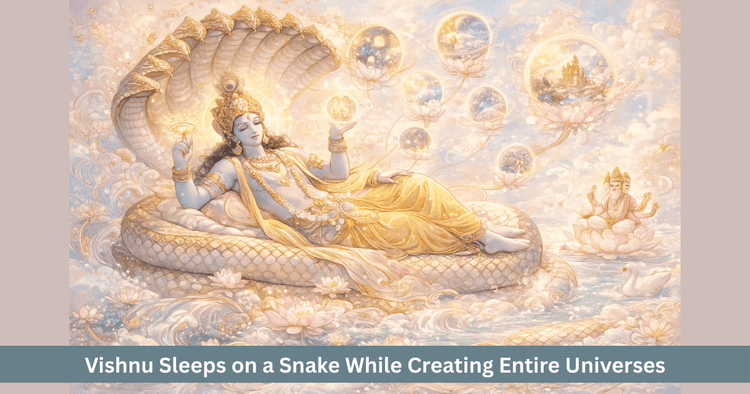
Table of Contents
At the heart of creation lies a scene so visually paradoxical and conceptually startling that it appears to violate every law of logic and physics. The supreme preserver of the universe reclines in deep sleep, floating passively on a cosmic ocean, while simultaneously creating and sustaining infinite universes through the simple act of breathing. He does not build, does not labor, does not exert effort. He merely rests. And from that rest emerges everything that exists. This image of Vishnu reclining on Sheshnag, the infinite serpent, in the cosmic ocean has captivated Hindu imagination for millennia. It appears in temples, in sacred art, in philosophical texts and in the meditation of countless seekers. Yet its power lies not in its visual beauty but in the profound truth it encodes about the nature of creation, the meaning of rest and the paradox of infinite power expressing itself through perfect stillness.
Understanding why Vishnu sleeps on a snake is to encounter one of spirituality's deepest mysteries. How does the universe create itself from nothing? How does infinite potential manifest into infinite diversity? And how is this cosmic process fundamentally an act of consciousness, not force? When we comprehend this symbolism, we understand not only the core principles of Hindu philosophy but also the nature of our own existence.
The Primordial Cosmos and the Depths of the Cosmic Ocean
The Ocean of Unmanifest Potential
Before the beginning of time, before Brahma created the first beings, before Shiva's cosmic dance, only one reality existed. This reality was the Parabrahma Samudra, the cosmic ocean of consciousness. This was not ordinary water as we know it but the infinite expanse of consciousness itself. This ocean possessed all the qualities that define ultimate reality.
The expanse of this ocean was infinite. There was no shore, no boundary, no edge. Extending limitlessly in all directions, this ocean existed not in any physical space because space itself had not yet manifested. It was undifferentiated. There was no division between subject and object. The observer and the observed had not separated. Everything was merged in uniform consciousness. Yet this ocean was pregnant with possibilities. It contained within itself all the possibilities that would ever manifest. Every being, every star, every thought, every experience that would ever come into existence existed in seed form within this ocean.
This ocean was dark and silent. There was no light because there was no object to reflect light. There was no sound because there were no ears to hear sound. There was no movement because movement requires space and time and they had not yet manifested. There was no change because change requires time. Yet this ocean was complete and whole. It needed nothing. It lacked nothing. It was eternally sufficient unto itself.
This ocean represents the fundamental reality from which all existence emerges. Hindu philosophy calls this Brahman. This is different from the god Brahma, who is himself a created being. Brahman is the unmanifest ground upon which all creation rests. It is neither male nor female, neither animate nor inanimate, neither being nor non-being. It exists beyond all dualities found in the manifest world.
The Sacred Rest of Vishnu and the Mystery of Yoga Nidra
Into this cosmic ocean, Vishnu enters a special state called Yoga Nidra. This is fundamentally different from ordinary sleep. Ordinary sleep is marked by unconsciousness and dreams. In Yoga Nidra, consciousness is not only preserved but heightened while the body and mind remain in a state of perfect rest. This is simultaneously the state of deepest rest and supreme awareness. It is paradoxical by nature and understanding it is central to spiritual practice.
In Yoga Nidra, consciousness is preserved. Vishnu is not unconscious but in a state of complete awareness without mental activity. In our ordinary waking state, the mind is constantly filled with thoughts. One thought gives birth to another and the mental chatter never stops. In Yoga Nidra, this mental activity becomes completely quiet, yet consciousness remains. Vishnu knows everything yet thinks nothing.
This state contains infinite receptivity. Vishnu's consciousness remains open to all possibilities simultaneously. There is no prejudice, no preference, no rejection. All possible universes, all possible beings, all possible experiences are equally present in his consciousness. This is like a calm lake that perfectly reflects every star in the sky because there are no ripples on its surface.
Yoga Nidra contains supreme peace. There is no tension, no striving, no resistance. Only infinite calm. This peace is not passivity but a state of perfect balance. Like a stone placed at the peak of a mountain that is neither rising nor falling but simply resting in perfect equilibrium, Vishnu's consciousness exists in perfect balance. This peace comes not from motionlessness but from the perfect balance of all opposing forces.
This rest is filled with creative readiness. Although Vishnu appears to rest, he exists in the state of maximum creative potential. This is like a bow that has been drawn back and stopped just before release. It appears still but is filled with immense power and ready to release an arrow at any moment. Vishnu's rest is like this. Outwardly calm but inwardly filled with infinite creative power.
This sleep is paradoxical because it is simultaneously the deepest rest and the highest awareness. Muscles are relaxed, mental chatter has ceased, yet consciousness is fully awake. This is the state from which everything emerges. From this paradoxical sleep, all existence arises.
The Cosmic Significance and Symbolic Depth of Sheshnag
The Nature and Divine Attributes of the Infinite Serpent
When we see Vishnu resting on Sheshnag, the first question arises about who this serpent is. This is not an ordinary giant snake but a being of cosmic significance. Sheshnag, also called Ananta or Adishesha, literally means the endless one. This name itself reveals his nature.
Sheshnag has a thousand hoods. Each hood represents an aspect of infinity. Each hood displays a dimension of cosmic consciousness. When we see a thousand hoods, we see the multidimensional nature of infinity. Infinity is not merely an expansion in one direction but an expansion in countless directions, countless dimensions, countless forms. Each hood is a possibility, a universe, a timeline.
Sheshnag is eternally coiled. His body forms spiraling coils and these coils are the foundation upon which the cosmos rests. According to Hindu cosmology, the earth rests on the head of Sheshnag. When Sheshnag moves his head, earthquakes occur. This symbolism shows that the entire physical world rests upon a deeper spiritual truth and that truth is the infinite cycle of time and consciousness.
Sheshnag is eternal in nature. He existed before creation, exists during creation and will continue to exist after dissolution. When the universe dissolves, Sheshnag remains because he is the symbol of time and time exists beyond both creation and dissolution. Time is the name of the cycle that eternally rotates whether a universe exists or not.
Sheshnag is not merely an object but a conscious being. He is described as supremely intelligent and devoted. He is aware of Vishnu's presence and honors the privilege of serving as his bed. Some texts describe him as an extension of Vishnu himself. This shows that consciousness and time are not separate but that consciousness manifests itself as time.
The Layers of Serpent Symbolism and Their Spiritual Message
Why does Vishnu rest specifically upon a serpent? Why not on a mountain, throne or simply floating? The answer to this question lies in the profound layers of symbolism that show the relationship between the serpent's nature and cosmic principles.
| Serpent Quality | Cosmic Principle | Spiritual Teaching |
|---|---|---|
| Infinite length with no beginning or end | Eternity and timelessness | Reality transcends temporal boundaries |
| Coiled form | The spiral of creation | Cycles within cycles and the fractal nature of reality |
| Shedding of skin | Renewal and transformation | Death and rebirth continuously occurring |
| Hood protection | Sheltering the sacred | The divine is both accessible and protected |
| Silent and still | Silence as the ground of being | Creation emerges from profound quiet |
| Thousand heads | Infinite multiplicity | Infinite forms arising from one essence |
The infinite extension of the serpent symbolizes eternity. A serpent has no beginning from which you can say it started and no end where it terminates. This is the precise representation of the nature of time. Time has no beginning and no end. We think about the beginning and end of time from our limited human perspective but from a cosmic viewpoint, time is without beginning and without end.
The coiled form of the serpent displays the spiral cycle of creation. The serpent does not move in a straight line but in undulating motion. This reflects the nature of cyclical time. Time does not progress in a straight line but rotates in cycles. Ages come and go. Satya Yuga, Treta Yuga, Dvapara Yuga, Kali Yuga and then Satya Yuga again. This cycle continues for eternity. Each coil represents an age and the infinite coils suggest that cycles repeat for eternity across cosmic history.
The serpent sheds its skin. At regular intervals, the serpent discards its old skin and emerges with new skin. This is a powerful symbol of renewal and transformation. Death and rebirth continuously occur. Shedding the old skin is death and emerging with new skin is rebirth. Everything in the universe is rotating in this cycle. Beings are born, live, die and are reborn. This process is eternal.
The serpent's hoods are protective. When Sheshnag protects Vishnu, he spreads his hoods above Vishnu, forming a canopy. This shows that the divine is both accessible and protected. Vishnu is in the open ocean, so he is accessible but Sheshnag's hoods cover him, so he is also protected. This duality reflects the nature of spiritual truth. It is accessible to all who seek it but it is also protected from those who do not understand it or would misuse it.
The serpent is silent and still. The serpent makes no noise. It moves silently. This symbolizes the silence that is the foundation of existence. All sounds, all music, all words emerge from silence and return to silence. Silence is the original state. Sound is secondary. The silent presence of Sheshnag reminds us that creation emerges from profound peace, not from noise and turmoil.
The Profound Relationship Between Sheshnag and Time
The most profound association of Sheshnag is with time itself. In Hindu cosmology, time is not a linear progression but a serpentine cycle. And the embodiment of this cycle is Sheshnag. Each coil represents an age. Satya, Treta, Dvapara and Kali. Four yugas together form one Mahayuga. And this cycle continues for eternity.
The coils of Sheshnag show that time is not linear. Modern Western thought views time as a straight line moving from past through present to future. But Hindu philosophy considers time to be cyclical. What has happened will happen again. Ages are repeated. Events occur in patterns. This cyclical vision is perfectly manifested in the spiral coils of Sheshnag.
The stillness of Sheshnag demonstrates that time itself is founded upon something beyond time. Time flows, changes and rotates in cycles, yet eternal consciousness rests upon time. Vishnu rests on Sheshnag, who symbolizes time. This means that consciousness is not governed by time but underlies time. Consciousness does not flow in the stream of time but time itself flows within consciousness.
This teaching is extremely important. In our daily lives, we feel subject to time. We feel that time controls us, pushes us, ages us, limits our lives. But the image of Vishnu on Sheshnag teaches that consciousness is beyond time. Our true nature, which is pure consciousness, is not limited by time. We are not in time but time is in us.
The Mechanics of Cosmic Breath and the Dance of Creation
The Origin of Universes Through Divine Respiration
The most extraordinary aspect of Vishnu's sleep is what occurs during it. With each breath, universes emerge and return. This is not merely poetic language but a precise spiritual teaching about how creation functions.
When Vishnu inhales, universes contract. Whatever was manifest returns to unmanifest potential. Stars and planets dissolve. All beings return to their source. All differentiation merges back into unity. All forms return to formlessness. Time itself reverses, returning to the eternal now. This is called Pralaya, the dissolution of all existence. It is not violent or destructive in a negative sense but a return to wholeness, a gathering back into unity.
When Vishnu exhales, the reverse occurs. New universes emerge. Potential takes form. Infinite possibilities crystallize into specific realities. Energy organizes into matter. Matter differentiates into countless forms. Time moves forward, creating the arrow of causality and history. This is called Srishti, creation, the manifestation of infinite potential.
This respiration does not occur only once but continues eternally. Breath in, universes dissolve. Breath out, new universes manifest. This rhythm never stops. This is the eternal dance of creation and dissolution that has been ongoing for eternity and will continue for eternity. The fundamental nature of the universe is revealed in this rhythm. Existence is not static but dynamic. It is eternally oscillating between manifest and unmanifest.
The Rhythm of Creation and Dissolution
The respiration of Vishnu establishes a cosmic rhythm with profound implications. This rhythm is not merely a poetic metaphor but is embedded in the structure of reality. Within the breath are yugas. One breath of Vishnu encompasses an entire Mahakalpa, which itself consists of multiple yugas.
One Vishnu Yuga equals four billion three hundred twenty million human years. This duration is beyond human comprehension. Our entire human civilization is only a few thousand years old. According to science, Earth is approximately four and a half billion years old. One Vishnu Yuga is approximately as long as Earth's entire age. And this is only one yuga. One complete respiration cycle of Vishnu is made up of countless such yugas stacked upon each other. Eternity itself breathes through these cycles.
The dance of manifestation and unmanifest occurs at every level in the universe. It is not only on the vast cosmic scale but at every level. Within a microscopic atom, electrons come into existence and disappear. Within a cell, molecules form and break down. In human life, thoughts arise and disappear. Civilizations rise and fall. Stars are born and die. The universe itself goes through cycles of expansion and contraction. All of this is an extension of Vishnu's respiration.
The simultaneity of all states is another profound teaching. From a transcendent perspective, all states exist simultaneously. Some universes are in the exhalation phase, meaning the creation phase. Some are in the midst of manifestation. Some are approaching the inhalation phase, meaning the dissolution phase. All exist eternally from the perspective of Vishnu's consciousness. Past, present and future are together. Your past, your present and your future all exist eternally in Vishnu's consciousness.
The Nature of Breathing Consciousness and Its Implications
This cosmic respiration teaching reveals something extraordinary about the nature of consciousness itself. Consciousness is fundamentally active. Even in sleep, Vishnu's consciousness is perpetually creating. Sleep does not mean inactivity but rest without cessation of function. This challenges our ordinary understanding. We think rest means doing nothing. But Vishnu's sleep shows that even in the deepest rest, supreme creativity can exist.
Creation is natural expression. The universe does not emerge as a forced creation but as the natural expression of conscious breathing. It is as natural and effortless as a sleeping person's respiration. When you sleep, you do not consciously breathe. Respiration happens automatically. You do not have to think about it. It is the natural expression of your body. Similarly, for Vishnu, the creation of the universe is the natural expression of his consciousness. It requires no effort or struggle.
Infinite simultaneous awareness is another remarkable feature. Vishnu is aware of all universes, all beings, all time simultaneously. This is not watching from outside but pervading all creation, being present in every atom. Vishnu is in your heartbeat. Vishnu is in the distant galaxy's rotating star. Vishnu is in the ant sitting on a leaf. Being present everywhere simultaneously is the nature of supreme consciousness.
The paradox of effort and effortlessness is perhaps the most important teaching. The entire cosmos with its unimaginable complexity emerges without any effort. Breath flows without deliberate control. This suggests that ultimate power requires no strain, that true creation flows from profound ease. In our lives, we think that to do great things we must work hard, struggle, push ourselves. But Vishnu's example shows that the greatest creation happens with complete ease.
The Dreaming Universe and the Expansion of Consciousness
The Nature of the Divine Dream
Perhaps the most beautiful aspect of this creation mythology is the realization that Vishnu is not merely resting but dreaming. And the universe, with all its beings, histories, struggles and glories, is the content of this divine dream.
What does this mean? It means that everything that exists, stars, planets, people, plants, minerals, are all part of Vishnu's dream. Our individual consciousness in this framework is a localized expression of Vishnu's dreaming consciousness. The universe has the nature of a dream. It appears real while being dreamed, has internal logic and consistency while ultimately being consciousness-dependent. Just as our dreams have internal logic and feel completely real while we are dreaming them, the universe has consistent laws and feels absolutely real while being the content of divine consciousness.
When you dream at night, everything in the dream seems real. You go places, meet people, experience emotions. You laugh, cry, fear, rejoice in the dream. Yet when you wake up, you realize it was all content of your consciousness. Those places did not actually exist. Those people were not actually there. It was all your consciousness manifesting in various forms. Similarly, Hindu philosophy suggests that the entire universe is Vishnu's dream and we are all characters in that dream.
The Implications of Cosmic Dreaming and Their Profound Meaning
This understanding fundamentally alters how we perceive reality. Reality is consciousness-dependent. Just as a dream cannot exist without a dreamer and ceases to exist when the dreamer wakes, the universe cannot exist without Vishnu's dreaming consciousness and would cease to exist if Vishnu woke. This is a revolutionary idea. We think the physical world is independent and objective. We think it is separate from consciousness. But this philosophy says the physical world arises from consciousness and depends on consciousness.
Individuality within unity is another important implication. Within Vishnu's single dream, infinite distinct beings exist with their own apparent autonomy. Yet all are expressions of one consciousness dreaming itself into multiplicity. When you dream, you can populate your dream with many characters. Your mother, your friends, strangers, even animals can appear in your dream. Each character seems different, speaks differently, acts differently. Yet when you wake, you realize they were all you. They were all expressions of your consciousness. Similarly, we all feel like separate individuals but ultimately we are all expressions of Vishnu's consciousness.
The phenomenal world is real yet dependent. The dream is not false in the sense of being meaningless. The experiences within the dream matter deeply to the dreamers. If you fall in a dream, you feel fear. If you meet a loved one in a dream, you feel joy. These emotions are real even though the dream is ultimately dependent on the dreamer. Similarly, our cosmic experiences are real and meaningful even though ultimately all dreams depend on Vishnu's consciousness.
The nature of awakening takes on new meaning from this perspective. Spiritual awakening means becoming aware that one is part of Vishnu's dream, recognizing one's ultimate identity as the dreamer rather than merely a character in the dream. When you dream at night, you forget you are dreaming. You think the dream is reality. But sometimes in the middle of a dream, you suddenly realize it is a dream. This is called lucid dreaming. At that moment, there is a shift in power. You are no longer a victim of the dream but the creator of the dream. Similarly, spiritual awakening means realizing in the middle of this cosmic dream that it is a dream and that you are the dreamer.
Eternal recreation is another beautiful aspect. Just as a dreamer's dream is recreated each night in fresh details while maintaining certain continuities, Vishnu's dreaming creates apparently new universes with each breath while maintaining underlying cosmic laws. Your dreams are different every night yet certain patterns repeat. You can fly or fall or be chased. The dream content changes but some structures remain. Similarly, with each respiration cycle of Vishnu, a new universe manifests but the laws of physics, the law of karma, the nature of consciousness all remain.
The Psychology of Dreams and Cosmic Parallels
The choice to use dreaming as the metaphor for creation is extraordinarily sophisticated. Dreams have internal coherence. Just as our dreams follow certain laws like gravity, causation, time, even though they are not real, the universe follows consistent physical laws even though it is ultimately a manifestation of consciousness. In your dream, if you jump, you come down. If you push something, it moves. Even in dreams, some laws of physics operate. This internal coherence makes the dream feel real while you are experiencing it.
Multiple characters within one mind is another parallel. A dreamer can populate their dream with apparently autonomous characters, yet all are expressions of the dreamer's own consciousness. Similarly, all beings are Vishnu, yet each has apparent individuality. This is one of the most profound mysteries. How can one consciousness become many? How can Vishnu simultaneously be you and me and every other being? The dream metaphor makes this comprehensible. In your dream, all the characters are you, yet each seems different.
Emotions drive dreams. Our dreams are often shaped by our emotional states and concerns. If you are anxious, you may have nightmares. If you are happy, you may have pleasant dreams. Similarly, the universe manifests the consciousness and intentions of Vishnu, reflecting divine love, wisdom and the desire for manifold expression. The universe is not random but a reflection of the emotional and spiritual state of divine consciousness.
Dream stability within dreaming is another important point. Within a dream, events seem to cause each other and follow causal laws, creating a stable internal reality. Similarly, the universe has consistent physical laws that create a stable world despite being fundamentally dream-like in nature. This dual nature is the key to understanding reality. It is simultaneously real and dream-like, stable and fluid, independent and dependent.
Why This Matters and Practical Applications in Life
The Paradox of Rest and Creation
The image of Vishnu sleeping while simultaneously creating teaches a revolutionary concept. Rest and action are not opposites. In modern life, we are taught that productivity requires constant activity, that rest is laziness, that creation requires force. Yet this mythology suggests that the most powerful creation flows from profound rest. Effortlessness achieves more than striving. Cessation of mental activity creates space for authentic creation. Sleep and wakefulness coexist at deeper levels of consciousness.
The spiritual practice is that many contemplative traditions teach that authentic action emerges from a state of restful awareness, like Vishnu resting while creating. This suggests that meditation is not wasting time but preparing consciousness for authentic action. The most important creations often occur in moments of quietness. Receptivity precedes activity. We must receive before we can give. This is practical guidance. When you are struggling with a problem, sometimes the best thing you can do is step away from it and rest. The solution often comes when you stop trying.
For our lives, this teaching is profound. Perhaps the most productive thing you can do is stop striving and rest. Creation emerges from profound ease, not from forced effort. When you constantly work, constantly push, constantly strive, you may actually be blocking your creativity. Rest creates space for creativity. When you rest, your mind can wander, make new connections, discover new insights. Many great scientific discoveries happened in moments of rest, not during hard work in the laboratory.
The Foundation of Infinite Consciousness
Vishnu rests on Sheshnag and Sheshnag coils in the cosmic ocean. This layering reveals that consciousness operates on multiple levels. Individual consciousness is our ordinary awareness. This is the consciousness with which we live daily life. We think, feel, make decisions. This is the most superficial level. This is the character in the dream.
Vishnu's consciousness is a deeper level. This is the consciousness that is dreaming. It is more vast and more powerful than individual consciousness. This is the dreamer. Yet even this rests upon something. Vishnu rests on Sheshnag. Sheshnag symbolizes time and space.
Cosmic consciousness or Brahman is the deepest level. This is the ground upon which the dreamer rests. This is the cosmic ocean, the ocean of unmanifest potential. This is the ultimate reality from which everything emerges and to which everything returns. Each level supports and pervades the others. Individual consciousness exists within Vishnu's consciousness. Vishnu's consciousness exists within cosmic consciousness. All are interconnected.
The spiritual teaching is that just as Vishnu depends upon Sheshnag for support and Sheshnag upon the cosmic ocean, our individual consciousness depends upon deeper levels of consciousness for its support and ultimately rests in infinite consciousness. We do not stand alone. We are not unsupported. We are small islands floating in a vast ocean of consciousness. Actually, we are not even separate islands but parts of that same ocean manifesting in a particular form.
Time as Foundation Rather Than Master
By resting on Sheshnag, the symbol of time, Vishnu teaches that consciousness is not governed by time but underlies time. Time flows, changes and cycles, yet eternal consciousness rests upon and maintains time. This is contrary to our ordinary experience. We feel trapped in time. Time pushes us forward. We age. We do not have enough time. Time seems to be our enemy.
But Vishnu's image suggests a different perspective. Time exists within consciousness, not consciousness within time. Just as Sheshnag coils beneath Vishnu, time is beneath consciousness. Consciousness is more fundamental than time. Time is the manifestation of consciousness. This means that our true nature, which is pure consciousness, is beyond time. We are not subject to time but time is subject to us.
For our lives, this suggests that we are not merely subject to time's tyranny but can connect with timeless consciousness within us. Past and future, while appearing to flow in linear progression, ultimately exist within the eternal now. The observer of time is different from time itself. We can identify with the observer rather than being swept away in time's current. When you meditate and watch your thoughts, you become the observer. You do not flow in the stream of thoughts but stand on the shore watching them. Similarly, you can become the observer of time rather than identifying with the stream of time.
The Nature of Support and Protection
Sheshnag shields Vishnu with his hoods, forming a canopy with his heads to protect the divine form. This shows that all beings exist within layers of protection. Individual beings are protected by families. Families exist within communities. Communities exist within nations. All exist within the cosmic protection of Sheshnag. All ultimately rest in infinite consciousness.
The teaching is that we are never truly alone or unprotected. Infinite layers of cosmic support sustain our existence. From the molecular bonds holding our bodies together to the gravitational fields holding galaxies in formation to the divine consciousness underlying all existence. Every breath you take is supported by countless systems. Your heart beats because electrical impulses come at the right time. Your lungs work because the diaphragm contracts and expands. Your cells function because countless chemical reactions happen in the right sequence. All of this happens automatically. You do not have to think about it.
When you recognize this vast support, fear and anxiety diminish. You realize you are embedded in a web of countless support systems. You are not alone. You are supported. This realization naturally generates gratitude. When you see how much has to fall into place to support your existence, you cannot help but feel grateful. This gratitude leads to deeper peace and trust.
The Deeper Paradoxes and Revealed Truths
The Paradox of Effort and Effortlessness
This image teaches that true power operates without effort. A sleeper's breath sustains infinite universes. No striving is required. No labor, no sweat, no struggle. Yet the most complex, intricate, sophisticated reality imaginable emerges. This challenges our assumptions that creation requires struggle. Perhaps the universe's stunning complexity emerges not from cosmic struggle but from infinite consciousness expressing its nature in the way a sleeping person's body naturally breathes.
The spiritual implication is that the path to authentic creation may involve releasing resistance and allowing natural expression rather than forcing outcomes through effort. When you try too hard, you often block your creativity. But when you relax and allow flow, creativity naturally emerges. This is true in all fields: art, music, writing, scientific discovery. The greatest works often come effortlessly, not from forced effort.
The Paradox of Infinite Diversity Within Unity
From one sleeping consciousness, infinite diverse universes emerge. How can multiplicity arise from unity? How can many emerge from one? The teaching is that unity and multiplicity are not opposites but complementary aspects of the same reality. From the perspective of Vishnu's consciousness, there is only one consciousness dreaming. From the perspective of beings within the dream, there are infinite distinct forms. Both perspectives are simultaneously true from their respective viewpoints.
The spiritual teaching is that we are simultaneously unique individual expressions with distinct identities and manifestations of one universal consciousness. Both truths are fully valid from their respective perspectives. When you look in the mirror, you see one person. That is you. You have a unique identity. Yet at a deeper level, you are made of the same consciousness that makes everyone. Both truths can coexist simultaneously. You do not need to reject one to accept the other.
The Paradox of Simultaneity
All of cosmic time exists simultaneously in Vishnu's eternal consciousness. The beginning and end of the universe coexist in the eternal present. Your past, present and future all exist eternally from the perspective of Vishnu's consciousness. Free will and predestination are reconciled. All possibilities exist eternally, yet your choices within time are genuinely free.
How is this possible? From Vishnu's perspective, which is outside time, everything exists simultaneously. Past, present and future are all spread out in the eternal present. This is like looking at a map. On a map, you can see an entire region at once. But when you travel through that region, you experience one place at a time. Similarly, Vishnu sees all time at once but we move through time linearly. From our perspective, the future has not yet happened and our choices will shape it. From Vishnu's perspective, all possible futures already exist.
Living With the Teaching and Personal Applications
Finding Strength in Stillness
Vishnu's image invites us to reconsider our relationship with rest. The challenge is that in a culture that celebrates constant activity, we have learned to equate rest with laziness and productivity with busyness. The teaching is that the greatest power often emerges from profound stillness.
Scientific breakthroughs often occur during rest, not during active research. Creative solutions emerge during sleep or meditation, not during forced effort. The deepest insights arise in silence, not in noise. Receiving is as important as giving. We must rest to receive. The practice is that rather than seeing meditation or rest as unproductive, recognize it as preparation for authentic action, like Vishnu resting to create universes.
When you are working on a difficult problem and get stuck, the best thing might be to step away from it. Go for a walk, take a nap, meditate. Your subconscious mind will continue working on the problem in the background. When you return, the solution is often clear. This is the power of rest. This is the power of effortlessness.
Trusting Cycles Over Linear Progress
Vishnu's breathing reveals that reality operates in cycles, not lines. The challenge is that modern culture assumes linear progress. Everything is getting bigger, better, faster. When we face cyclical downturn, we experience depression. The teaching is that reality naturally cycles between creation and dissolution, activity and rest, growth and consolidation, hope and despair.
The practice is that rather than fighting cycles, align with them. During exhalation or creative phases, act, create, build. During inhalation or dissolution phases, rest, reflect, release. Understand that both are necessary and neither is permanent. Nature has seasons. Spring, summer, autumn, winter. Each has its purpose. In spring, you plant. In summer, they grow. In autumn, you harvest. In winter, the land rests. You do not try to harvest during winter. You work with the season. Similarly, in your life, you can recognize your personal seasons and act accordingly.
Recognizing Dreams Within Dreams
The teaching that the universe is Vishnu's dream suggests that the challenge is we treat the world as absolute reality, forgetting its dream-like nature. This creates excessive attachment and suffering. The teaching is that the world is simultaneously absolutely real within its own level and ultimately dependent on consciousness for its existence.
When you are in a nightmare, you feel fear. But if you realize you are dreaming, the fear diminishes. You know it is only a dream. It cannot actually harm you. Similarly, when you realize this life is part of a larger dream, you can still be fully engaged in it but with less attachment. The practice is that while fully engaged in life, maintain awareness that you are part of a larger consciousness dreaming itself into manifold expressions. This brings both humility and freedom.
When you face a challenge, you can ask yourself what purpose this challenge is serving in the larger dream. If this is a dream, what does it mean? From this perspective, you can find new meanings and insights that are not available from the ordinary perspective.
Understanding Support Systems
Vishnu rests on Sheshnag, who is supported by the cosmic ocean. We too rest on invisible support systems. The challenge is that we often feel isolated or unsupported, forgetting the vast web of support sustaining us. The teaching is that countless systems are supporting our existence.
At the physical level, atoms, cells organs are working in perfect coordination. At the biological level, ecosystems, species relationships, food chains support us. At the social level, families, communities, institutions, knowledge passed across generations support us. At the cosmic level, gravity, light, stellar processes are sustaining planetary conditions.
The practice is that rather than feeling isolated, recognize yourself resting within infinite layers of support. This naturally generates gratitude and diminishes anxiety. Every breath you take is a gift. Your heart beats without you telling it to. Your cells regenerate themselves without your direction. The sun rises every morning. Earth continues to rotate. These are all supports. When you see this, how can you not be grateful?
The Final Message of the Sleeping God and Waking Consciousness
The image of Vishnu sleeping on Sheshnag in the cosmic ocean teaches something that transcends mythology to become profound philosophy. Reality is consciousness expressing itself. Not consciousness creating reality through effort but consciousness naturally manifesting its infinite potential, the way a sleeping person naturally breathes without conscious direction.
This mythology extends an invitation to each of us. To rest without guilt. Perhaps the most productive thing you can do is stop striving and rest. Creation emerges from profound ease, not from forced effort. To trust cycles. Your life naturally cycles through seasons of activity and rest, growth and consolidation, hope and despair. None of these are permanent. Trust the rhythm.
To recognize interconnection. You are not isolated but nested within infinite layers of support: physical, biological, social and cosmic. You are simultaneously an individual expression and a manifestation of universal consciousness. To awaken within the dream. Recognize your life as meaningful and real while also understanding that ultimately everything rests in infinite consciousness. This brings both full engagement with life and non-attached perspective.
To create from stillness. The universe teaches that authentic creation flows from profound peace, not from desperate striving. Learn to act from the calm center rather than from anxious reactivity. The final vision is to imagine the scene: Vishnu lies in perfect peace on the infinite serpent, floating in the cosmic ocean. His body rises and falls with each breath, infinitely gentle, infinitely vast, infinitely creative. With each exhalation, universes emerge: galaxies spin into existence, stars ignite, planets form, life awakens, consciousness manifests in infinite forms. With each inhalation, it all returns, dissolves, merges back into potential.
And here you are, reading these words, part of this divine breath, part of this cosmic dream, resting ultimately upon infinite consciousness, creating your own universe through each moment of awareness. Perhaps the deepest teaching is this: You are not separate from Vishnu's sleep but part of it. Your consciousness is Vishnu's consciousness, locally expressed. Your dreams at night are echoes of the cosmic dream. Your need for rest reflects the universe's nature.
And when next you lie down to sleep, you might pause and wonder: What universes are being created from my consciousness? What infinite being am I dreaming into existence? And what divine being am I, in sleeping, creating? The serpent coils eternal. The ocean breathes. And in that infinite stillness, all worlds emerge, flourish and return, while Vishnu sleeps the sleep that creates everything, teaches everything, sustains everything and is, ultimately, everything.
Frequently Asked Questions
What is the real meaning of Sheshnag and why is he so important to Vishnu?
Sheshnag, also called Ananta or Adishesha, is not merely a giant serpent but a cosmic representation of time, space and eternity. His thousand hoods symbolize countless dimensions of infinity. His coiled structure reflects cyclical time and the eternal repetition of ages. Vishnu resting on Sheshnag demonstrates that consciousness is not governed by time but underlies time and exists beyond it. The shedding of the serpent's skin symbolizes the eternal cycle of death and rebirth that continuously occurs in the universe. Sheshnag's silent and still nature teaches that creation emerges from profound peace, not from turmoil.
How does Vishnu's Yoga Nidra differ from ordinary sleep?
Yoga Nidra is fundamentally different from ordinary sleep. In ordinary sleep, consciousness diminishes and one becomes unconscious or lost in dreams. In Yoga Nidra, consciousness is not only preserved but heightened while the body and mind remain in a state of perfect rest. This is simultaneously the state of deepest rest and supreme awareness. Vishnu knows everything yet thinks nothing. His consciousness is infinitely receptive to all possibilities. This is the state of maximum creative potential from which entire universes effortlessly emerge. This is the state that yogis and meditators attempt to attain in their practice.
What is the connection between Vishnu's breath and the origin of universes?
Vishnu's breath is the mechanism of creation and dissolution. When Vishnu exhales, new universes manifest. Potential takes form, energy becomes matter and countless diverse forms emerge. This is the creation phase. When Vishnu inhales, universes dissolve. All forms return to unmanifest potential. This is the Pralaya or dissolution phase. This respiration continues eternally, creating an eternal cycle of creation and dissolution. One complete respiration cycle extends over billions of years and encompasses countless yugas. This teaching shows that creation is not the result of effort but the natural expression of consciousness, as effortless as breathing.
What does it mean to understand the universe as Vishnu's dream?
Understanding the universe as Vishnu's dream is a profound philosophical concept. It means that everything that exists is content of Vishnu's dreaming consciousness. Just as characters, places and events in our dreams are expressions of our consciousness and cannot exist without us, the entire universe with all its beings and events depends on Vishnu's consciousness. Our individual consciousness is localized expressions of Vishnu's consciousness. This perspective makes reality consciousness-dependent, not independent physical existence. The dream is real at its level but ultimately dependent on the dreamer. Similarly, our universe is real but ultimately dependent on divine consciousness. This understanding provides profound spiritual freedom and perspective.
How can this teaching be applied in daily life?
This teaching provides several practical applications. First, view rest not as opposite to productivity but as a source of creativity. Authentic action emerges from deep rest. Second, recognize the cyclical nature of life. Growth and decline, activity and rest, hope and despair are all natural cycles. Rather than fighting them, flow with them. Third, recognize yourself as nested within vast support systems. You are not alone but supported by countless physical, biological, social and spiritual systems. Fourth, cultivate awareness that while fully engaged in life, you are part of a larger consciousness. This reduces attachment and increases peace. Fifth, learn to act from effortlessness rather than forced effort. The most powerful creation happens when you allow flow rather than when you force it.
Get your accurate Kundali
Generate KundaliDid you like it?
Author
Pt. Amitabh Sharma (56 Years)
Experience: 20
Consults About: Family Planning, Career
Clients In: Punjab, Haryana, Delhi
Share this article with friends and family
About ZODIAQ
ZODIAQ is an online Vedic Astrology platform. It connects clients seeking astrological advice to experienced astrologers with deep knowledge. Our users also generate kundali and perform kundali milan for free. ZODIAQ also offers services to the Astrologers. Astrologers utilize various offerings by ZODIAQ to serve their clients effectively.
If you are a User
Consult with experienced astrologers and seek their guidance. You can also order handwritten Janm Patrika report with life prediction prepared by experienced astrologers. Generate accurate Kundali, perform Kundali Matching and check horoscope and muhurat. Utilize our online library for all the necessary astrological and spiritual information.
If you are an Astrologer
Create accurate kundali for your clients and perform Kundali Matching for up to 5 people at a time. Write comprehensive Janm Patrika report for your clients with ZODIAQ. Check client details anytime by saving it in client directory. Become more productive by tracking how many clients you guide every day.
WELCOME TO
ZODIAQ
Right Decisions at the right time with ZODIAQ
