Daily Peace And Positivity From The Gita
By Aparna Patni
A deep yet practical way to reduce anxiety and awaken daily peace and real positivity through simple teachings of the Bhagavad Gita
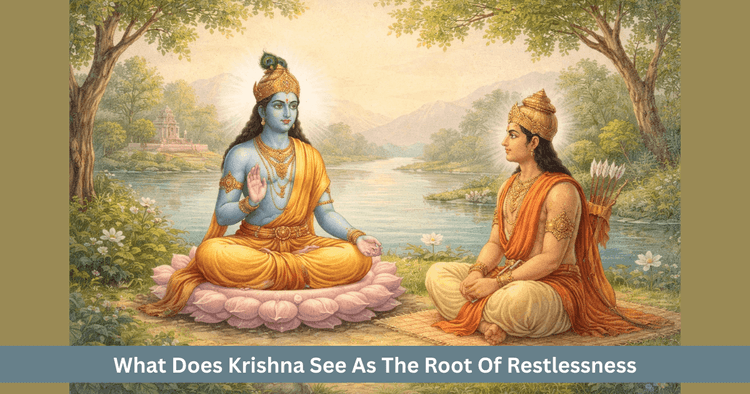
Table of Contents
Is Inner Peace Really Possible In Daily Life
Most people wake up and within moments feel the pull of the day. Notifications, tasks, worries, expectations, all rush in. Genuine stillness feels rare and short lived. It is easy to assume that constant anxiety is simply the cost of modern life.
The Bhagavad Gita offers a different picture. It treats peace as our natural baseline which has been covered over, not as a luxury for a few. Through Krishna’s dialogue with Arjuna it shows that calmness is not the absence of activity. It is the presence of the right inner connection.
What Does Krishna See As The Root Of Restlessness
On the battlefield Arjuna’s mind is stormy.
- duty clashes with emotion
- fear of results clouds judgment
- confusion weakens his will
Krishna explains that when a person is not yukta or connected with the Supreme
- intelligence loses balance
- the mind does not stay steady
- and without a steady mind peace is not possible
So people try to anchor themselves in
- achievements
- relationships
- possessions
These give some comfort yet remain temporary. Krishna then asks, “How can there be any happiness without peace.” The question itself invites a shift from chasing outer changes to tending the state of the mind.
What Does The Ocean And Rivers Example Teach About Desire
The Gita uses a powerful metaphor. Desires flow into the mind like rivers into an ocean.
- new goals
- new comforts
- new comparisons
keep arising. The mind believes, “Once this desire is fulfilled I will be at ease.” Yet after one wave comes another.
Krishna describes the wise one as
- like an ocean constantly being filled
- yet remaining still at its depth
The ocean does not stop the rivers. Its vastness keeps it unmoved.
In the same way, peace does not demand that all desires vanish. It calls for inner depth so that desires do not control us. We see them, act wisely toward them and yet do not surrender our centre.
Table: Two Ways Of Relating To Desire
| Approach | Consequence |
|---|---|
| Grabbing every desire tightly | ongoing anxiety, fatigue and comparison |
| Seeing and releasing desire | effort remains, inner calm stays |
Does Peace Mean Giving Up All Desires
The Gita does not condemn the wish to grow, support family or seek spiritual progress. These too are desires. The key question is who is in charge.
- if desire rules the mind, peace disappears
- if the mind can hold desire lightly, peace can remain
When happiness is made completely dependent on outcome, the person is bound to constant tension. Krishna points toward a different stance.
Peace blossoms when a person carries a quiet sense of inner sufficiency even while striving. From that place action becomes clearer, not weaker.
How Can The Same Mind Become Bondage And Liberation
The Gita notes that the mind can be both friend and enemy.
When the mind
- treats every passing emotion as absolute truth
- reacts instantly to outer events
- ties self worth to success and failure
it keeps the person chained to suffering.
The very same mind, when gently trained to
- pause before reacting
- remember “I am the atman, not only this changing story”
- and observe thoughts instead of obeying each one
starts to function as an ally. Regular practice slowly shifts its role from jailor to guide.
Why Does The First Half Hour After Waking Matter So Much
From a Gita based view the start of the day is crucial.
Commonly
- the phone appears in hand within seconds
- the mind jumps into news, messages and comparisons
- the inner field is crowded before it even settles
If instead there is a simple shift
- sit up and spend 5 to 10 minutes in quiet
- watch the natural flow of breath
- gently remember that “I am the witnessing consciousness, not only my passing roles and moods”
the entire tone of the day changes.
This does not remove responsibilities. It gives them a stable base. The mind learns that before meeting the world it is worth meeting oneself.
Karma Yoga: Same Work, Different Inner Grip
Much stress comes not from work itself but from the way results are held. Careers, relationships and social image become heavy when every outcome feels like a verdict on one’s worth.
Krishna clarifies that
- it is not action that binds
- it is attachment to the fruit that binds
Karma yoga can be lived in three simple steps
1. Prepare Well
- build skill
- plan sincerely
2. Act Fully
- give your best attention to the present task
- avoid half hearted effort
3. Release The Result
- accept outcomes without arrogance or self hatred
- inwardly offer the fruit to the Divine
With this spirit, work stays serious yet the worker feels lighter. Responsibility remains but the tight knot of obsession loosens. Peace finds room to enter.
How Can Gita Wisdom Enter Ordinary Routines
The Gita becomes most alive when its insights shape daily habits.
Morning
- do not touch the phone for the first few minutes
- sit, breathe deeply and remember your deeper identity
- set a small intention for the day such as
- “I will pause before reacting”
- or “I will notice at least three things to be grateful for”
Daytime
- insert one or two one minute pauses in busy periods
- during conflict, see the other person as a teacher of patience
- keep language a little softer and more aware
Night
- recall two or three moments
- where you stayed centred
- where you lost balance
- take one lesson for tomorrow
- name a few things you are genuinely grateful for
This night review acts like gentle cleaning. It supports a more peaceful mind by the next morning.
Table: Simple Daily Practices Drawn From The Gita
| Time | Practice | Effect on mind |
|---|---|---|
| On waking | 5-10 minutes breath awareness and self memory | grounded start instead of instant rush |
| During work | one minute pauses with deep breathing | lower stress, clearer decisions |
| In conflict | silent count or breath before speaking | less impulsive words, safer relationships |
| Before sleep | brief review and gratitude list | lighter mind, deeper and more positive sleep |
“My Devotee Never Perishes” As A Source Of Courage
Krishna gives Arjuna a strong assurance.
“My devotee never perishes.”
This does not mean a trouble free life. It means that honest effort in the right spirit is always held and honoured.
When a person
- tries to align actions with dharma
- keeps returning the mind to remembrance and trust
- and offers outcomes beyond personal control to a higher wisdom
this promise can calm very deep fears.
Circumstances will rise and fall. Yet the heart knows, “If my intention and direction are sincere, something good will ultimately unfold.” That faith itself is a powerful form of peace.
What Does “Daily Positivity” Look Like Through The Gita’s Lens
Positivity here is not forced cheerfulness. It is not ignoring pain.
Gita based positivity is the capacity to
- see lessons inside challenges
- respond from the witnessing Self instead of raw impulse
- and trust that life has meaning even when the pattern is unclear
With this stance
- success does not intoxicate
- failure does not crush
Each morning becomes a fresh chance to be a little more yukta, a little truer to karma yoga and a little kinder to oneself and others.
Frequently Asked Questions
1. What is one small change I can make if I am very busy
Protect five phone free minutes after waking and use them for quiet breathing and self remembrance. Add one pause before reacting in any tense moment. Even these two shifts begin to change the texture of the day.
2. Does the Gita ask us to suppress all desires
No. It teaches wise handling of desire. Goals and aspirations are natural. Bondage starts when we believe happiness depends only on their fulfilment. The Gita guides us to act towards goals while resting our sense of self in something deeper.
3. How can I practise karma yoga in a practical way
Before an important task, decide to do your best and to accept whatever result comes without self attack. After finishing, take a moment to inwardly offer the outcome to the Divine. Over time this shifts work from pressure to offering.
4. How can night time self review avoid creating guilt
Approach it like a gentle teacher, not a strict judge. Notice both what went well and what did not. Turn each mistake into a specific intention for tomorrow. This keeps the focus on learning rather than blame.
5. Can I benefit from these teachings without reading the whole Gita
Yes. Even a few principles, if lived consistently, bring change. Later, reading one verse or a short passage daily can deepen understanding but practice in daily life is the real heart of Gita study.
Get your accurate Kundali
Generate KundaliDid you like it?
Author

Aparna Patni (63)
Experience: 20
Consults About: Family Planning, Career
Clients In: Punjab, Haryana, Delhi
Share this article with friends and family
About ZODIAQ
ZODIAQ is an online Vedic Astrology platform. It connects clients seeking astrological advice to experienced astrologers with deep knowledge. Our users also generate kundali and perform kundali milan for free. ZODIAQ also offers services to the Astrologers. Astrologers utilize various offerings by ZODIAQ to serve their clients effectively.
If you are a User
Consult with experienced astrologers and seek their guidance. You can also order handwritten Janm Patrika report with life prediction prepared by experienced astrologers. Generate accurate Kundali, perform Kundali Matching and check horoscope and muhurat. Utilize our online library for all the necessary astrological and spiritual information.
If you are an Astrologer
Create accurate kundali for your clients and perform Kundali Matching for up to 5 people at a time. Write comprehensive Janm Patrika report for your clients with ZODIAQ. Check client details anytime by saving it in client directory. Become more productive by tracking how many clients you guide every day.
WELCOME TO
ZODIAQ
Right Decisions at the right time with ZODIAQ
