Daily Peace From The Gita
By Pt. Suvrat Sharma
How the wisdom of the Bhagavad Gita can turn daily anxiety into steady peace and practical positivity
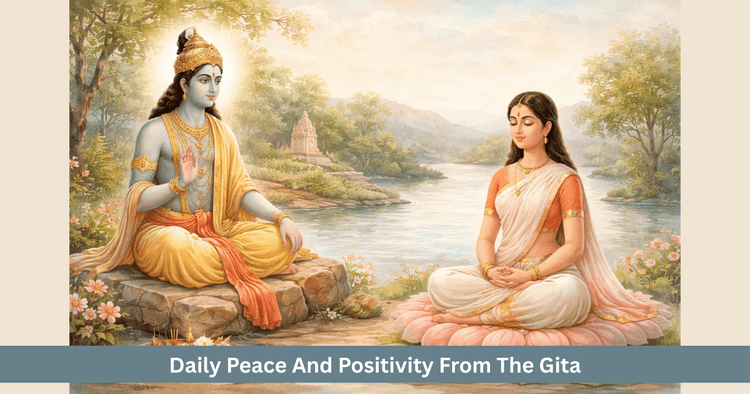
Table of Contents
Can Inner Peace Really Become A Daily Experience
For many people the day begins with a rush before the feet even touch the floor. The alarm rings, the phone lights up, messages wait, tasks pile up in the mind. By the time breakfast arrives, a quiet undercurrent of anxiety has already settled in. It feels almost normal, as if constant tension is the unavoidable price of modern life.
The Bhagavad Gita suggests something very different. It treats peace not as a luxury but as a natural state that we have forgotten. Shri Krishna’s guidance to Arjuna on the battlefield is not only for warriors. It is also for anyone who wants to move from surviving each day to living it with steadiness and joy.
What Does Krishna See As The Root Of Restlessness
Arjuna’s crisis on the battlefield is an intense version of what many people feel in quieter ways.
- pressure to decide
- confusion about duty
- fear of consequences
- conflict between heart and role
Krishna points to one central issue. When a person is not yukta or connected with the Supreme,
- intelligence loses balance
- the mind loses steadiness
- and true peace stays out of reach
We then try to anchor ourselves in
- roles
- relationships
- results
These bring some comfort yet do not stay fixed. So Krishna asks a direct question.
“How can there be happiness without peace.”
The message is simple. Lasting happiness grows from a calm mind. Circumstances help, yet they cannot replace that inner base.
The Ocean And The Rivers: Handling Desires
The Gita uses a vivid picture to explain why peace slips away. Desires keep arriving like rivers flowing into an ocean.
- one more achievement
- one more purchase
- one more sign of appreciation
Each desire promises new satisfaction. As soon as it is met, another appears. If peace depends on finishing this list, it will never arrive.
Krishna describes the person who attains peace as
- like an ocean always being filled
- yet remaining level and still
The ocean does not try to stop the rivers. It remains deep enough to stay steady.
In the same way, a human being does not need to erase every desire. The real need is to grow in depth. Then desires can be seen, evaluated and sometimes fulfilled, without shaking the core. Peace is not the absence of movement at the surface. It is steadiness in the depths.
Table: Restless Mind And Peaceful Mind
| Aspect | Restless mind | Peaceful mind |
|---|---|---|
| Relation to desire | Rushes to satisfy every impulse | Observes desire, chooses calmly |
| View of results | Identity tied tightly to success and failure | Gives best effort, holds outcomes lightly |
| Morning pattern | Phone and news first, tension rises early | First minutes for remembering inner identity |
| Night pattern | Replays worries and complaints | Reviews day, notes lessons and gratitude |
Mind As The Cause Of Bondage And Liberation
A key insight of the Gita is that the mind plays both roles.
- absorbed in objects, it binds
- centred in the Self, it frees
When the mind
- takes every passing mood as absolute truth
- clings to labels such as job title and social image
- reacts without reflection
it naturally creates anxiety and conflict.
The same mind, when gently trained to remember
- “I am more than my roles and situations”
- “emotions come and go, I remain as the witness”
starts to turn into an ally.
Morning is especially important.
- reaching for the phone at once throws the mind outward
- starting with a few minutes of silence, breath awareness or mantra brings it inward
Over time this small choice each morning sets a different tone for the entire day.
Karma Yoga: Work Fully, Hold The Fruit Lightly
Much daily stress comes from holding results too tightly. People feel that they alone must control every outcome in work and family. The fear of failure makes every task heavy.
The Gita offers a surprisingly practical solution. Action itself is not the chain. Attachment to the fruit is the chain.
Karma yoga can be understood in three steps
Prepare Thoroughly
- learn properly
- plan with care
- practise your skill
Act Sincerely
- give full attention to the present task
- avoid half hearted effort
Release The Outcome
- accept success without arrogance
- accept setbacks without collapse
- offer the result inwardly to the Divine
When results are treated as offerings rather than possessions, the heart relaxes. Work remains intense, yet the worker becomes lighter. This inner change is a powerful source of peace.
How To Bring Gita Wisdom Into Everyday Routines
The Gita becomes real through small consistent habits, not only through study.
Morning
- after waking, sit for a few minutes before touching the phone
- watch the breath and let it deepen naturally
- repeat a simple mantra or remember that “I am the atman, not only this changing story”
Through The Day
- do one task at a time with full attention
- when irritation rises, pause for a slow count of five before speaking
- remind yourself that effort is in your hands, outcome is not fully yours
Evening
- recall two or three moments from the day
- where you stayed calm
- where you lost balance
- note one lesson for tomorrow
- remember at least two things you are grateful for
These small practices gradually align the mind with Krishna’s guidance. Peace then becomes a natural by product rather than a forced project.
Table: Simple Daily Practices Inspired By The Gita
| Time | Practice | Effect |
|---|---|---|
| On waking | 3-5 minutes of quiet breath and remembrance | Starts day from depth, not from distraction |
| Mid work | Short pause with a few deep breaths | Resets attention, reduces mental noise |
| Difficult moment | Silent count to five before responding | Softens reactions, protects relationships |
| Before sleep | Brief review and gratitude list | Clears mind, supports restful and positive sleep |
“My Devotee Never Perishes” As A Source Of Strength
Among many promises in the Gita one stands out for daily life. Krishna declares that his devotee never perishes. This does not mean that problems will never arise. It means that sincere effort in the right direction is never wasted.
For someone who
- tries to remember the higher Self
- works with honesty
- and learns to offer outcomes inwardly
this assurance can soothe deep fears. Circumstances may rise and fall. Plans may succeed or fail. Behind all this there is a quiet trust.
“I am not walking alone. My efforts rest in a larger wisdom.”
From that trust peace arises. Positivity then does not depend only on mood or events. It springs from knowing that life has meaning even when the outer pattern is unclear.
Frequently Asked Questions
How can a very busy person apply the Gita daily
Begin with only two changes. Protect a few quiet minutes after waking and practise one short pause before reacting in tense moments. When these become natural, more practices can be added gradually.
Does the Gita ask us to suppress all desires
The Gita does not ask for dry suppression. It teaches understanding and mastery. Desires are to be seen clearly, guided by dharma and not allowed to rule the mind. The ocean image shows that inner depth, not inner emptiness, is the key.
If I let go of results, will my performance drop
Letting go of attachment is different from losing interest. In fact, when fear of outcome reduces, many people find that focus and performance improve. Effort becomes cleaner because it is no longer mixed with panic.
How does the Gita help with negative thinking
It encourages awareness of thought patterns, not blind identification with them. By reminding oneself of the higher Self, practising gratitude and viewing challenges as part of a larger design, the mind gains room to shift away from habitual negativity.
Is it necessary to read the whole Gita to benefit from it
Even a few verses, if reflected on and lived, can change the texture of daily life. Over time deeper study adds richness, yet the real transformation comes from steady practice of its core insights in ordinary situations.
Get your accurate Kundali
Generate KundaliDid you like it?
Author

Pt. Suvrat Sharma (63)
Experience: 20
Consults About: Family Planning, Career
Clients In: Punjab, Haryana, Delhi
Share this article with friends and family
About ZODIAQ
ZODIAQ is an online Vedic Astrology platform. It connects clients seeking astrological advice to experienced astrologers with deep knowledge. Our users also generate kundali and perform kundali milan for free. ZODIAQ also offers services to the Astrologers. Astrologers utilize various offerings by ZODIAQ to serve their clients effectively.
If you are a User
Consult with experienced astrologers and seek their guidance. You can also order handwritten Janm Patrika report with life prediction prepared by experienced astrologers. Generate accurate Kundali, perform Kundali Matching and check horoscope and muhurat. Utilize our online library for all the necessary astrological and spiritual information.
If you are an Astrologer
Create accurate kundali for your clients and perform Kundali Matching for up to 5 people at a time. Write comprehensive Janm Patrika report for your clients with ZODIAQ. Check client details anytime by saving it in client directory. Become more productive by tracking how many clients you guide every day.
WELCOME TO
ZODIAQ
Right Decisions at the right time with ZODIAQ
