Still Kind to People Who Hurt You? The Gita’s Courageous Message
By Pt. Narendra Sharma
When unconditional kindness weakens the soul, the Gita teaches self-respect and boundaries
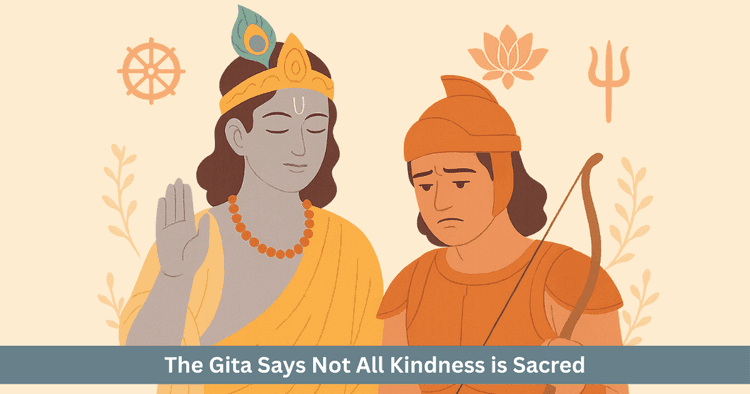
Table of Contents
The Age-Old Dilemma of Boundless Kindness
It is a familiar story, continuously enduring those who hurt you, forgiving harsh words, overlooking betrayals and treating backstabs as mere scratches. Why do you do this? Because you believe kindness is divine, unconditional and that being “the bigger person” is an unbreakable moral code. Somewhere deep inside, you’ve been taught that compassion means endless forgiveness.
But what if this ceaseless kindness is slowly diminishing your soul? What if it is not elevating you but draining your vitality? In a world that often confuses niceness with virtue, the timeless spiritual guide of India, the Bhagavad Gita, offers a profound alternative. It does not glorify suffering or demand self-sacrifice unto destruction. Instead, through Krishna’s voice, it whispers a daring truth: not all kindness is sacred and sometimes the bravest act of love is to stop being kind to those who hurt you.
Arjuna’s Heartbreak and the First Signal
At the heart of the Bhagavad Gita is a young prince named Arjuna, caught in a grave moral crisis. Standing on the battlefield of Kurukshetra, he sees his relatives, cousins, mentors, friends, as enemies. His heart trembles and his mind whispers, “I cannot do this.”
He turns to Krishna and says,
“I will not fight. I would rather die than harm my own people.”
This moment reflects the internal battles many of us face, choosing silence and kindness to avoid conflict. We often tolerate manipulation by friends, abuse from partners or belittlement within family out of fear or habit.
But Krishna does not comfort Arjuna with empty words or demand blind sacrifice. He says:
“Your compassion is weakness. Your duty is to rise.”
This is not cruelty but clear truth. Krishna teaches that righteous action must prevail over blind emotion. Sometimes this requires standing firm, walking away or confronting those who hurt us. It is not kindness to let yourself be injured endlessly.
Misunderstanding Dharma: When Kindness Becomes Chains
In Indian philosophy, dharma is often translated as duty or righteousness and mistakenly equated with “being nice.” however the Bhagavad Gita defines dharma as alignment with your highest truth, not others’ expectations or your own fears.
If dharma calls you to grow, protect your peace and evolve, then staying trapped in toxic relations out of guilt, obligation or pity is adharma, the opposite of your true path.
Krishna never told Arjuna to spare the Kauravas just because they were family; he urged him to confront injustice firmly.
Forgiving continuous harm without change is not noble; it is enabling damage.
| Situation | Duty According to Dharma | Examples of Adharma |
|---|---|---|
| Loving relationships clouded by fear | Stand for truth and justice | Continual misuse tolerated |
| Differentiating compassion and weakness | Set clear boundaries wisely | Blind forgiveness |
| Preserving self-respect | Safeguard mental and spiritual health | Self-neglect |
Ask yourself: Is your kindness genuine or fear disguised as virtue?
The Prison of Samskaras: How Cultural Conditioning Traps Us
Powerful cultural imprints shape us from childhood:
- “Always respect elders, no matter what.”
- “Forgive and forget.”
- “Do not answer back.”
- “God rewards endless kindness.”
While these drive respect and harmony, they can also imprison us in cycles of silence and submission. The Gita rejects blind obedience and teaches conscious discernment. Krishna instructs Arjuna to act with wisdom and courage beyond tradition.
Spiritual awakening sometimes demands breaking free from unhealthy patterns, even if it feels rebellious or isolating. True love includes fiercely protecting oneself with firm boundaries.
The Inner Warrior: Your Right to Choose Yourself
The Gita is framed on a battlefield because awakening often requires the courage of a warrior. Krishna reminds Arjuna that he must fight his inner conflict, not succumb to guilt.
If you tolerate lies or manipulation repeatedly in love’s name, you betray your inner warrior.
The Gita invites you to:
- Protect your peace like sacred ground.
- Cut karmic ties suffocating your spirit.
- Stand your truth, even if you walk alone.
This is not selfishness but spiritual hygiene, necessary self-preservation and authenticity.
Love but Let Go: The Higher Kindness
Krishna’s wisdom never encourages bitterness or hatred. It encourages detachment without coldness. Higher kindness is loving without losing yourself, forgiving without enabling harm.
Detachment says:
- “I bless you but I choose me.”
- “I release pain but hold onto my power.”
- “I love myself too much to remain wounded.”
Letting go is clarity, not cruelty. Kindness does not require self-erasure.
Practical Gita: Setting Spiritual Boundaries Today
If the Bhagavad Gita spoke to today’s generation facing relationship trauma, fake friends and gaslighting, it might advise:
- Block, don’t bleed.
- Unfollow, don’t unravel.
- Speak, don’t suppress.
- Heal, don’t hush.
Boundaries are sacred rituals of self-respect. Distance is divine healing. Krishna never told Arjuna to be violent but to be aligned. And alignment sometimes means choosing the lonelier, harder path rather than the soul-killing easy road.
Not Everyone Deserves Your Light
Every soul walks a unique karmic path. Saving those who repeatedly hurt you is not your duty. You are not their guru, counselor or punching bag. You are your own sacred flame, protect it fiercely.
When you make yourself available to all at the cost of your peace, your energy becomes cheap. True love knows when to close the door.
Krishna’s timeless message echoes:
“If someone chooses darkness, don’t dim your light to join them. Shine brighter and walk away.”
From People-Pleasing to Purpose-Living
The world needs awakened souls, not martyrs. Souls who distinguish ego from essence, strength from submission.
The Gita calls for powerful love and loving power.
Next time someone says “Be kind no matter what,” ask:
Is my kindness serving growth or silencing it?
You are not cruel for protecting yourself or heartless for walking away.
You are finally hearing the divine whisper:
“Enough. Choose you.”
Perhaps this is the real dharma.
Frequently Asked Questions
Q1: Does the Gita condemn kindness entirely?
No, it honors authentic kindness rooted in truth but rejects enabling ongoing harm.
Q2: Is walking away from toxic relationships selfish?
The Gita teaches that detachment done with clarity is self-preserving, not selfish.
Q3: What is the difference between dharma and people-pleasing?
Dharma aligns with truth and higher purpose; people-pleasing stems from fear and conditioning.
Q4: How can one practice higher kindness daily?
By setting firm boundaries, forgiving without tolerating harm and balancing self-respect with compassion.
Q5: Why does the Gita emphasize courage in relationships?
Because true love often demands strength to end destructive patterns, even if ties are deep or painful.
Get your accurate Kundali
Generate KundaliDid you like it?
Author

Pt. Narendra Sharma (63)
Experience: 20
Consults About: Family Planning, Career
Clients In: Punjab, Haryana, Delhi
Share this article with friends and family
About ZODIAQ
ZODIAQ is an online Vedic Astrology platform. It connects clients seeking astrological advice to experienced astrologers with deep knowledge. Our users also generate kundali and perform kundali milan for free. ZODIAQ also offers services to the Astrologers. Astrologers utilize various offerings by ZODIAQ to serve their clients effectively.
If you are a User
Consult with experienced astrologers and seek their guidance. You can also order handwritten Janm Patrika report with life prediction prepared by experienced astrologers. Generate accurate Kundali, perform Kundali Matching and check horoscope and muhurat. Utilize our online library for all the necessary astrological and spiritual information.
If you are an Astrologer
Create accurate kundali for your clients and perform Kundali Matching for up to 5 people at a time. Write comprehensive Janm Patrika report for your clients with ZODIAQ. Check client details anytime by saving it in client directory. Become more productive by tracking how many clients you guide every day.
WELCOME TO
ZODIAQ
Right Decisions at the right time with ZODIAQ
