Walking Through Adversity with Unwavering Strength: The Gita's Eternal Message
By Pt. Nilesh Sharma
Learn from Gita’s wisdom how to remain invincible in adversity and keep moving toward your goals
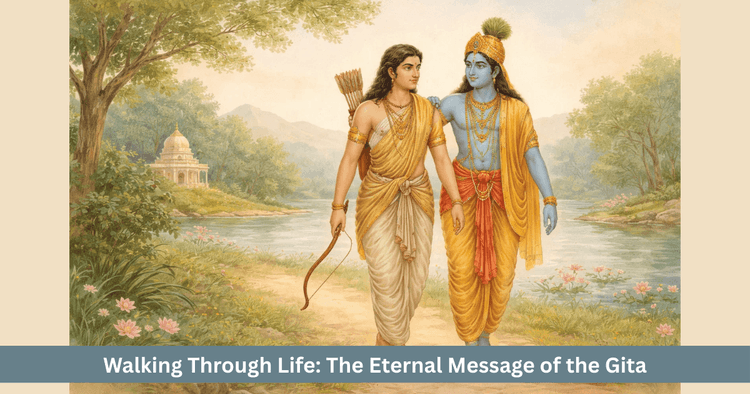
Table of Contents
Have you ever noticed how life tests you precisely when you feel most ready? The missed call, the unexpected betrayal, the relentless pressure of responsibilities as if the entire universe were conspiring against you. Yet there exists a path through it all without breaking, without bitterness, without letting exhaustion drain your spirit. The Gita calls this dharma your duty, your alignment with life itself. This wisdom is simple but not easy: walk your path even when the world seems determined to stop you. This isn't mere spiritual rhetoric, it's a practical, universally human strategy for facing adversity, staying true to yourself and still moving forward with purpose.
Stand in Your Own Reality, Not Life's Expectations
Life is loud. Opinions, judgments, fears they all clamor for attention. Most people stumble because they mistake noise for truth. Your reality is shaped not by external chaos but by how firmly you stand within yourself.
When everyone panics about "what ifs," you quietly handle "what is." That calm confidence doesn't come from luck, it comes from knowing who you are, what you value and what you will never compromise. The world will push; your clarity keeps you upright.
The Importance of Self-Knowledge and Self-Respect
In the Gita, Krishna explains that the soul's establishment in its true nature is real power. When a person recognizes their authentic essence, external circumstances lose their overwhelming influence. This state isn't indifference but profound awareness that your core being is unchangeable and eternal.
A person established in themselves doesn't alter their behavior according to others' expectations. They know that external approval or disapproval cannot affect their inner truth. This is why the Gita describes the sthitaprajna (steady-minded) person in such detail.
Obstacles Are Not Enemies but Teachers
Every blockage, delay or setback is a mirror. The Gita reminds us that challenges aren't punishments, they're invitations to grow. Frustration is optional but self-reflection is mandatory.
The missed promotion, harsh words from a friend, the collapsed project pain is unavoidable but suffering is optional. By observing lessons hidden in difficulty, you transform each moment into fuel for deeper resilience. Adversity is a doorway, not a wall.
The Principle of Karma Yoga
The Gita's karma yoga teaches that every action should be performed with complete dedication and concentration but without attachment to results. When you adopt this principle, even failure becomes a teacher. You learn what works and what doesn't, which path is right and which is wrong.
Obstacles test your capabilities. Just as gold is purified by fire, personality is refined through difficulties. With each problem, your patience, intelligence and determination grow.
Act Without Attachment to Outcome
This is the core of Gita wisdom: do your work, not your worry. Results are beyond your control; your effort is within it. You can't force others to respect you, compel luck or control every variable but you can always act with intention.
Focus on the next step, the next choice, the next effort. In the ripples of consistent, purposeful action, progress quietly accumulates. Freedom comes when you release the need to control what you cannot.
The Power of Nishkama Karma (Desireless Action)
Nishkama karma doesn't mean you shouldn't have goals or purposes. It means your happiness or self-worth shouldn't depend on outcomes. When you work this way:
- Your performance improves because anxiety and stress diminish
- Failure doesn't break you but teaches you
- Success doesn't make you arrogant but keeps you humble
- Your energy goes into work, not worrying about results
This mental state makes you invincible because your power doesn't depend on external circumstances.
Embrace the Paradox of Strength and Vulnerability
Walking through life like nothing can stop you isn't a mask. True strength isn't the absence of fear or sorrow, it's moving forward despite them.
Heartbreak, failure, disappointment they visit everyone. What separates those who crumble from those who rise is the courage to continue with full humanity and awareness. You are both fragile and unstoppable. Both are true, both necessary. Courage doesn't erase vulnerability; it integrates it into action.
Characteristics of the Sthitaprajna (Steady-Minded Person)
Describing the sthitaprajna, Krishna says in the Gita:
- They aren't elated by pleasure nor disturbed by pain
- Their mind remains steady, like a lamp that doesn't flicker in a windless place
- They aren't attached to sensory objects
- Their intelligence is stable and they see with equal vision
This person doesn't suppress emotions but understands them and remains unaffected. This is real strength responding from inner stability rather than reacting to circumstances.
Presence Is the Ultimate Power
The past can weigh you down. The future can terrify you. But life exists only in the present. Walking like nothing can stop you requires focus that is deep, patient and unwavering. When the world spins too fast, anchor yourself in what you can do now. One breath. One choice. One step.
Everyone faces chaos, uncertainty and loss. But presence allows you to respond with clarity, wisdom and strength that the world cannot touch. The moment you inhabit is where your power lives.
Meditation and Self-Realization
The Gita considers meditation the highest practice. Meditation doesn't just mean sitting with closed eyes it means being completely present in every action. When you're fully present:
- Your work efficiency increases
- Stress and anxiety naturally decrease
- Decision-making ability becomes sharp
- Inner peace and stability are attained
All power resides in the present moment. Regret over past mistakes or fear of future uncertainty scatters your present power.
Practical Principles of the Gita in Life
Recognizing Dharma and Swadharma
In the Gita, dharma doesn't just mean religious rituals but your natural duty. Each person has their swadharma work that matches their natural talent and inclination. When you work according to your swadharma:
- Work becomes joyful
- Chances of success increase
- Inner satisfaction is achieved
- Your contribution to society becomes meaningful
The State Beyond the Three Gunas
According to the Gita, nature consists of three gunas, sattva, rajas and tamas. When a person transcends these three qualities, they become trigunatita. In this state:
- External circumstances have less impact
- Mental peace is maintained
- Clear, unbiased vision develops
- Perfection comes in actions
Arjuna's Dilemma and Its Solution
Arjuna's dilemma before the Mahabharata war remains relevant in every person's life today. When we face difficult decisions, conflicts between family and duty, Gita wisdom provides guidance:
- Understand emotions but don't be controlled by them
- See the bigger purpose, don't get tangled in small problems
- Perform duty without worrying about results
- Clearly distinguish between dharma and adharma
Krishna Consciousness: Developing Divine Nature
In the Gita, Krishna isn't just a person but represents a state of consciousness. When a person attains Krishna consciousness:
Developing the Attitude of Lila (Divine Play)
Krishna's life is filled with lila bhava. This perspective views life like a play participating fully but not taking it too seriously. With lila attitude:
- Work becomes joyful
- Stress and anxiety decrease
- Creativity increases
- Love and humor enter relationships
Balance of Love and Justice
Krishna's personality shows a wonderful balance of love and justice. He loves the gopis and fights for justice in war. This teaches that:
- Both gentleness and firmness are necessary
- Behavior should change according to circumstances
- Love is strength, not weakness
- Fighting for justice is dharma
Applying the Gita in Modern Life
Gita Principles in the Workplace
In today's competitive age, Gita principles are even more relevant:
Stress Management: The principle of nishkama karma reduces stress. When you work without worrying about results, performance improves.
Leadership Development: The Gita teaches that leaders should be established in themselves and think of others' welfare.
Decision-Making Ability: A sthitaprajna person makes decisions through wisdom rather than emotions.
Gita Wisdom in Relationships
Gita principles are useful in interpersonal relationships too:
Selfless Love: Loving unconditionally but remaining free from attachment.
Understanding and Patience: Understanding others' perspectives and maintaining patience.
Respecting Boundaries: Recognizing your own and others' limits.
Aid in Spiritual Development
The Gita guides not only practical life but spiritual development:
Self-Realization: Recognizing your true nature.
Attaining Moksha: Liberation from the cycle of birth and death.
Developing Divine Nature: Awakening divine qualities within yourself.
Combining Ritual and Practicality
The beautiful aspect of the Gita is that while being idealistic, it remains completely practical. It neither advises escaping from the world nor completely drowning in materialism. Its middle path is:
Yoga: The Art of Balance
In the Gita, yoga doesn't just mean physical postures but the art of balance in life. This balance is:
- Between action and rest
- Between solitude and sociability
- Between material and spiritual
- Between personal and social responsibilities
Samya Bhava: Equanimity
The Gita's samya bhava teaches maintaining equality in pleasure-pain, success-failure, praise-criticism. This isn't indifference but deep understanding that:
- Life's ups and downs are natural
- Only change is permanent
- Inner peace shouldn't depend on external circumstances
Moving Forward with Grace and Grit
Life is inevitable in its challenges. Misfortune, betrayal, failure these aren't optional. But how you meet them is your choice. The Gita's guidance is profound in its simplicity: walk your path, do your duty, embrace the present, learn from obstacles and act without attachment.
You will be tested. You will stumble. You will feel the weight of the world. And yet, if you cultivate clarity, courage and presence, you will walk through it all like everything is against you and still, somehow, you cannot be stopped. Strength isn't the absence of struggle; it's the mastery of moving forward despite it.
The Gita's message is timeless because it recognizes deep truths about human nature. We all want life to be easy but growth happens in difficulty. The Gita teaches us how to make these difficulties tools for our development.
Ultimately, the Gita's greatest message is that you are far more powerful than you think. When you recognize your true nature, no external force can stop you. This is the Gita's immortal message remain steadfast, keep walking and trust your inner power.
Frequently Asked Questions
What is the main message of the Gita?
The main message is to perform your duty without worrying about results and maintain inner purity.
What does nishkama karma mean?
Nishkama karma means performing your duty with complete sincerity without attachment to results.
Who is a sthitaprajna person?
A sthitaprajna is someone who remains equal in pleasure and pain and maintains inner peace.
How is the Gita relevant to modern life?
Gita principles are still useful for stress management, leadership development and improving relationships.
What's the difference between dharma and swadharma?
Dharma refers to general moral principles, while swadharma is an individual's natural duty and work suited to their nature.
Get your accurate Kundali
Generate KundaliDid you like it?
Author

Pt. Nilesh Sharma (63)
Experience: 20
Consults About: Family Planning, Career
Clients In: Punjab, Haryana, Delhi
Share this article with friends and family
About ZODIAQ
ZODIAQ is an online Vedic Astrology platform. It connects clients seeking astrological advice to experienced astrologers with deep knowledge. Our users also generate kundali and perform kundali milan for free. ZODIAQ also offers services to the Astrologers. Astrologers utilize various offerings by ZODIAQ to serve their clients effectively.
If you are a User
Consult with experienced astrologers and seek their guidance. You can also order handwritten Janm Patrika report with life prediction prepared by experienced astrologers. Generate accurate Kundali, perform Kundali Matching and check horoscope and muhurat. Utilize our online library for all the necessary astrological and spiritual information.
If you are an Astrologer
Create accurate kundali for your clients and perform Kundali Matching for up to 5 people at a time. Write comprehensive Janm Patrika report for your clients with ZODIAQ. Check client details anytime by saving it in client directory. Become more productive by tracking how many clients you guide every day.
WELCOME TO
ZODIAQ
Right Decisions at the right time with ZODIAQ
