Vedic Link Between Kumbha Rashi and Phalguna Month
By Pt. Sanjeev Sharma
Beginning of Phalguna Month and Natural Energy with Sun’s Entry in Kumbha
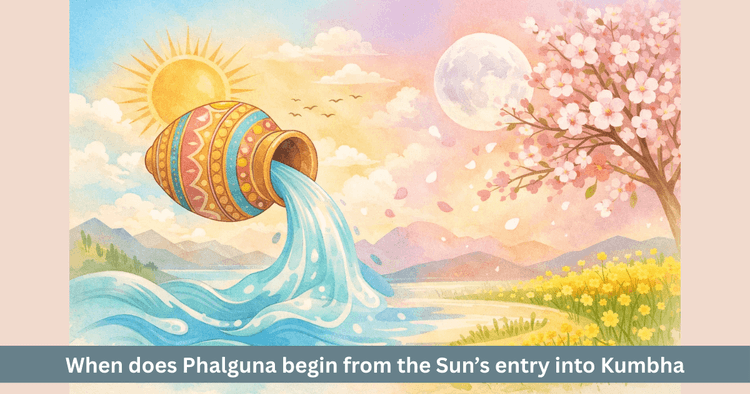
Table of Contents
In Vedic astrology the measure of time is based not only on calendars but on the transit of the Sun through the zodiac signs. During the year the Sun moves through twelve rashis and at the very moment it enters a new sign a new solar month begins. According to this principle, when the Sun enters Kumbha rashi Aquarius, the span of the month Phalguna starts. Therefore Phalguna is understood as directly and clearly connected with Kumbha rashi and this whole period reflects the Sun’s stay in Aquarius.
When does Phalguna begin from the Sun’s entry into Kumbha
When the Sun passes out of Makara rashi and enters Kumbha rashi, the event is called Kumbha Sankranti. From that instant the energy of Phalguna is taken as active and a new month begins in the solar panchang. In the Indian solar calendar this is the period during which the Sun continuously remains in Kumbha, so Phalguna in fact is the name of the complete span of the Sun’s transit through Kumbha. At this time the cycle of seasons shifts clearly from peak winter towards the doorway of spring.
How are solar months and signs structured
In the Vedic tradition solar months are determined by the sequential entry of the Sun into the zodiac signs. The Sun stays in one sign for about a month and then moves into the next. In this way twelve solar months are formed and each month represents the Sun’s residence in one particular rashi. This link can be seen briefly through a simple table.
| Solar sign | Solar month | Main qualities |
|---|---|---|
| Makara | Magha | Stability, discipline, patience |
| Kumbha | Phalguna | Change, broad vision, freshness |
When the Sun is in Kumbha rashi, that span is called the month of Phalguna. Thus both the name and timing of Phalguna are directly tied to the Sun’s transit through Kumbha and give a clear picture of the structure of the Vedic solar panchang.
Nature of Kumbha rashi and the timing of Phalguna
Kumbha rashi belongs to the air element. Its nature is associated with broad vision, thought, collective awareness, freedom and new ideas. This sign respects tradition yet also supports reform and constructive change. Kumbha energy encourages a person to rise beyond purely personal interest and to think about society, groups and wider circles.
During the part of the year when the Sun enters Kumbha, winter begins to move gradually towards its end. The cold lessens, the air becomes lighter and a new liveliness can be felt in nature. Buds begin to prepare on trees and in fields and surroundings the first hints of spring can be seen. This sign of change and fresh beginnings matches closely with the open and forward looking nature of Kumbha.
Harmony between Phalguna and Kumbha energy
Phalguna is the time in which the pressure of winter weakens and the signs of spring emerge more clearly. A gentle warmth, openness and fresh energy enter the environment. The wind carries a lighter feeling, as though nature itself is preparing for a new chapter.
Kumbha rashi symbolises broad vision and new ideas in a similar way. It does not break structures for the sake of restlessness but seeks to fill them with new awareness and a spirit of improvement. Just as nature in Phalguna leaves behind the heaviness of winter and moves towards fresh greenery, Kumbha energy inspires a person to move beyond old patterns and limitations and to think about new possibilities, new connections and new efforts. The harmony between Phalguna and Kumbha is therefore visible both in the brightness of nature and in the opening of thought.
Do Kumbha rashi and Phalguna influence mental and social tendencies
The energy of Kumbha is not confined to the individual level. This sign is strongly connected with groups, social patterns, shared ideas and collective aims. It indicates that time can be used not only for personal gain but also for common benefit.
As the climate becomes lighter in Phalguna, people’s moods also tend to become more open and sociable. In many places this is the period of preparation for gatherings, festivals and collective activities. People begin to think about new work, new forms of cooperation and new plans. All this resembles the movement of Kumbha’s air element, which sets thoughts in motion and invites a person to consider the welfare of others along with one’s own. Thus the mental and social atmosphere of Phalguna can be seen as deeply related to the generous and inclusive nature of Kumbha.
Place of Kumbha and Phalguna in the Vedic panchang
The Indian Vedic panchang rests on the rule that the sign in which the Sun is placed gives identity to the period that follows. When the Sun is in Makara, the solar month is called Magha. When the Sun is in Kumbha, the solar month is called Phalguna. In this way both the name and duration of Phalguna are defined by the Sun’s transit through Kumbha.
The panchang describes Phalguna as favourable for many festive, collective and emotionally expressive activities. As the air grows milder, the pace of life too becomes somewhat lighter, more joyful and inclined towards meeting and sharing. Kumbha energy gives this time a tone in which a person can reshape ideas, relationships and plans and may feel a natural wish to connect more closely with others.
Astrological meaning of the Kumbha and Phalguna link
According to Vedic astrology planetary positions shape the energy and quality of time. When the Sun is placed in Kumbha rashi, it carries an energy that is related to change, broad vision, new ideas and possibilities. This is not a phase of abrupt upheaval but of gradual forward movement.
During Phalguna, Kumbha energy can awaken the understanding that life is not only for repetition but also for improvement and expansion. The period can be helpful for those who wish to bring new direction into their thinking, to launch new projects, create new connections or step forward with fresh ideas. The link between Phalguna and Kumbha therefore suggests that this is a time favourable for new possibilities, wider perspective and constructive change.
Inner message of Phalguna and Kumbha energy
Phalguna is essentially the period of the Sun’s stay in Kumbha rashi and this placement determines the astrological identity and natural energy of the month. It carries the message that after every long and cold phase there comes a time that brings fresh air and new light. Kumbha teaches that when thoughts become fresh, relationships open and the direction of life widens, support from time can be felt more naturally.
A person who uses Phalguna to create space for new ideas, to release some old burdens, to give attention to collective welfare and cooperation and to hold an open vision for the future can benefit greatly from Kumbha’s air energy. This month stands like a bridge between the steady phase of winter and the new possibilities of spring and offers an opportunity to prepare inwardly for that transition.
Frequently asked questions
Why is Phalguna linked specifically with Kumbha rashi
Phalguna is the name of the period during which the Sun remains in Kumbha rashi. In the Vedic solar system months are always based on the Sun’s sign, so the span of the Sun’s transit through Kumbha is called Phalguna. This makes the link between them stable and clearly recognised.
Does Phalguna always fall between the same Gregorian dates
No. The beginning of Phalguna depends on the Sun’s entry into Kumbha. The date of Kumbha Sankranti shifts slightly from year to year, so the start of the solar month of Phalguna also changes by a few days, although the rule that it begins when the Sun enters Kumbha remains constant.
How is the air based energy of Kumbha seen in Phalguna
Kumbha’s air element appears in Phalguna through lighter weather, an opening environment, increased social activity and movement of new ideas. People think more freely about plans, cooperation and future direction, which reflects Kumbha’s broad vision.
Is Phalguna concerned only with festivals and emotions or does it affect practical life as well
Phalguna influences practical life too. With milder weather, opportunities grow for travel, starting new work, improving relationships and moving plans forward. It is considered a supportive time for decisions that involve new direction, new partnerships or new beginnings.
How can one use Phalguna and Kumbha energy in daily life
A person who keeps an open mind during this time, welcomes fresh ideas and suggestions, strengthens cooperative ways of working and prepares broad plans for the future can gain much from Kumbha energy. Actions started in Phalguna that carry freshness, wide perspective and concern for the collective are believed to have good scope for positive results.
What does Sun Sign reveal about me?
My Sun SignDid you like it?
Author

Pt. Sanjeev Sharma (63)
Experience: 20
Consults About: Family Planning, Career
Clients In: Punjab, Haryana, Delhi
Share this article with friends and family
About ZODIAQ
ZODIAQ is an online Vedic Astrology platform. It connects clients seeking astrological advice to experienced astrologers with deep knowledge. Our users also generate kundali and perform kundali milan for free. ZODIAQ also offers services to the Astrologers. Astrologers utilize various offerings by ZODIAQ to serve their clients effectively.
If you are a User
Consult with experienced astrologers and seek their guidance. You can also order handwritten Janm Patrika report with life prediction prepared by experienced astrologers. Generate accurate Kundali, perform Kundali Matching and check horoscope and muhurat. Utilize our online library for all the necessary astrological and spiritual information.
If you are an Astrologer
Create accurate kundali for your clients and perform Kundali Matching for up to 5 people at a time. Write comprehensive Janm Patrika report for your clients with ZODIAQ. Check client details anytime by saving it in client directory. Become more productive by tracking how many clients you guide every day.
WELCOME TO
ZODIAQ
Right Decisions at the right time with ZODIAQ
