Vedic Link Between Mithuna Rashi and Ashadha Month
By Pt. Nilesh Sharma
Beginning of Ashadha Month and Nature’s Changes with Sun’s Entry in Mithuna
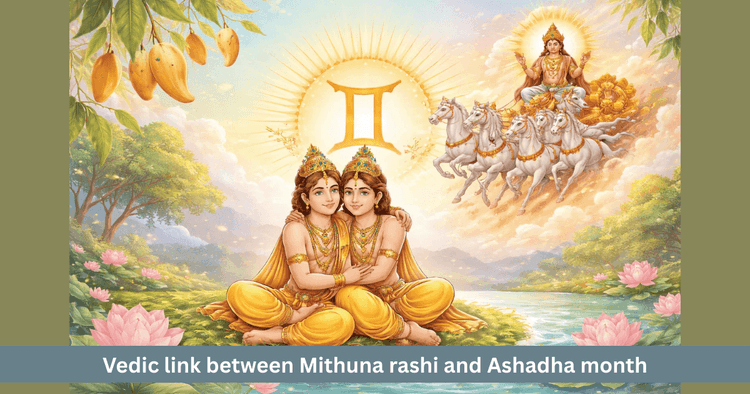
Table of Contents
In Vedic astrology time is not measured only by dates and calendars but through the transit of the Sun across the zodiac. The movement of the year is viewed by seeing which sign the Sun occupies at any moment and when it shifts from one sign to another. The instant the Sun enters a new sign is called Sankranti and from that point a new solar month begins.
According to this core principle, when the Sun enters Mithuna rashi Gemini, the span of the month Ashadha begins. Therefore Ashadha has a direct and clear connection with the sign Mithuna. This link is not just a similarity of names but a deeper Vedic principle based on nature, seasonal change and the position of the Sun.
How Ashadha month is formed from the Sun’s transit
The ancient Indian astrologers observed the sky with patience over long periods. They understood that the Sun remains in each sign for roughly one month and then moves on to the next sign, completing a full circle through the twelve signs in a year. On this basis the twelve solar months were defined.
According to this arrangement
when the Sun is in Mesha the month is Vaishakha
when the Sun is in Vrishabha the month is Jyeshtha
and when the Sun is in Mithuna the solar month is Ashadha.
As long as the Sun travels along the path of Mithuna, that entire duration is called the month of Ashadha. In this way Ashadha is in reality the astrological outcome of the Sun’s transit through Mithuna.
Nature of Mithuna rashi and its season
Mithuna rashi belongs to the air element. Its nature is linked with movement, change, communication and mental activity. Wherever the air element is strong there is less rigidity and more interaction, exchange of ideas and readiness for change.
During that part of the year when the Sun enters Mithuna, visible changes begin to appear in nature. Moisture in the air increases, the character of the winds changes, clouds start gathering and the approach of the rainy season can be felt. People also begin to alter plans, preparing fields and work patterns to suit the coming rains. All this stands in clear harmony with the mutable energy of Mithuna.
Meeting of Ashadha’s nature with Mithuna energy
Ashadha is recognised as a transition phase of the year. The grip of heat gradually starts to loosen, clouds appear more often and fields, trees and human activity all move into a state of expectation for the rains. The month does not belong fully to summer, nor fully to the monsoon. It carries a dynamic balance of both.
Mithuna is likewise a symbol of change and transition. It is neither entirely fixed nor excessively forceful, rather it acts like a bridge between two conditions. Thus it is natural from the Vedic point of view that the Sun’s stay in Mithuna should define the month called Ashadha. Together they signal that the time has come to move out of the older pattern and step towards a new season and a new set of circumstances.
Vedic harmony between nature and the sign
During Ashadha the language of the weather itself begins to change. The scent of moisture in the air, the movement of clouds, flashes of distant lightning and the stirrings that come before the rains create a mixed and expectant atmosphere. The mind too often becomes more restless and open to new ideas.
The inborn tendencies of Mithuna also centre around thought, dialogue and change. New information, planning, communication and decisions become more active under its influence. The shifts seen in nature during Ashadha are of the same flavour that Mithuna brings into human life at the level of ideas and circumstances. For this reason Ashadha and Mithuna are said to be connected not only by calculation but also by living experience.
Place of Mithuna and Ashadha in the Vedic panchang
The structure of the Indian Vedic panchang rests on the principle that the sign occupied by the Sun gives identity to the period that follows. Hence the span of time during which the Sun stays in Mithuna has been given the name Ashadha.
The relationship can be seen more clearly with a simple table.
| Solar sign | Solar month | General nature of the period |
|---|---|---|
| Mesha | Vaishakha | New beginnings, rise of warmth |
| Vrishabha | Jyeshtha | Steady heat, maturity |
| Mithuna | Ashadha | Change, approach of the rains |
This table shows that to understand Ashadha properly one must understand the Sun’s transit through Mithuna. The fasts, observances and disciplines associated with Ashadha in the panchang are also framed with this transitional energy in mind.
Astrological meaning of the Mithuna and Ashadha link
Vedic astrology teaches that planetary positions shape the nature of time. When the Sun is placed in Mithuna, the energy of that period points towards movement, communication, thought and new direction.
During Ashadha many people alter plans, receive results, enter new courses of study or adapt their work to the coming monsoon. Farmers prepare for sowing and in towns and cities daily routines start adjusting to the pattern of rains. Amidst all this Mithuna’s core message remains that it is no longer wise to cling to the old pattern. It is better to walk in step with change.
This is why the month of Ashadha is linked with Mithuna rashi. The connection teaches that time itself signals when to remain firm and when to respond with flexibility.
Inner message of Ashadha and Mithuna energy
Ashadha month and Mithuna rashi together indicate that accepting change as part of spiritual growth is important. Those who keep the mind open, speech clear and behaviour flexible during this period may find that new possibilities open in front of them.
The airy energy of Mithuna keeps the mind active. When guided properly, Ashadha can support study, writing, planning and reflective thought. Just as nature prepares for rainfall, a person can use this time to prepare life, lighten unnecessary burdens and ready the mind for a new season of effort and growth.
Frequently asked questions
Why is Ashadha linked specifically with Mithuna rashi
Ashadha denotes the span during which the Sun is in Mithuna. Vedic solar months are always determined from the Sun’s sign, so the period of the Sun’s transit through Mithuna is called Ashadha. This fixes the relationship between the two.
Does Ashadha begin on the same Gregorian dates every year
No. The start of Ashadha depends on the Sun’s entry into Mithuna. The exact sankranti date shifts slightly from year to year, so the beginning of Ashadha also moves by a few days, though the underlying rule remains unchanged.
How is the airy energy of Mithuna felt during Ashadha
The airy nature of Mithuna increases movement, dialogue and change. In Ashadha this is seen in shifting weather, cloud movements, altered plans and readiness for rains. The time demands flexibility rather than rigid attachment to old patterns.
Is Ashadha only a transition in season or does it carry spiritual value as well
Ashadha is not just a seasonal bridge. It is also a time to reconsider direction in life. Under Mithuna’s influence, mantra practice, study, self enquiry and attentive listening to guidance can all deepen, provided the mind is kept ordered and alert.
How can one use Ashadha and Mithuna energy practically
A person who chooses this period for needed adjustments, new planning or the start of meaningful study can benefit from Mithuna’s dynamic energy. Like the preparation before rains, arranging life, creating order and letting go of what is unnecessary are simple ways to use this month’s energy positively.
What does Sun Sign reveal about me?
My Sun SignDid you like it?
Author

Pt. Nilesh Sharma (63)
Experience: 20
Consults About: Family Planning, Career
Clients In: Punjab, Haryana, Delhi
Share this article with friends and family
About ZODIAQ
ZODIAQ is an online Vedic Astrology platform. It connects clients seeking astrological advice to experienced astrologers with deep knowledge. Our users also generate kundali and perform kundali milan for free. ZODIAQ also offers services to the Astrologers. Astrologers utilize various offerings by ZODIAQ to serve their clients effectively.
If you are a User
Consult with experienced astrologers and seek their guidance. You can also order handwritten Janm Patrika report with life prediction prepared by experienced astrologers. Generate accurate Kundali, perform Kundali Matching and check horoscope and muhurat. Utilize our online library for all the necessary astrological and spiritual information.
If you are an Astrologer
Create accurate kundali for your clients and perform Kundali Matching for up to 5 people at a time. Write comprehensive Janm Patrika report for your clients with ZODIAQ. Check client details anytime by saving it in client directory. Become more productive by tracking how many clients you guide every day.
WELCOME TO
ZODIAQ
Right Decisions at the right time with ZODIAQ
