Deep Connection Between Indian Months and Solar Signs
By Pt. Abhishek Sharma
Importance of Sun’s Movement and Monthly Structure in Vedic Astrology
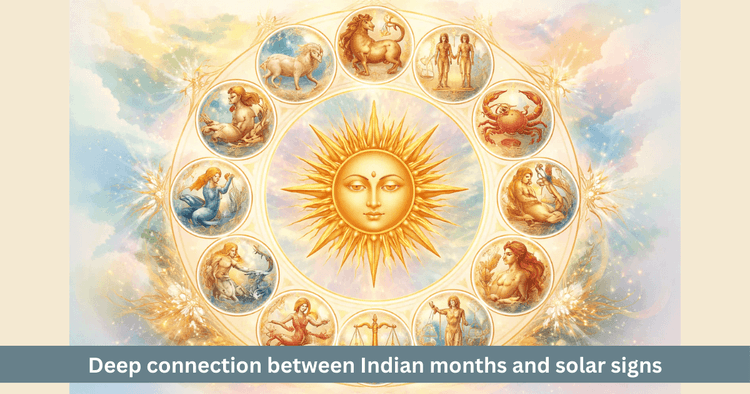
Table of Contents
In Indian Vedic astrology time is not viewed merely as a calendar device but as a living energy. The Sun is regarded as the centre of the wheel of time because through its movement day and night, seasons, climate and the rhythm of life are all governed. For this reason the true structure of the traditional Indian year is understood through the Sun’s journey across the twelve zodiac signs.
Whenever the Sun moves from one sign to another the moment is called Sankranti. On the basis of these sankrantis the Indian solar months are formed. This creates a direct connection between traditional months and the Sun’s position in the zodiac. This framework has been followed for thousands of years and still guides the panchang, religious festivals and many rituals in daily life.
In Vedic astrology the zodiac is calculated according to the nirayana zodiac, which remains aligned with the actual constellation belt in the sky. Because of this, the system differs significantly from the Western tropical zodiac in both calculation and interpretive flavour.
Vedic view of the Sun and the wheel of time
In the Rgveda and other Vedic texts the Sun is addressed as the maker of time. Through the Sun’s motion
day and night arise
seasons unfold
and the yearly cycle moves forward.
When the Sun enters a fresh sign it is not only an astronomical shift but also a change in the subtle energy of nature. Variations in temperature, wind, growth of plants and the behaviour of living beings can gradually be noticed.
Therefore each solar month is understood to have its own nature, qualities and spiritual indication. Some months are considered good for new beginnings, others for austerity and discipline and some for self reflection and completion of cycles.
Solar signs and Indian solar months
Based on the Sun’s transit through the zodiac, Indian solar months form a coherent structure. The following table shows how each solar sign relates to a traditional solar month and its approximate period.
| Solar sign | Indian solar month | Approximate period |
|---|---|---|
| Mesha | Vaishakha | Mid April to mid May |
| Vrishabha | Jyeshtha | Mid May to mid June |
| Mithuna | Ashadha | Mid June to mid July |
| Karka | Shravana | Mid July to mid August |
| Simha | Bhadrapada | Mid August to mid September |
| Kanya | Ashvina | Mid September to mid October |
| Tula | Kartika | Mid October to mid November |
| Vrishchika | Margashirsha | Mid November to mid December |
| Dhanu | Pausha | Mid December to mid January |
| Makara | Magha | Mid January to mid February |
| Kumbha | Phalguna | Mid February to mid March |
| Meena | Chaitra | Mid March to mid April |
This complete sequence represents the annual journey of the Sun through the twelve signs and forms the basis for agriculture, festivals, pilgrimage baths and many fasts.
Meaning of Mesha Sun and Vaishakha
When the Sun enters Mesha rashi Aries the sankranti is known as Mesha Sankranti. This is considered the exalted position of the Sun and is associated with high energy, enthusiasm and the power of new beginnings.
Vaishakha is linked with emergence, growth and active movement. Many Indian traditions treat this time as the start of the year. Regional New Years, harvest celebrations and fresh resolutions are often placed in this period. The Mesha Sun supports self confidence, courage and the starting of important ventures.
Meaning of Vrishabha Sun and Jyeshtha
When the Sun moves into Vrishabha rashi Taurus, nature gains stability and grounded strength. Jyeshtha is usually the hottest part of the year when the heat of the earth reaches a peak and tests endurance.
Vrishabha Sun is associated with material resources, wealth, land, family and a sense of security. Efforts made during this time can create long lasting foundations. It is considered a good month for planning with patience, strengthening finances and bringing steadiness into daily life.
Mithuna Sun and communicative Ashadha
As the Sun enters Mithuna rashi Gemini, mental activity, communication and the urge to learn increase. Ashadha is related to thinking, studying and exchanging information.
Mithuna Sun emphasises dialogue in relationships. Travels, planning and networking tend to grow. From a spiritual viewpoint this month encourages scriptural study, exploration of teachings and deepening the guru disciple connection.
Karka Sun and devotional Shravana
Entry of the Sun into Karka rashi Cancer often marks the beginning of Dakshinayana. Days start to shorten and nights to lengthen, symbolically pointing to inner orientation and emotional depth.
Shravana is widely associated with devotion, the water element and emotional purification. Worship of Shiva, water based rituals and various fasts are commonly observed in this period. Karka Sun also awakens themes of home, mother and emotional security.
Simha Sun and radiant Bhadrapada
When the Sun reaches its own sign Simha rashi Leo, issues of self confidence, leadership and honour come to the forefront. In Bhadrapada the Sun is naturally strong and expressive.
Simha Sun relates to royal qualities, morale and healthy pride. This month is favourable for clarifying one’s role in society, taking responsibility and expressing talents in a balanced, dignified way.
Kanya Sun and orderly Ashvina
With the Sun’s transit into Kanya rashi Virgo, attention shifts to detail, analysis and organisation. Ashvina is seen as a period for cleansing and arranging life in a more refined order.
Kanya Sun supports practical thinking and discrimination. This month is helpful for reviewing mistakes, improving health routines, refining work methods and establishing a more balanced daily schedule. Several fasts and early autumn observances fall in this phase.
Tula Sun and introspective Kartika
In Tula rashi Libra the Sun is considered debilitated. This does not mean the time is negative but that the solar ego learns humility and balance.
Kartika highlights the importance of harmony, justice and fair relationships. Tula Sun invites examination of choices and partnerships. Spiritually it is a month of lamps, light and inner transformation, where one reflects on how to bring more balance into life.
Vrishchika Sun and deep Margashirsha
The Sun in Vrishchika rashi Scorpio is connected with depth, transformation and inner research. Margashirsha supports a seeker in recognising hidden patterns, fears and attachments.
Vrishchika Sun brings to light what is buried in the subconscious. It becomes a powerful period for meditation, intense spiritual practice and honest self enquiry.
Dhanu Sun and dharmic Pausha
When the Sun enters Dhanu rashi Sagittarius, focus moves towards dharma, philosophy and higher wisdom. Pausha is known for religious observances, service to saints and interest in sacred knowledge.
Dhanu Sun encourages reflection on life’s purpose, connection with teachers and clarity about one’s beliefs. It is a favourable time for contemplating spiritual goals and aligning outer life with inner values.
Makara Sun, Magha and Uttarayana
The Sun’s entry into Makara rashi Capricorn is called Makara Sankranti and marks the beginning of Uttarayana. Magha is regarded as a very auspicious month as the Sun’s movement towards the north symbolises ascent and illumination.
Makara Sun relates to responsibility, work and building solid foundations. Pilgrimage baths, charity, japa and austerity are especially recommended. Many traditions describe this period as one in which divine forces are more supportive of sincere effort.
Kumbha Sun and collective Phalguna
As the Sun moves into Kumbha rashi Aquarius, themes of society, community and service become prominent. Phalguna is full of gatherings, fairs and shared celebrations.
Kumbha Sun inspires individuals to look beyond personal concerns and to contribute to the welfare of the wider world. It is an encouraging time for friendship, collaboration and collective projects.
Meena Sun and preparatory Chaitra
When the Sun enters Meena rashi Pisces it signals the completion of one annual cycle. Chaitra can be understood as a preparatory phase for the next solar year.
Meena Sun heightens compassion, renunciation and inner reflection. It is a suitable time to close unfinished chapters, release emotional burdens and purify the mind in readiness for a new beginning.
Spiritual message of the solar months
In Vedic astrology the year is not only a chain of seasons but a map of inner evolution.
Each solar month brings a distinct energy.
Sometimes the Sun supports courage and initiation
at other times knowledge and clear communication
or austerity and discipline
or self reflection and peaceful closure.
Seen in this way the Sun’s journey through the signs mirrors the inner journey of a human being. When a person understands the nature of these solar months and gently aligns vows, lifestyle and spiritual effort with them, time no longer simply passes. It becomes a conscious companion on the path of growth.
Frequently asked questions
Are Indian solar months and lunar months always identical
Indian solar months are based on the Sun’s entry into zodiac signs, whereas lunar months are based on the Moon’s motion and tithis. To keep both in harmony an extra month is added at intervals, so the names and starting points of solar and lunar months do not always coincide exactly.
Why is Sankranti treated as so important
Sankranti marks the exact moment of the Sun’s entry into a new sign. From the Vedic perspective this marks the start of a new flow of energy. Many fasts, charities and pilgrimages are timed around sankranti because it represents a threshold and a fresh spiritual signal.
Why do many traditions regard Mesha Sankranti as the beginning of the year
In Mesha the Sun is exalted and Vaishakha carries the energy of warmth, growth and renewal. Therefore several regional calendars take the Sun’s entry into Mesha as the solar New Year and place festive and social beginnings around this time.
What does the debility of the Sun in Tula signify in practical life
The Sun is considered debilitated in Tula, which encourages a softening of ego and greater attention to balance and cooperation. It is a favourable time for reviewing decisions, restoring harmony in relationships and learning fairness and moderation.
How can spiritual practice be planned according to the Sun’s transit
If one understands the nature of each solar month, new beginnings may be kept around Mesha Vaishakha, decisions of stability during Vrishabha Jyeshtha, devotional and introspective practices in Karka Shravana and deeper self reflection in Meena Chaitra. The aim is not dependence on astrology but conscious cooperation with the natural flow of time.
What does Sun Sign reveal about me?
My Sun SignDid you like it?
Author

Pt. Abhishek Sharma (63)
Experience: 20
Consults About: Family Planning, Career
Clients In: Punjab, Haryana, Delhi
Share this article with friends and family
About ZODIAQ
ZODIAQ is an online Vedic Astrology platform. It connects clients seeking astrological advice to experienced astrologers with deep knowledge. Our users also generate kundali and perform kundali milan for free. ZODIAQ also offers services to the Astrologers. Astrologers utilize various offerings by ZODIAQ to serve their clients effectively.
If you are a User
Consult with experienced astrologers and seek their guidance. You can also order handwritten Janm Patrika report with life prediction prepared by experienced astrologers. Generate accurate Kundali, perform Kundali Matching and check horoscope and muhurat. Utilize our online library for all the necessary astrological and spiritual information.
If you are an Astrologer
Create accurate kundali for your clients and perform Kundali Matching for up to 5 people at a time. Write comprehensive Janm Patrika report for your clients with ZODIAQ. Check client details anytime by saving it in client directory. Become more productive by tracking how many clients you guide every day.
WELCOME TO
ZODIAQ
Right Decisions at the right time with ZODIAQ
