Vedic Link Between Tula Rashi and Kartika Month
By Pt. Abhishek Sharma
Beginning of Kartika Month and Natural Balance with Sun’s Entry in Tula
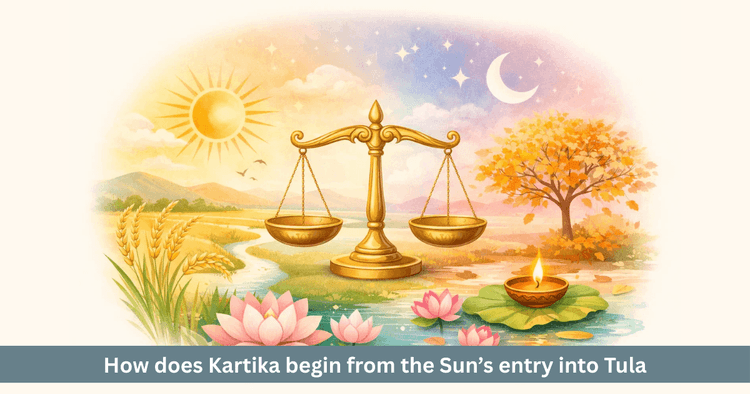
Table of Contents
In Vedic astrology the flow of time is understood not only through calendars but through the transit of the Sun across the zodiac. During the year the Sun travels through twelve rashis and the very moment it enters a new sign a new solar month is considered to begin. According to this rule, when the Sun enters Tula rashi Libra, the span of the month Kartika starts. Hence Kartika is regarded as directly and clearly connected with Tula rashi. This link rests not merely on name but on a subtle balance between nature, season and energy.
How does Kartika begin from the Sun’s entry into Tula
When the Sun moves out of Kanya rashi and enters Tula rashi, the event is known as Tula Sankranti. From this moment the energy of Kartika becomes active and a new month begins in the solar panchang. In the Indian solar calendar this is the period during which the Sun remains continuously in Tula, so Kartika in truth represents the full span of the Sun’s transit through Tula. During this time the seasonal cycle also shifts from the tail end of the monsoon and early autumn into a more balanced, clear and calm phase.
Structure of solar months and signs
Within the Vedic tradition solar months are formed on the basis of the Sun’s orderly passage through the zodiac. The Sun stays in each sign for about one month and then enters the next sign. Through this sequence twelve solar months arise and each month represents the stay of the Sun in one rashi. This relationship can be seen briefly in a simple table.
| Solar sign | Solar month | Main qualities |
|---|---|---|
| Kanya | Ashwin | Order, purity, balance |
| Tula | Kartika | Equality, harmony, clarity |
When the Sun resides in Tula rashi that span is called Kartika month. In this way both the name and timing of Kartika are directly linked to the Sun’s transit through Tula.
Nature of Tula rashi and the timing of Kartika
Tula rashi belongs to the air element. Its nature is associated with balance, harmony, equity and a sense of justice. The symbol of Tula is the scale, which points to weighing matters carefully, understanding both sides and taking even handed decisions.
During the part of the year when the Sun enters Tula, the monsoon has come to an end. Excess moisture in the atmosphere decreases, the air feels clearer and lighter, the sky appears cleaner and the temperature is experienced as more moderate. Around this phase the lengths of day and night are also felt as quite close to one another, which matches deeply with the sense of balance that belongs to Tula. In this way Kartika brings a season that is outwardly calm, clean and well poised.
Harmony between Kartika month and Tula energy
Kartika is the period in which nature appears clear and balanced after the rains. The mixed conditions of dust and heavy moisture give way to a fresh, light and orderly climate. The sky remains more open, the wind turns cooler and nature adjusts itself to a new and steady rhythm.
Tula rashi is likewise seen as a symbol of balance and harmony. It is connected with relationships, agreements, fairness and cooperation. Just as nature in Kartika adopts a coherent and balanced state, the energy of Tula encourages balance at the level of thought, relationship and choice. For this reason the stay of the Sun in Tula and the naming of this span as Kartika are understood in the Vedic view as natural and meaningful.
Place of Tula and Kartika in the Vedic panchang
The Indian Vedic panchang is based on the principle that the sign occupied by the Sun gives identity to the period that follows. When the Sun is in Kanya the solar month is called Ashwin, when the Sun is in Tula the solar month is called Kartika. Thus both the name and duration of Kartika are defined by the Sun’s transit through Tula.
In the panchang Kartika is regarded as a special month for many religious, spiritual and bathing vows. This is the time when nature is calm, water sources are relatively stable and the environment is clean, which makes it easier and more supportive to observe spiritual practices, vows and disciplines. The balanced energy of Tula turns this entire month into an opportunity to hold dharma and daily life together in a measured way.
Astrological meaning of the Tula and Kartika link
According to Vedic astrology planetary positions shape the energy and quality of time. When the Sun occupies Tula rashi, it stands in a sign associated with fairness, balance in relationships and a sense of inner justice. For this reason the energy of Kartika is also regarded as connected with balance, harmony and clarity.
This phase invites a person to observe where life has gone out of balance and in which relationships or decisions a greater sense of equality is needed. The energy of Tula restrains extremes and shows a middle path that honours both sides. Decisions made during Kartika can turn out to be more thoughtful, fair and beneficial in the long term if taken with a balanced mind.
Inner message of Kartika and Tula energy
Kartika in essence is the span of the Sun’s stay in Tula rashi and this position defines the astrological identity and natural energy of the month. It signals that along with outer achievements balance and equality are also essential in life. Tula encourages justice in relationships, clarity in communication and restraint in decisions so that support from time flows more naturally.
A person who uses Kartika to review thoughts, relationships and duties, who lets go of bias, develops a balanced vision and introduces needed adjustments in life can draw strong support from the air energy of this period. Kartika may be understood as a time to level the inner scales, quieten unbalanced currents within and clarify the path ahead.
Frequently asked questions
Why is Kartika linked specifically with Tula rashi
Kartika is the name of the span during which the Sun remains in Tula rashi. In the Vedic solar system months are always based on the Sun’s sign, so the period of the Sun’s transit through Tula is called Kartika. This makes the link between the two stable and clearly recognised.
Does Kartika always fall between the same Gregorian dates
No. The beginning of Kartika depends on the Sun’s entry into Tula. The date of Tula Sankranti shifts slightly from year to year, so the start of the solar month of Kartika also changes by a few days, although the basic rule that it begins when the Sun enters Tula remains unchanged.
How is the airy energy of Tula experienced during Kartika
The airy nature of Tula appears in Kartika through clear atmosphere, light breezes, moderate temperatures and an open sky. On the mental plane this energy supports balanced thinking, courteous communication and a sense of fairness, helping a person to choose a middle and just path rather than leaning to one extreme.
Is Kartika significant only in a religious sense or does it affect practical life as well
Kartika influences practical life also. As a post monsoon period it is favourable for travel, planning, storage, arranging homes and workplaces and adjusting health routines. When the environment is steady and clean it becomes easier to make economic, family and personal decisions.
How can one use Kartika and Tula energy in daily life
A person who works during this time to balance relationships, responsibilities and choices, who resolves conflicts through dialogue and gives priority to fair conduct, can benefit greatly from Tula energy. Considering agreements, partnerships and long term plans with a calm and even mind in Kartika is a practical way to use the energy of this month.
What does Sun Sign reveal about me?
My Sun SignDid you like it?
Author

Pt. Abhishek Sharma (63)
Experience: 20
Consults About: Family Planning, Career
Clients In: Punjab, Haryana, Delhi
Share this article with friends and family
About ZODIAQ
ZODIAQ is an online Vedic Astrology platform. It connects clients seeking astrological advice to experienced astrologers with deep knowledge. Our users also generate kundali and perform kundali milan for free. ZODIAQ also offers services to the Astrologers. Astrologers utilize various offerings by ZODIAQ to serve their clients effectively.
If you are a User
Consult with experienced astrologers and seek their guidance. You can also order handwritten Janm Patrika report with life prediction prepared by experienced astrologers. Generate accurate Kundali, perform Kundali Matching and check horoscope and muhurat. Utilize our online library for all the necessary astrological and spiritual information.
If you are an Astrologer
Create accurate kundali for your clients and perform Kundali Matching for up to 5 people at a time. Write comprehensive Janm Patrika report for your clients with ZODIAQ. Check client details anytime by saving it in client directory. Become more productive by tracking how many clients you guide every day.
WELCOME TO
ZODIAQ
Right Decisions at the right time with ZODIAQ
