Vedic Link Between Dhanu Rashi and Pausha Month
By Pt. Narendra Sharma
Beginning of Pausha Month and Natural Energy with Sun’s Entry in Dhanu
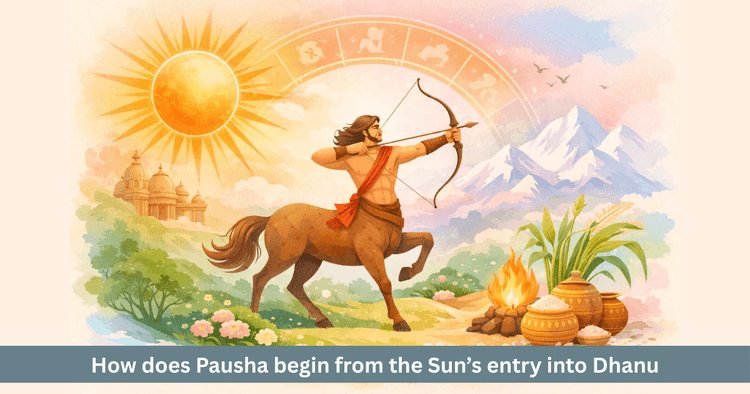
Table of Contents
In Vedic astrology the flow of time is identified not only through calendar dates but through the transit of the Sun across the zodiac. Throughout the year the Sun moves through twelve rashis and the very moment it enters a new sign a new solar month is considered to begin. According to this same principle, when the Sun enters Dhanu rashi Sagittarius, the span of the month Pausha starts. For this reason Pausha is regarded as directly and clearly connected with Dhanu rashi, because this month reflects the full period of the Sun’s stay in Sagittarius.
How does Pausha begin from the Sun’s entry into Dhanu
When the Sun leaves Vrishchika rashi and enters Dhanu rashi, the event is called Dhanu Sankranti. From that instant the energy of Pausha is considered active and a new month begins in the solar panchang. In the Indian solar calendar this is the period during which the Sun remains continuously in Dhanu, so Pausha in truth represents the full span of the Sun’s transit through Dhanu. At this time the cycle of seasons also moves into a more fully established winter and stability and seriousness become evident in the atmosphere.
Structure of solar months and signs
Within the Vedic tradition solar months are defined on the basis of the Sun’s sequential entry into the zodiac signs. The Sun stays in one sign for roughly a month and then moves into the next. In this manner twelve solar months are formed and each month represents the presence of the Sun in a particular rashi. This can be seen briefly through a simple table.
| Solar sign | Solar month | Main qualities |
|---|---|---|
| Vrishchika | Margashirsha | Depth, transformation, inwardness |
| Dhanu | Pausha | Direction, knowledge, expansion |
When the Sun is in Dhanu rashi, that span is called the month of Pausha. Thus both the name and the timing of Pausha are directly linked to the Sun’s transit through Dhanu and express the basic structure of the Vedic solar panchang.
Nature of Dhanu rashi and the timing of Pausha
Dhanu rashi belongs to the fire element and its nature is associated with expansion, knowledge, direction, ideals and long sighted vision. The symbol of this sign is an archer with a bow, which shows that when energy is focused toward a clear target, both direction and progress become possible in life. Dhanu energy encourages a person to move toward high principles, broader understanding and long term aims.
During the part of the year when the Sun enters Dhanu, winter has become clearly established. The cold stabilises, a strong sense of stillness fills the air and outer activities naturally become more limited. This is a phase in which people turn more toward reflection, planning and the search for understanding than toward outward restlessness. In this still, cool and serious environment of Pausha, the fiery energy of Dhanu works as inner inspiration and direction, which makes this month favourable for thought, study and setting clear goals.
Harmony between Pausha month and nature
Pausha is a time of the year in which nature appears quiet and stable. In many regions crops are ripening or preparing to ripen, the sky tends to remain clear and the air feels dense with cold and calm. Outer liveliness becomes somewhat restrained, yet inwardly processes of preparation and planning continue.
This condition matches the nature of Dhanu rashi. Dhanu gives importance not only to activity but to direction and purpose. During Pausha, the mind is naturally drawn to questions such as where to place one’s energy, what plan to make for the coming period and which areas of knowledge or experience should be deepened. In this sense, Pausha and Dhanu together create an atmosphere that suggests preparation for the journey ahead, grounded in steadiness.
Are Dhanu rashi and Pausha linked with mental tendencies as well
Dhanu rashi is connected with elevated thought, spirituality, philosophy and a broad viewpoint. It encourages a person to think not only about immediate profit but also about long term results and higher purposes.
Because of the quiet and stable environment of Pausha, the mind receives more scope to think calmly. People often use this time to reflect on life direction, career, study, goals and responsibilities. This is the same tendency that turns the fire of Dhanu toward knowledge and clear direction. The reflective mood that grows in Pausha can therefore be seen as closely related to the expansive yet purposeful energy of Dhanu.
Place of Dhanu and Pausha in the Vedic panchang
The Indian Vedic panchang is built on the principle that the sign occupied by the Sun gives identity to the period that follows. When the Sun is in Vrishchika, the solar month is called Margashirsha. When the Sun is in Dhanu, the solar month is called Pausha. Hence both the name and span of Pausha are determined by the Sun’s transit through Dhanu.
Pausha is described in the panchang as supporting restraint, charity, spiritual practice and inner discipline. The stable winter season allows a person to step back from outer display and pay more attention to inner growth. Dhanu energy gives this period a character in which dharma, knowledge and duty can be brought into better alignment.
Astrological meaning of the Dhanu and Pausha link
According to Vedic astrology planetary positions shape the energy and quality of time. When the Sun is placed in Dhanu rashi, it brings a field of energy that is related to direction, wisdom, purpose, expansion and higher ideals. Life events during this time can gently push a person to think about where time is leading and in which areas growth is truly needed.
In Pausha the influence of Dhanu can awaken the question that it is not enough merely to move but necessary to see toward which goal one is moving. This period can be especially helpful for those who wish to clarify a path of study, a spiritual direction, a long term aim or a higher purpose in life. In this way the link between Pausha and Dhanu conveys that this is a time to strengthen direction, knowledge and intention.
Inner message of Pausha and Dhanu energy
Pausha is in essence the period of the Sun’s stay in Dhanu rashi and this placement determines the astrological identity and natural energy of the month. It shows that a time of pause is not only for stopping but also for shaping a clearer road for the journey ahead. The fiery energy of Dhanu in this cold season can act like an inner flame that keeps a person away from discouragement and offers direction and trust.
Those who use this time to clarify life goals, renew their commitment to study or spiritual practice or redefine their responsibilities can find strong support in the energy of Pausha. The month arrives like a quiet halt from which the next step can be taken with greater thought, understanding and alignment with one’s chosen path.
Frequently asked questions
Why is Pausha linked specifically with Dhanu rashi
Pausha is the name of the span during which the Sun remains in Dhanu rashi. In the Vedic solar system months are always based on the Sun’s sign, so the period of the Sun’s transit through Dhanu is called Pausha. This makes the bond between them stable and clearly accepted.
Does Pausha always fall between the same Gregorian dates
No. The beginning of Pausha depends on the Sun’s entry into Dhanu. The date of Dhanu Sankranti shifts slightly from year to year, so the start of the solar month of Pausha also changes by a few days, although the rule that it begins when the Sun enters Dhanu remains constant.
How is the fiery energy of Dhanu seen during Pausha
The fire of Dhanu is seen in Pausha as inner motivation, goal setting, interest in study and attraction toward higher thought. The weather may be cold outside, yet inside new plans, resolutions and the search for direction can become active, which is in harmony with the nature of this sign.
Is Pausha important only in a religious or spiritual sense or does it influence practical life as well
Pausha affects practical life also. Because of the winter season, attention to health, routine and energy management becomes important. People often use this time to plan the next phase of the year, review finances and organise their direction in life, all of which relate closely to the knowledge and guidance oriented energy of Dhanu.
How can one use Pausha and Dhanu energy in daily life
A person who decides during this time to define long term goals, strengthen regularity in study or spiritual practice and shape decisions in line with higher aims can benefit greatly from Dhanu energy. Plans formed in Pausha, when joined with knowledge and responsibility, can become a steady foundation for progress in the months that follow.
What does Sun Sign reveal about me?
My Sun SignDid you like it?
Author

Pt. Narendra Sharma (63)
Experience: 20
Consults About: Family Planning, Career
Clients In: Punjab, Haryana, Delhi
Share this article with friends and family
About ZODIAQ
ZODIAQ is an online Vedic Astrology platform. It connects clients seeking astrological advice to experienced astrologers with deep knowledge. Our users also generate kundali and perform kundali milan for free. ZODIAQ also offers services to the Astrologers. Astrologers utilize various offerings by ZODIAQ to serve their clients effectively.
If you are a User
Consult with experienced astrologers and seek their guidance. You can also order handwritten Janm Patrika report with life prediction prepared by experienced astrologers. Generate accurate Kundali, perform Kundali Matching and check horoscope and muhurat. Utilize our online library for all the necessary astrological and spiritual information.
If you are an Astrologer
Create accurate kundali for your clients and perform Kundali Matching for up to 5 people at a time. Write comprehensive Janm Patrika report for your clients with ZODIAQ. Check client details anytime by saving it in client directory. Become more productive by tracking how many clients you guide every day.
WELCOME TO
ZODIAQ
Right Decisions at the right time with ZODIAQ
