Vedic Link Between Vrishabha Rashi and Jyeshtha Month
By Pt. Narendra Sharma
Energy of Jyeshtha Month and Nature’s Changes with Sun’s Entry in Vrishabha
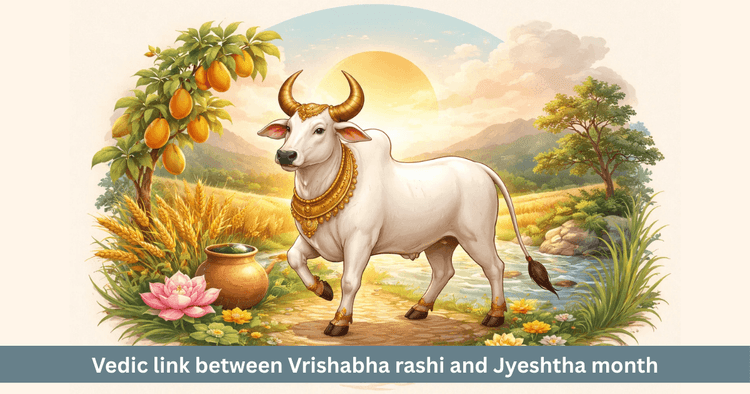
Table of Contents
In Vedic astrology time is not defined only by calendar dates but by the Sun and the planets and their positions. The flow of the year is understood mainly from the sign in which the Sun is placed and from the moments when it moves from one sign to another. When the Sun enters a new sign that moment is called Sankranti and from that instant a new solar month is considered to begin.
According to this very principle, when the Sun enters Vrishabha rashi Taurus, the energy of the month Jyeshtha is treated as active. Thus a direct and deep relationship is formed between Jyeshtha and the sign Vrishabha. This link is not only a matter of terminology. It rests on the experience of changes in nature, temperature, soil and the maturing energy of life.
How solar months are arranged through the Sun’s transit
In Vedic astrology each solar month is associated with the sign in which the Sun is located during that period. The ancient Indian astrologers carefully studied celestial motion and saw that over the course of a year the Sun passes through twelve signs. In each sign it remains for roughly one month.
On this observation the structure of Indian solar months was built. When the Sun is in Mesha the month is Vaishakha, when it is in Vrishabha the month is Jyeshtha, when in Mithuna the month is Ashadha and so the sequence continues. From this perspective Jyeshtha is that solar span during which the Sun resides in Vrishabha rashi. Hence, Jyeshtha may rightly be called the living representation of the Sun’s transit through Vrishabha.
Why was Vrishabha rashi linked with this part of the year
Vrishabha rashi belongs to the earth element and is considered a stable sign. Its nature is connected with patience, endurance, nourishment and material steadiness. During that section of the year when the Sun enters Vrishabha, a kind of steady heat begins to be felt in nature.
The warmth of the Sun is no longer just emerging. It becomes more settled. The temperature of the soil rises and the processes of ripening and maturing in plants, fruits and grains intensify. The air feels heavier and for human beings this becomes a time that naturally tests patience, tolerance and physical strength.
Because of this the inherent character of Vrishabha and the external conditions of Jyeshtha match one another very closely. The sign symbolises earth, patience and stability, while the month reflects the earth’s grown heat and a firm environment.
Harmony between the nature of Jyeshtha and Vrishabha energy
Jyeshtha is recognised as a time of the year when the heat of the Sun is felt most strongly. Days become long and intense, sunlight feels sharp and the stored energy within the earth moves towards a state of full ripening.
Vrishabha, as a fixed earth sign, expresses similar energy. Its basic qualities are nourishment, accumulation, endurance and practicality. Therefore the Sun’s placement in Vrishabha is seen as very fitting for the natural situation in this phase of the year.
On an inner level this month also trains human beings in patience and balance. Heat creates pressure on body and mind and under that pressure the stable energy of Vrishabha guides towards moderation, regular habits and an honest recognition of personal limits. In this way, during Jyeshtha, Vrishabha energy serves to give life a firm and grounded base.
Basis of the Vrishabha and Jyeshtha link in the Vedic panchang
The Indian Vedic panchang is not the outcome of dry mathematical calculation alone. It is a living map of the relationship between the sky and nature. The sign in which the Sun stands becomes the basis for the naming and character of the solar month that follows.
For this reason, when the Sun is in Vrishabha rashi that span is called the month of Jyeshtha. The Sun’s position in this sign shapes the identity of the month, its energy and its religious emphasis. In Jyeshtha the power of the Sun is strong, the need for water is greater and it becomes important to maintain discipline and care. The panchang keeps this in view and associates Jyeshtha with specific fasts, rules and rituals.
In brief, the name and timing of Jyeshtha are directly tied to the Sun’s transit in Vrishabha and this is fully consistent with the basic principles of Vedic astrology.
Astrological principle behind the Vrishabha and Jyeshtha relationship
The core idea of Vedic astrology is that planetary positions define the quality of time. Time is not just a mechanical measure but a subtle form of energy whose tone changes with planetary motion.
The sign in which the Sun is placed influences the energy and nature of that month. When the Sun occupies Vrishabha rashi, the stable, patient and nourishing energy of the earth element colours the whole atmosphere of that period. On this basis it is said that Jyeshtha month and Vrishabha rashi are directly connected.
From this angle the view that Jyeshtha is the duration of the Sun’s stay in Vrishabha is the natural conclusion of Vedic astrology. The quality of that stay guides the character, experiences and discipline associated with the month.
Inner message of Jyeshtha and Vrishabha energy
Both Jyeshtha and Vrishabha invite a person to remain steady, to conserve energy and to use resources thoughtfully. This time discourages haste and encourages patient waiting and balanced effort.
Anyone who chooses during this period to value discipline, regular spiritual practice and sound practical decisions can receive strong support from the stable energy of Vrishabha. Amid the intensity of Jyeshtha, if inner equilibrium is preserved, the month becomes not only a symbol of heat but also a sign of maturity and stability.
Frequently asked questions
Why is Jyeshtha linked specifically with Vrishabha rashi and not with some other sign
Jyeshtha appears at the time when the Sun is placed in Vrishabha. Vedic solar months are always defined from the Sun’s position, so the period during which the Sun remains in Vrishabha is recognised as Jyeshtha. This fixes the relationship between the two.
Does Jyeshtha fall between the same Gregorian dates every year
No. The start of Jyeshtha depends on the Sun’s entry into Vrishabha. The exact sankranti date shifts slightly from year to year, so the beginning of Jyeshtha also moves by a few days, even though the underlying rule remains the same.
How is the earth element of Vrishabha reflected during Jyeshtha
Vrishabha, as an earth sign, stresses stability, patience and nourishment. In Jyeshtha the earth’s heat steadily increases, crops, fruits and plants move towards ripening and human life also faces tests of endurance and tolerance.
Is Jyeshtha only a hot and difficult month or does it have spiritual value as well
Jyeshtha is not just a period of heat. It is also a time for cultivating inner moderation and balance. The importance of water and cooling routines rises and it is advisable to keep the body light and the mind calm. Through fasting, japa and regular practice the stable energy of Vrishabha can be channelled positively.
Is it suitable to begin new discipline or resolutions in Jyeshtha
Jyeshtha is linked with Vrishabha energy, which encourages stability and long term commitment. If a person chooses this time to take up resolutions related to health, routine, financial discipline or steady spiritual practice, the influence of Vrishabha can help in remaining consistent, provided that the decisions are thoughtful and sincere.
What does Sun Sign reveal about me?
My Sun SignDid you like it?
Author

Pt. Narendra Sharma (63)
Experience: 20
Consults About: Family Planning, Career
Clients In: Punjab, Haryana, Delhi
Share this article with friends and family
About ZODIAQ
ZODIAQ is an online Vedic Astrology platform. It connects clients seeking astrological advice to experienced astrologers with deep knowledge. Our users also generate kundali and perform kundali milan for free. ZODIAQ also offers services to the Astrologers. Astrologers utilize various offerings by ZODIAQ to serve their clients effectively.
If you are a User
Consult with experienced astrologers and seek their guidance. You can also order handwritten Janm Patrika report with life prediction prepared by experienced astrologers. Generate accurate Kundali, perform Kundali Matching and check horoscope and muhurat. Utilize our online library for all the necessary astrological and spiritual information.
If you are an Astrologer
Create accurate kundali for your clients and perform Kundali Matching for up to 5 people at a time. Write comprehensive Janm Patrika report for your clients with ZODIAQ. Check client details anytime by saving it in client directory. Become more productive by tracking how many clients you guide every day.
WELCOME TO
ZODIAQ
Right Decisions at the right time with ZODIAQ
