Vedic Link Between Kanya Rashi and Ashwin Month
By Aparna Patni
Beginning of Ashwin Month and Natural Balance with Sun’s Entry in Kanya
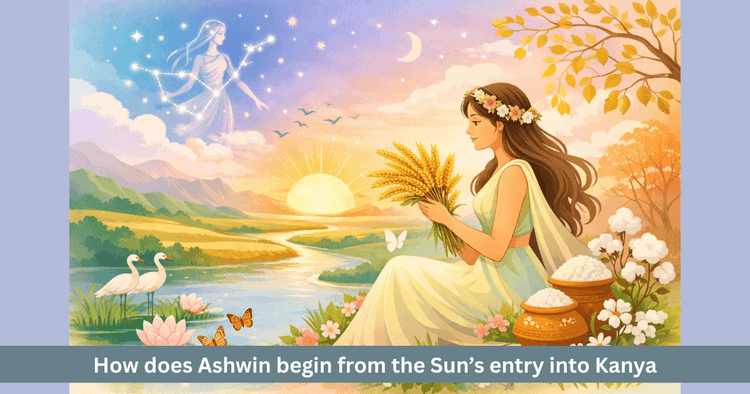
Table of Contents
In Vedic astrology the flow of time is identified not only through calendar dates but through the transit of the Sun across the zodiac signs. During the year the Sun moves through twelve rashis and the very moment it enters a new sign a new solar month is considered to begin. In keeping with this principle, when the Sun enters Kanya rashi Virgo, the span of the month Ashwin starts. Therefore Ashwin is regarded as directly and clearly connected with Kanya rashi. This relationship rests not just on a shared name but on a balanced meeting of nature, seasonal change and the position of the Sun.
How does Ashwin begin from the Sun’s entry into Kanya
When the Sun leaves Simha rashi and enters Kanya rashi the event is called Kanya Sankranti. From this moment the energy of Ashwin is treated as active and in the solar panchang a new month begins. In the Indian solar calendar this is the period during which the Sun remains continuously in Kanya, so Ashwin in fact represents the complete span of the Sun’s transit through Kanya. During this time, along with the change in the Sun’s position, a clear shift appears in the nature of the season as the year moves away from the monsoon towards the early autumn.
Arrangement of solar months and signs
In the Vedic tradition solar months are structured on the basis of the Sun’s orderly transit through the zodiac. The Sun stays in each sign for about one month and then passes into the next, thus forming twelve solar months. This connection can be seen briefly through a simple table.
| Solar sign | Solar month | Main qualities |
|---|---|---|
| Simha | Bhadrapada | Stability, radiance, leadership |
| Kanya | Ashwin | Order, balance, purity |
When the Sun resides in Kanya rashi that period is called Ashwin month. In this way both the name and timing of Ashwin are directly tied to the Sun’s transit through Kanya and this explains the basic structure of Vedic solar timekeeping.
Nature of Kanya rashi and the timing of Ashwin
Kanya rashi belongs to the earth element. Its nature is associated with order, analysis, purity and practicality. The energy of this sign encourages bringing structure into disorder, understanding details and taking balanced decisions.
During the part of the year when the Sun enters Kanya, the rainy season moves towards its close. Heavy showers usually decrease, the sky looks clearer and a feeling of cleanliness and lightness develops in the atmosphere. The fertility of the soil has become steady, crops are taking shape and the climate is moving gradually towards a balanced temperature. All this harmonises closely with the earth based orderly and balanced nature of Kanya.
Harmony between Ashwin and Kanya energy
Ashwin is the phase of seasonal change in which the force of the monsoon clearly recedes and purity and clarity become visible in the environment. After the rains the air becomes relatively clean, the colour of the sky grows sharper and a new kind of calm and order can be felt in nature. The time is neither excessively damp nor completely dry but moves towards a more balanced state.
Kanya rashi in the same way symbolises order, balance and purity. Its influence helps to filter out what is unnecessary and to focus attention on what is essential. That is why when the Sun remains in Kanya and that very span is called Ashwin, it becomes clear that there is deep harmony between the pure, balanced and well arranged state of nature and the subtle earth element energy of Kanya. Ashwin may therefore be seen as a signal for introducing inner cleansing and order into life.
Place of Kanya and Ashwin in the Vedic panchang
The Indian Vedic panchang is built on the principle that the sign occupied by the Sun gives identity to the period that follows. When the Sun is in Simha, the solar month is called Bhadrapada. When the Sun is in Kanya, the solar month is called Ashwin. Thus both the name and duration of Ashwin are fixed by the Sun’s transit through Kanya.
The fasts, festivals and observances recorded in the panchang for this time are also set with this energy in mind. Many important religious practices, early autumn festivals and purity oriented rules are placed near this month. The subtle and analytical nature of Kanya makes this phase suitable for reflecting on order in life, health, spiritual discipline and the direction of one’s work.
Astrological meaning of the Kanya and Ashwin link
According to Vedic astrology planetary positions shape the energy and quality of time. When the Sun is placed in Kanya rashi, the energy of that period is linked with balance order, analysis and clarity. This phase can be seen as well suited for correction, adjustment and practical planning on both outer and inner levels.
In Ashwin, Kanya energy inspires a person to see where life has become tangled, in which areas cleansing and simplicity are needed and which decisions must be taken with greater thought. Just as nature brings itself into balance after the monsoon, during this time it is beneficial for a person to organise daily routine, health and working patterns. For this reason the bond between Ashwin month and Kanya rashi underlines that this is a period of balanced improvement and fine understanding.
Inner message of Ashwin and Kanya energy
Ashwin is in reality the span of the Sun’s stay in Kanya and this position defines the astrological identity and natural energy of the month. It indicates that life requires not only enthusiasm and movement but also structure and clarity. Kanya rashi suggests that by paying attention to small details, correcting what needs correction in time and adopting simplicity, the larger results of the future can be made more favourable.
Anyone who uses this time to review habits, health, work style and spiritual discipline, who lets go of unnecessary burdens and focuses on what is truly needed, can gain strong support from the energy of Ashwin. The month acts like a signal to clean the pages of life’s notebook, prepare the next chapter and bring the mind into a practical and balanced state.
Frequently asked questions
Why is Ashwin linked specifically with Kanya rashi
Ashwin is the name of the period during which the Sun remains in Kanya rashi. Vedic solar months are always based on the Sun’s sign, so the span of the Sun’s transit through Kanya is called Ashwin. This makes the bond between the two stable and clearly accepted.
Does Ashwin always fall between the same Gregorian dates
No. The beginning of Ashwin depends on the Sun’s entry into Kanya. The date of Kanya Sankranti changes slightly from year to year, so the start of the solar month of Ashwin also shifts by a few days, although the rule that it begins when the Sun enters Kanya remains constant.
How is the earth based nature of Kanya seen during Ashwin
The earth element of Kanya appears in Ashwin through balanced weather, steady fertility, clear air and well arranged agricultural activity. The time is favourable for doing practical work in an orderly way, paying attention to details and implementing plans with clarity.
Is Ashwin important only astrologically or does it influence practical life as well
Ashwin affects many areas of life. As a balanced period after the rains it is regarded as suitable for matters of health, cleanliness, storage, travel and reorganisation of schedules. People are naturally drawn to arrange home, workplace and daily routines, which reflects the active influence of Kanya.
How can one use Ashwin and Kanya energy in daily life
A person who gives priority during this time to cleanliness, discipline, time management and practical planning can benefit greatly from Kanya’s analytical energy. Health checkups, review of working systems, forming a clear plan for study or spiritual practice and reducing unnecessary complications are all considered good ways to use the energy of this month.
What does Sun Sign reveal about me?
My Sun SignDid you like it?
Author

Aparna Patni (63)
Experience: 20
Consults About: Family Planning, Career
Clients In: Punjab, Haryana, Delhi
Share this article with friends and family
About ZODIAQ
ZODIAQ is an online Vedic Astrology platform. It connects clients seeking astrological advice to experienced astrologers with deep knowledge. Our users also generate kundali and perform kundali milan for free. ZODIAQ also offers services to the Astrologers. Astrologers utilize various offerings by ZODIAQ to serve their clients effectively.
If you are a User
Consult with experienced astrologers and seek their guidance. You can also order handwritten Janm Patrika report with life prediction prepared by experienced astrologers. Generate accurate Kundali, perform Kundali Matching and check horoscope and muhurat. Utilize our online library for all the necessary astrological and spiritual information.
If you are an Astrologer
Create accurate kundali for your clients and perform Kundali Matching for up to 5 people at a time. Write comprehensive Janm Patrika report for your clients with ZODIAQ. Check client details anytime by saving it in client directory. Become more productive by tracking how many clients you guide every day.
WELCOME TO
ZODIAQ
Right Decisions at the right time with ZODIAQ
