The Sky Shape of Anuradha Nakshatra: A Gentle Curved Chain in the Scorpius Sky
By Pt. Nilesh Sharma
Anuradha Nakshatra presents a gentle curved chain of stars, creating a smooth flowing experience in the sky
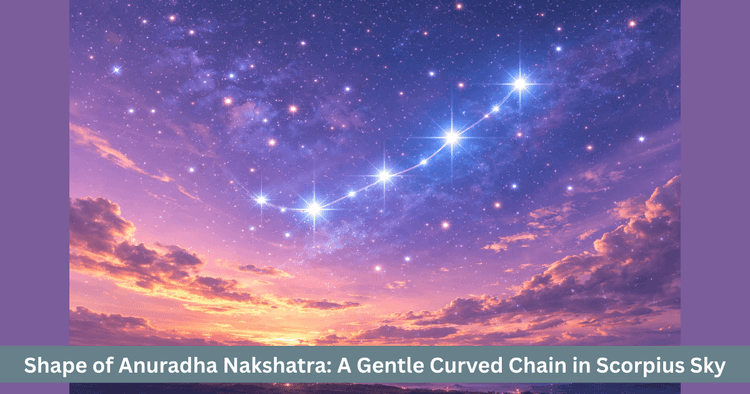
Table of Contents
In Vedic astrology, Anuradha Nakshatra marks the point where the sky begins to feel deeper and more layered. After Vishakha, which appears as a branching formation, Anuradha shifts the viewing experience toward a smoother flow. It does not look like a fork and it does not resemble a box. Instead it feels like a small chain of stars that gently curves, as if the sky has drawn a soft path for the eyes to follow.
Anuradha lies in the Scorpius region. This part of the sky often feels richer because the stars start arranging themselves into more recognisable sequences. For a viewer, Anuradha becomes engaging precisely because it is not about one dominant point. It is about tracing a short line with a subtle bend, a pattern that invites continuous movement.
What the Actual Shape of Anuradha Looks Like
In the night sky, Anuradha is best experienced as a small chain of stars that forms a gentle curve. The stars associated with this area, linked with the central Scorpius region, create a pattern that looks like a short arc rather than a long sweeping bow.
The simplest description of Anuradha’s sky shape can be put like this.
A short curved chain of stars in Scorpius, like a small arc that the eyes can easily trace.
This arc does not span a very large part of the sky. It remains compact, yet it is clear enough that once noticed, the eyes naturally travel along it and rarely stop at only one point.
Key Features of Anuradha’s Sky Pattern
| Feature | Experience in the sky |
|---|---|
| Core form | Short sequence of closely placed stars |
| Shape impression | Gentle curve, like a small bow or arc |
| Nature | Neither branching nor box like but a smooth directional line |
| Overall feeling | Sense of flow, rhythm and quiet continuity |
This outline shows that Anuradha is recognised through its curved form and the way its stars hold together as a single flowing sequence.
Why Does Anuradha Feel Different to a Viewer
A branching pattern makes the eyes split between two directions. A curved chain makes the eyes flow along one line. Anuradha carries exactly this flowing quality.
When someone observes this Nakshatra, the gaze does not stop at one star and remain fixed there. It moves steadily across the short line and that motion makes Anuradha feel connected and alive. This is why Anuradha is often described as holding a sense of rhythm and continuity. The sky shape itself supports this impression, because it gently guides the eyes instead of forcing them to choose between branches.
How to Spot Anuradha in the Sky Like a Viewer
A practical method can help a viewer locate Anuradha with ease.
- First identify the main outline of the Scorpius constellation. Scorpius usually stands out because of its distinctive shape and several brighter stars.
- Once it is clear that the gaze is inside Scorpius, look for a small line of stars that seems to run in a single direction rather than scattering outward.
- Examine whether that line has a gentle bend. If the stars do not sit in a perfectly straight row but instead suggest a slight bow like curve, this is a strong hint of Anuradha.
- Stop scanning for a few moments and allow the eyes to rest on that sequence while mentally tracing the arc. As soon as this happens, the curved chain of Anuradha becomes more distinct and memorable.
In city skies, fewer stars may be visible, yet if the main stars remain, the line like feeling of the pattern can still be recognised. Under darker, clearer skies, the arc becomes more satisfying because the entire chain can be seen as one continuous curve.
What Makes the Shape of Anuradha Interesting
Anuradha is interesting because it introduces the viewer to a new style of pattern. It is not a strong single marker like Magha. It is not a simple pair like Punarvasu. It is not a compact triangle like Pushya. Anuradha is defined by a connected curved chain.
This gives it the feeling of a pathway rather than a signpost. The sky appears to be guiding the observer deeper into Scorpius, toward regions where the later Nakshatras form even more intense and concentrated designs. Before that intensity begins, Anuradha offers a rhythmic pause where the journey is felt as a smooth progression along a gentle arc.
The Viewer Feeling of Anuradha
When a viewer spends time with Anuradha, the impressions often gather into a few clear notes.
A small yet distinct connected sequence of stars.
A gentle arc instead of a stiff or sharp angle.
A sense of flow, as though the eyes are moving along a path rather than jumping between points.
This is why Anuradha tends to stay in memory. It is not just a group of lights in one place. It is a line that leads and the memory of that movement remains.
A Simple Line to Remember the Shape of Anuradha
One concise sentence can hold Anuradha’s form clearly in mind.
Anuradha looks like a short curved chain of stars in Scorpius, a gentle arc that the viewer naturally follows with the eyes.
Anyone who keeps this line in mind while studying the Scorpius region will gradually begin to recognise the same curved chain as the steady signature of Anuradha.
The Moving Presence of Anuradha Nakshatra
Anuradha Nakshatra shows that some parts of the sky are best understood through motion rather than stillness. Here the focus is not on a single brilliant point but on the small arc that the eyes travel along.
The moment that curved chain is noticed and the gaze begins to trace it, the sky feels more alive. The zodiac stops being just a fixed map and starts to feel like a journey. Within that journey, Anuradha becomes a graceful turning, a place where light arranges itself into a quiet path rather than a rigid sign.
Frequently Asked Questions
What is the main visible shape of Anuradha Nakshatra in the sky
Anuradha appears as a short curved chain of stars in the Scorpius region, forming a gentle arc that the eyes can easily follow.
How is the experience of Anuradha different from that of Vishakha
Vishakha looks like a branching fork like pattern that splits the gaze into two directions, while Anuradha looks like one flowing curved line that guides the eyes smoothly along a single path.
What is the simplest way to locate Anuradha while stargazing
First identify the outline of Scorpius, then look inside it for a small line of stars that shows a soft bend rather than a straight row and patiently trace that arc with the eyes.
Can Anuradha’s arc be recognised from city skies with light pollution
Often it can, if the main stars are still visible. Even when fainter points fade, the basic line like impression of the pattern may remain, though a truly clear sense of the arc is easier under darker skies.
What is the easiest line to remember Anuradha’s sky shape
One can remember that Anuradha is a short gently curved chain of stars in Scorpius, a small arc that turns the sky from a static picture into a feeling of motion.
What does Nakshatra reveal about me?
My NakshatraDid you like it?
Author

Pt. Nilesh Sharma (63)
Experience: 20
Consults About: Family Planning, Career
Clients In: Punjab, Haryana, Delhi
Share this article with friends and family
About ZODIAQ
ZODIAQ is an online Vedic Astrology platform. It connects clients seeking astrological advice to experienced astrologers with deep knowledge. Our users also generate kundali and perform kundali milan for free. ZODIAQ also offers services to the Astrologers. Astrologers utilize various offerings by ZODIAQ to serve their clients effectively.
If you are a User
Consult with experienced astrologers and seek their guidance. You can also order handwritten Janm Patrika report with life prediction prepared by experienced astrologers. Generate accurate Kundali, perform Kundali Matching and check horoscope and muhurat. Utilize our online library for all the necessary astrological and spiritual information.
If you are an Astrologer
Create accurate kundali for your clients and perform Kundali Matching for up to 5 people at a time. Write comprehensive Janm Patrika report for your clients with ZODIAQ. Check client details anytime by saving it in client directory. Become more productive by tracking how many clients you guide every day.
WELCOME TO
ZODIAQ
Right Decisions at the right time with ZODIAQ
