The Sky Shape of Ashlesha Nakshatra: A Winding Serpentine Line in the Cancer Region
By Pt. Nilesh Sharma
How to recognise a curving star chain in Cancer, not a triangle, but a flowing line that guides the gaze forward
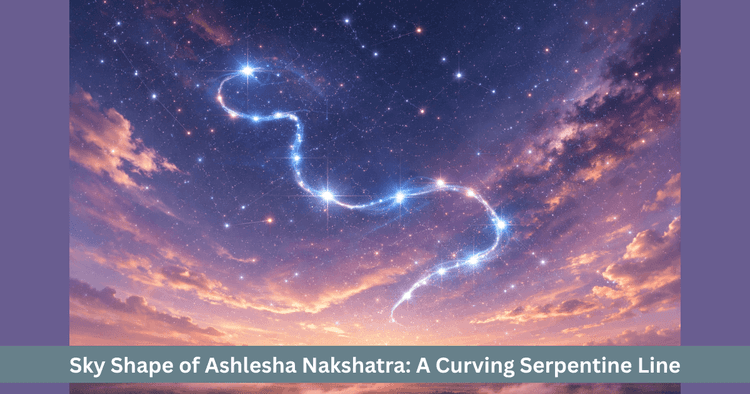
Table of Contents
In Vedic astrology, Ashlesha Nakshatra is one of the most visually distinct regions once a viewer understands what to look for. It is not a neat triangle and it is not a clean twin pair. Instead it carries a flowing shape. It looks like a curve. For the attentive viewer, Ashlesha feels as if the zodiac sky has moved beyond compact contained patterns into something that stretches and winds across a section of space.
Ashlesha lies within the Cancer region of the sky, yet its visual identity is closely linked with a nearby line of stars that feels like a long celestial serpent. This connection gives Ashlesha a more extended and serpentine impression when compared with the compact triangular feel of Pushya. It seems as though someone has drawn a soft wandering line across the calm canvas of Cancer.
What the Actual Shape of Ashlesha Looks Like
In the sky, Ashlesha is best experienced as a curving chain of stars. The stars in this region do not lock themselves into a simple geometric outline. Instead the main points create the sense of a bent line, almost like a slow wave moving across the sky. The line is not sharply broken. It bends gently and the eye follows its motion with ease.
The simplest way to describe Ashlesha’s sky shape can be said in a single thought.
A curved line of stars that feels like a winding chain rather than a closed shape.
It is not a tight cluster. It is not a single dominant point. It is a stretched pattern that invites the eyes to travel along it, as if the night itself has sketched a subtle path through Cancer.
Key Traits of Ashlesha’s Flowing Form
| Feature | Experience |
|---|---|
| Basic form | Gently curved sequence of stars, like a flowing line |
| Nature | Not a closed figure but an extended bending chain |
| Visual effect | Eyes move along it instead of stopping in one place |
| Recognition | Marked more by overall flow than by any single bright star |
This summary makes it clear that Ashlesha is recognised by its sense of flow and curved line, not by a compact or sharply defined geometric figure.
Why This Shape Feels So Different to a Viewer
When a viewer looks at a pair of stars, the eyes come to rest quickly. With a triangle, the gaze connects three corners and holds the shape in a single glance. When Ashlesha appears, the experience changes. The eyes travel. They move slowly from one point to the next. The shape itself invites motion. It seems as if the sky is drawing a gentle curve for the viewer to follow.
This quality makes Ashlesha especially engaging for those who read and reflect on the sky. The viewing experience becomes interactive. One does not only spot Ashlesha. One traces it. The awareness of the Nakshatra is built step by step as the gaze flows along the line of stars and this adds a layer of participation to the observation.
How to Spot Ashlesha in the Sky Like a Viewer
Because many stars in this region are not extremely bright, Ashlesha can appear subtle in city skies. A simple and patient method helps a great deal.
- First identify the general Cancer region, usually found near the part of the sky that follows Gemini.
- Within Cancer, do not look for a clear triangle or a bright pair. Instead search for a faint chain of stars that refuses to close into a simple figure.
- Once such a chain appears, allow your eyes to follow the stars one by one. If the gaze naturally curves along them, you are very likely entering the zone of Ashlesha.
- Avoid rushing. Let your vision adjust and slow down. As the eyes become more settled, the bending line becomes clearer and the sense of a curving chain emerges.
The key is to stop expecting a single beacon. Ashlesha reveals itself when the viewer begins to look for the feeling of a line that bends rather than a point that dominates.
What Makes the Shape of Ashlesha Interesting
Ashlesha looks like a pattern that can almost wrap around a piece of sky. It feels as if it is holding something, not just resting in one place. A curving chain naturally creates a sense of movement and movement in turn creates a distinct mood for that region.
This is why many readers and observers find Ashlesha especially fascinating. It is one of the earlier Nakshatras in this sequence where the sky shape stops behaving like a neat object and begins to resemble a living path. Instead of a tidy geometric symbol, the viewer meets a form that stretches, bends and quietly suggests continuity.
The Viewer Feeling of Ashlesha
A viewer who spends time with Ashlesha often describes the experience in words like these.
A quiet sky region where stars arrange themselves into a slow curve.
A pattern that seems to be stretching across part of the sky rather than sitting in a small corner.
A shape that guides the eyes along its length instead of stopping them at one fixed point.
Explained in this manner, even beginners start to recognise what they should look for when they turn toward the Cancer region and search for Ashlesha’s signature curve.
A Simple Line to Remember the Shape of Ashlesha
One short line can help fix Ashlesha’s pattern in memory.
Ashlesha looks like a faint curving chain of stars, a winding line that you follow with your eyes rather than a shape you capture in a single glance.
Holding this sentence in mind makes it easier for anyone to locate Ashlesha. Once the idea of a bending chain is clear, the sky begins to reveal the Nakshatra more willingly.
The Flowing Presence of Ashlesha
Ashlesha Nakshatra reminds the observer that not all sky patterns are about fixed points. Some speak through flow. The curved chain of Ashlesha shows how a Nakshatra can behave less like a rigid figure and more like a moving stream of light.
When a viewer takes a little time, traces this winding line and allows the gaze to move with it, there is a sense that Ashlesha is not only seen but also experienced. Among the more compact shapes of the zodiac, this Nakshatra stands out as a region where the sky feels more dynamic and quietly alive.
Frequently Asked Questions
What is the main visible shape of Ashlesha Nakshatra in the sky
Ashlesha appears as a gently curving chain of stars, giving the impression of a bending line rather than any closed geometric figure.
How does the experience of Ashlesha differ from that of Pushya
Pushya feels like a small compact triangle, while Ashlesha behaves as a stretched curving chain, where the eyes move along the line instead of resting in one tight area.
Why can Ashlesha be harder to recognise from bright city locations
Many of its stars are not very bright, so under heavy light pollution the chain can look faint. Recognising Ashlesha demands a slow patient gaze and attention to the gentle curve.
What inner feeling can Ashlesha create for viewers
It often gives a sense of movement, flow and a subtle wrapping quality, as if the sky is quietly drawing the observer forward along a soft path.
What is the simplest visual cue for remembering Ashlesha’s shape
Remember that in the Cancer sky, whenever a faint star line bends into a soft curve instead of closing into a shape, you are likely looking at the core sky sign of Ashlesha.
What does Nakshatra reveal about me?
My NakshatraDid you like it?
Author

Pt. Nilesh Sharma (63)
Experience: 20
Consults About: Family Planning, Career
Clients In: Punjab, Haryana, Delhi
Share this article with friends and family
About ZODIAQ
ZODIAQ is an online Vedic Astrology platform. It connects clients seeking astrological advice to experienced astrologers with deep knowledge. Our users also generate kundali and perform kundali milan for free. ZODIAQ also offers services to the Astrologers. Astrologers utilize various offerings by ZODIAQ to serve their clients effectively.
If you are a User
Consult with experienced astrologers and seek their guidance. You can also order handwritten Janm Patrika report with life prediction prepared by experienced astrologers. Generate accurate Kundali, perform Kundali Matching and check horoscope and muhurat. Utilize our online library for all the necessary astrological and spiritual information.
If you are an Astrologer
Create accurate kundali for your clients and perform Kundali Matching for up to 5 people at a time. Write comprehensive Janm Patrika report for your clients with ZODIAQ. Check client details anytime by saving it in client directory. Become more productive by tracking how many clients you guide every day.
WELCOME TO
ZODIAQ
Right Decisions at the right time with ZODIAQ
