Dhanishta Nakshatra: Balanced Geometric Identity
By Pt. Amitabh Sharma
Dhanishta’s Structured and Balanced Sky in Capricorn-Aquarius
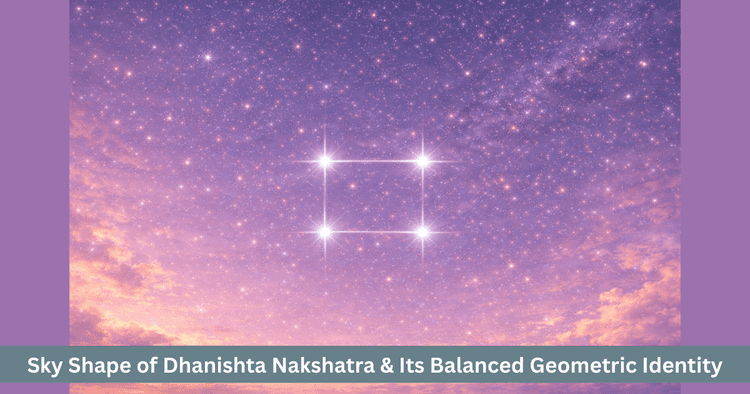
Table of Contents
Dhanishta Nakshatra gives the feeling that the sky has become clearly geometric again. After the short stellar line of Shravana, Dhanishta places in front of the viewer a shape that feels like a small framed figure. The experience is compact, balanced and quietly satisfying because the mind can complete its outline very quickly.
Dhanishta lies in the transition zone between Capricorn and Aquarius. For casual observers this entire belt may feel subtle or understated, yet Dhanishta separates itself from the background through its clean structure. The order and clarity in its pattern give this Nakshatra a distinct presence in the sky, even when the individual stars are not extremely bright.
What Does the Actual Shape of Dhanishta Look Like in the Sky
Dhanishta Nakshatra is best understood as a small diamond like framework. When the main stars are mentally joined, they form a neat four point outline. This outline does not feel stretched or loosely scattered. The entire figure looks compact, contained and framed, almost as if a tiny kite like drawing has been placed in the sky.
In the simplest words, the sky shape of Dhanishta is a small four star diamond or kite in the Capricorn Aquarius region. Its beauty lies in the feeling of clear corners. Once a viewer connects these four points even once, the diamond like image settles inside the mind. Later, whenever the gaze passes through this region, the same small pattern returns to awareness with ease.
Key points of Dhanishta’s shape in brief
| Aspect | Description |
|---|---|
| Region | Around the Capricorn and Aquarius boundary |
| Core shape | Small **diamond or kite** of four main stars |
| Spread or compactness | Compact in size, not stretched over a wide area |
| Feeling of corners | Four clear corners that stand out in the pattern |
| Effect on the mind | Quickly remembered, stable and balanced image |
This summary helps readers anchor the visual idea of Dhanishta in very little time.
How Does Dhanishta Feel Compared to Shravana
In Shravana Nakshatra the viewer traces a short line of three stars. The experience there is similar to seeing a slim path drawn in the sky. When the gaze moves onward and reaches Dhanishta, the feeling changes. Four points appear that seem to hold each other, forming a complete framed outline.
In Shravana the eyes travel along a route. In Dhanishta the eyes take in a whole figure at once. This movement from Shravana to Dhanishta is like moving from a path to a shape. The line of Shravana gives direction and flow, while the diamond of Dhanishta generates a sense of stability and completion. This contrast makes Dhanishta especially memorable for readers and observers.
How to Spot Dhanishta Nakshatra as a Viewer
A simple method that can be repeated in practice is very effective for identifying Dhanishta. Over time this method turns into a clear inner map.
The steps to find Dhanishta can be viewed in this way.
- First allow the gaze to travel forward from the area of Shravana and move gently from Capricorn towards Aquarius. This is the belt where Dhanishta finds its place.
- In this zone search for four stars that can be joined in the mind to form a small diamond or kite.
- Pay special attention to the corners. When four points appear in such a way that they can form a tiny frame, this may be the signature of Dhanishta.
- Then mentally link these points one after another and complete the outline, letting the gaze move slowly from one corner to the next.
In city skies, where strong artificial light often hides supporting stars, some smaller points may not be clearly visible. Even then, if the main four points can be seen, the diamond impression of Dhanishta can still be formed in the mind. Under open and clear skies when the four corners and some nearby stars appear together, the entire figure feels even more ordered and visually pleasing.
What Makes the Shape of Dhanishta Especially Interesting
The special charm of Dhanishta is that it offers a clean visual reward. Many Nakshatras are subtle and require patience and careful observation before their pattern becomes clear. The diamond like structure of Dhanishta is comparatively easier for the mind. The human brain recognises forms like a diamond or a kite very naturally, so this pattern settles in memory faster than many irregular arrangements.
The shape also feels balanced. A pair of stars conveys only a sense of connection. A line of three points suggests direction. A small diamond of four points produces a feeling of stability and completion. This sense of completeness allows Dhanishta to stand out as a strong pattern in the sky. When this Nakshatra is described as a small diamond or kite of four stars, many people can picture it clearly even before they see it. That clarity is a sign of a strong sky shape.
How Does a Viewer Commonly Experience Dhanishta
Once viewers learn to recognise Dhanishta, certain impressions tend to repeat themselves.
- A compact geometric outline that looks like a small frame.
- A modest diamond shaped figure that feels stable, balanced and whole.
- A pattern that, once seen, can be recalled easily in the mind.
This feeling of completeness becomes the identity of Dhanishta in the sky. For many observers this Nakshatra becomes a favourite landmark because its pattern is neither confusing nor excessively subtle. It can be understood and remembered even with simple and sincere sky watching.
A Simple Line to Remember the Shape of Dhanishta
A practical sentence for remembering Dhanishta is that it looks like a small diamond or kite shaped four star outline in the Capricorn Aquarius region, a compact geometric pattern that feels complete in a single glance. If this line stays in the mind, the shape of Dhanishta returns easily whenever the eyes visit that part of the sky.
Short Questions and Answers on Dhanishta Nakshatra
What is the basic shape of Dhanishta Nakshatra in the sky?
The basic shape of Dhanishta is a small diamond or kite like outline formed by four main stars that appear compact and balanced.
How does the experience of Dhanishta differ from that of Shravana?
Shravana creates the feeling of a three star line or path, whereas Dhanishta presents a four point closed figure that looks complete and steady.
What should a viewer notice first while searching for Dhanishta?
While moving from Capricorn towards Aquarius, the viewer should look for four stars that can form a clear diamond or kite frame with distinct corners.
Is it possible to recognise Dhanishta in bright city skies?
Even if several supporting stars are hidden by city lights, the four main points can still allow the mind to build the diamond pattern of Dhanishta.
Why does Dhanishta tend to stay in memory once it has been seen?
Because its shape is balanced and geometric. Four corners, a compact frame and a sense of completeness make Dhanishta an easy and lasting visual memory.
What does Nakshatra reveal about me?
My NakshatraDid you like it?
Author

Pt. Amitabh Sharma (56 Years)
Experience: 20
Consults About: Family Planning, Career
Clients In: Punjab, Haryana, Delhi
Share this article with friends and family
About ZODIAQ
ZODIAQ is an online Vedic Astrology platform. It connects clients seeking astrological advice to experienced astrologers with deep knowledge. Our users also generate kundali and perform kundali milan for free. ZODIAQ also offers services to the Astrologers. Astrologers utilize various offerings by ZODIAQ to serve their clients effectively.
If you are a User
Consult with experienced astrologers and seek their guidance. You can also order handwritten Janm Patrika report with life prediction prepared by experienced astrologers. Generate accurate Kundali, perform Kundali Matching and check horoscope and muhurat. Utilize our online library for all the necessary astrological and spiritual information.
If you are an Astrologer
Create accurate kundali for your clients and perform Kundali Matching for up to 5 people at a time. Write comprehensive Janm Patrika report for your clients with ZODIAQ. Check client details anytime by saving it in client directory. Become more productive by tracking how many clients you guide every day.
WELCOME TO
ZODIAQ
Right Decisions at the right time with ZODIAQ
