The Sky Shape of Hasta Nakshatra: A Compact Geometric Box in the Virgo Region
By Aparna Patni
Hasta Nakshatra’s pattern is structured, allowing viewers to easily outline its form in the sky
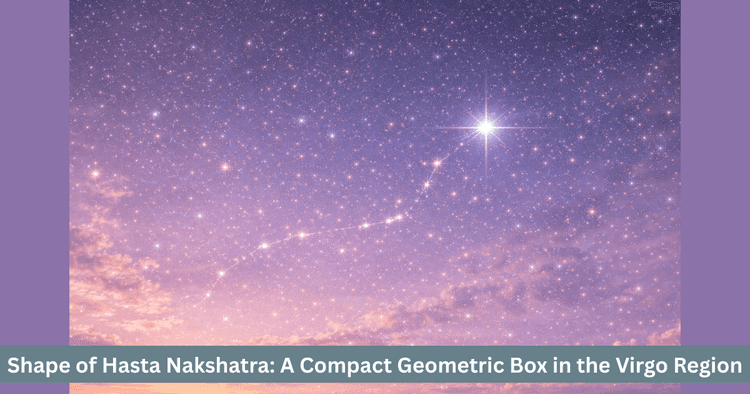
Table of Contents
In Vedic astrology, Hasta Nakshatra belongs to that group of star regions which are especially satisfying to explain to a viewer. Many Nakshatras feel like a single bright marker and some feel like a soft cluster but Hasta offers something different. It looks like a small geometric figure, almost as if the sky has drawn a neat shape and placed it gently in front of the eyes so that the mind can outline it with ease.
Hasta lies within the Virgo zone, yet its star pattern is strongly associated with the well known Corvus group. Because of this link, the experience of Hasta feels more structured compared with the softer Virgo background. It is as though a calm region of the sky suddenly reveals a clearly defined form.
What the Actual Shape of Hasta Looks Like
In the sky, Hasta is best understood as a compact four star outline that resembles a small tilted box or tight quadrilateral. These four main stars create a frame that does not spread too widely and retains a contained look. In clear dark skies, a fifth point can often be noticed nearby. This additional light seems to extend the figure slightly, so that the pattern feels like a box with an extra corner or like a box with a small handle on one side.
The simplest way to remember Hasta’s sky shape can be put into one sentence.
A small four star box like outline in Virgo with one nearby point that completes and strengthens the overall impression.
The stars that are often linked with this region in star maps form a group that appears close enough for the viewer to feel them as a compact structural figure rather than a scattered field.
Key Features of Hasta’s Geometric Pattern
| Feature | Experience in the sky |
|---|---|
| Core shape | Tilted quadrilateral made from four main stars |
| Extra point | A fifth star placed close by, adding a slight extension |
| Nature | Compact, limited, clearly framed rather than scattered |
| Overall feel | Small box or frame with a gentle added corner or handle |
From this description it becomes clear that Hasta is recognised through its square like organised form and not through random brightness alone.
How It Feels When You First Spot Hasta
When the viewer first catches the shape of Hasta, a very particular feeling arises. The eyes do not wander much. They quickly settle into this little pattern because it feels complete in itself. That sense of completeness is the special charm of Hasta as a sky experience. It offers a clean outline and clean outlines are easy for the mind to store and recall.
Many observers describe their first impression in words like these.
A small tilted frame resting clearly in the sky.
A tight figure that looks drawn with intention rather than formed by accident.
A pattern that stays clear in memory once the corners have been mentally connected.
In this way Hasta builds a strong mental image, even though it uses only a few points of light.
How to Spot Hasta in the Sky Like a Viewer
A practical step wise approach can make it easier to locate Hasta when looking at the Virgo region.
- First identify the general area of Virgo, which often appears as a relatively calm part of the sky with many moderate stars rather than very sharp beacons. Let the gaze roam for a short while so that the background becomes familiar.
- Within this area, begin to look for a slightly tighter grouping of stars, a place where a few points seem to sit closer together, as if they are trying to form a distinct shape.
- In that tighter zone, search for four stars that can be mentally joined into a small box like or quadrilateral shape. This little box will usually feel slightly tilted, which actually makes it easier to remember.
- Once that basic box appears, notice whether a fifth star sits close to one side of the quadrilateral, adding a gentle extension that feels like an extra corner or handle attached to the frame.
- Now stop scanning and simply hold the gaze for a few seconds on this figure. As the eyes become still, the box outline grows clearer and the presence of Hasta becomes firmly established.
In city light, some of the subtler points may fade, yet the compactness and overall sense of a framed figure often remain. Under clearer skies, the pattern of Hasta stands out with much greater confidence and precision.
What Makes the Shape of Hasta Interesting
Hasta is visually interesting because it feels crafted. A simple line or gentle curve can feel natural but a small quadrilateral suggests intention, like a basic design. This makes Hasta especially appealing for readers who enjoy pattern spotting in the sky. It gives a strong feeling of achievement, because once discovered the pattern looks unmistakably clear.
Hasta also demonstrates that Nakshatras can be experienced as geometry. The sky is not speaking only through brightness. It is speaking through structure. The viewer is not just seeing points of light. The viewer is seeing the arrangement that those lights quietly hold. This quality places Hasta among the Nakshatras that serve as good examples when teaching how to recognise shapes in the night sky.
The Viewer Feeling of Hasta
When someone spends time looking at Hasta, the inner experience often takes a consistent form.
A compact shape that appears organised rather than loose.
A small frame like figure that the eyes can trace quickly from corner to corner.
A pattern that remains in memory because it has visible corners and balance built into it.
The formation feels quiet but confident. It does not shout for attention, yet it remains very clear once seen even for a brief moment.
A Simple Line to Remember the Shape of Hasta
One concise line can help hold the image of Hasta firmly in memory.
Hasta looks like a small tilted four star box in the Virgo region with a nearby extra point, a compact geometric pattern that becomes easy to recognise once its corners have been connected.
Anyone who keeps this description in mind while scanning Virgo will gradually find that Hasta stands out as one of the most approachable and readable shapes in that part of the sky.
The Composed Presence of Hasta Nakshatra
Hasta Nakshatra reminds the observer that the sky does not always speak through brightness alone. Many times it speaks through form. In this region, the square like outline, the corners and the slight extension combine to create a star pattern that feels simple yet very clear.
When a viewer notices this small box like outline and allows the gaze to rest on it for a short while, it becomes easier to understand why this Nakshatra feels so distinct. It is not about a dramatic spread of stars. It is about a defined shape that both the eyes and the mind can truly see and remember with ease.
What does Nakshatra reveal about me?
My NakshatraDid you like it?
Author

Aparna Patni (63)
Experience: 20
Consults About: Family Planning, Career
Clients In: Punjab, Haryana, Delhi
Share this article with friends and family
About ZODIAQ
ZODIAQ is an online Vedic Astrology platform. It connects clients seeking astrological advice to experienced astrologers with deep knowledge. Our users also generate kundali and perform kundali milan for free. ZODIAQ also offers services to the Astrologers. Astrologers utilize various offerings by ZODIAQ to serve their clients effectively.
If you are a User
Consult with experienced astrologers and seek their guidance. You can also order handwritten Janm Patrika report with life prediction prepared by experienced astrologers. Generate accurate Kundali, perform Kundali Matching and check horoscope and muhurat. Utilize our online library for all the necessary astrological and spiritual information.
If you are an Astrologer
Create accurate kundali for your clients and perform Kundali Matching for up to 5 people at a time. Write comprehensive Janm Patrika report for your clients with ZODIAQ. Check client details anytime by saving it in client directory. Become more productive by tracking how many clients you guide every day.
WELCOME TO
ZODIAQ
Right Decisions at the right time with ZODIAQ
