The Sky Shape of Mrigashira Nakshatra: An Alert Triangle at the Taurus Gemini Junction
By Pt. Narendra Sharma
A compact pointed triangle beyond Rohini, suggesting direction, searching energy and transition in the sky
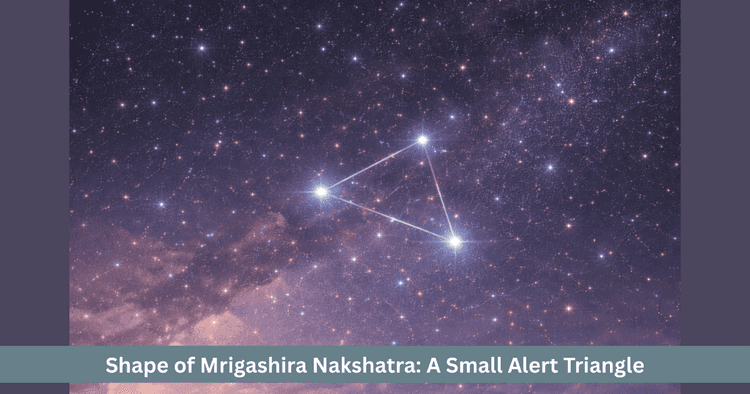
Table of Contents
In Vedic astrology, Mrigashira Nakshatra is one of those regions in the sky that feels like a transition point to the attentive viewer. After the calm and steady presence of Rohini, the eyes move into a zone that appears more pointed and searching. Mrigashira does not look like a single bright anchor and it does not resemble a tight cluster. Instead it appears as a small alert pattern, a shape that seems ready to move.
In the zodiac sequence, Mrigashira lies where the sky shifts from Taurus to Gemini. Because of this, its visual impression carries both the memory of the earlier stability and the sense of an emerging forward motion. It feels as if this part of the sky is gently indicating a direction rather than simply resting.
What Does the Actual Shape of Mrigashira Look Like
In the sky, Mrigashira is best understood as a small triangular formation. It sits in the transition zone between Taurus and Gemini and visually appears to connect the Taurus region with the nearby Orion area. This gives the sense that Mrigashira links one part of the sky to another.
The key identity of Mrigashira is its pointed triangle. The main stars form a compact, tight triangle that looks like a small wedge or tapered tip. It is not a wide triangle spread across the sky. It is a neatly held, focused triangle, which looks as if it is pointing towards a certain direction.
Many viewers describe their experience in the following ways.
A small set of stars that looks like a pointed head.
A clean three point outline that the mind can easily join into a triangle.
A pattern that feels slightly tilted or angled, not flat and straight.
For this reason Mrigashira is often remembered as a Nakshatra that can be recognised by its sharp pointed impression.
How Mrigashira Appears to the Naked Eye
Under average skies the triangle of Mrigashira usually appears as three noticeable points. These stars are distinct enough that the mind can link them into a triangle without much effort. Under darker and clearer skies some fainter stars may appear around this group, yet the main identity still remains the same triangular feeling.
Mrigashira does not resemble Krittika, which feels like a tight patch or cluster. It also does not look like Rohini, which is dominated by a single bright anchor star with a structured background. Instead Mrigashira feels like a small shape with its own direction. It looks as if the pattern itself is quietly looking ahead.
Visual Difference between Krittika, Rohini and Mrigashira
| Nakshatra | Apparent sky shape | Feeling it gives to a viewer |
|---|---|---|
| Krittika | Small tight glittering group of stars | Concentrated, intense, energy gathered in one patch |
| Rohini | Bright star with a calm V shaped spread | Stable, nourishing, a resting visual centre |
| Mrigashira | Small pointed triangle or wedge like shape | Alert, directional, a sign of movement and searching |
This summary shows how the sharp triangular form of Mrigashira creates a different experience from the previous two Nakshatras.
How to Spot Mrigashira in the Sky Like a Viewer
A simple sequence can help anyone recognise Mrigashira directly in the night sky.
- First look towards the Taurus region and identify the bright area around Rohini.
- From there allow your gaze to move gently in the direction that leads towards the Orion constellation.
- Along this path, search for a small compact triangle that feels like a pointed tip or a tiny wedge.
- Once a clear three point outline appears, pause and let your eyes rest on it for a while. As you stop scanning and stay still, the triangular shape of Mrigashira becomes much more obvious.
In bright city skies it may require some patience, because the stars that form Mrigashira are not always very luminous. however once the triangle has been seen clearly even once, it becomes much easier to locate the same pattern on later nights.
What Makes the Shape of Mrigashira Interesting
The shape of Mrigashira is fascinating because it suggests a questioning quality without using a curve like a question mark. It does not stretch. It points. Through geometry alone it gives the feeling of searching. A tight triangle naturally creates an impression of direction and alertness, as though the sky itself is hinting at movement.
This is why many readers connect with Mrigashira easily. They do not have to memorise a complicated map. They only need to hold one clear visual idea in mind, that of a small pointed triangle in the transition zone of the sky. With that single image, the region of Mrigashira becomes recognisable and meaningful.
A Simple Line to Remember the Shape of Mrigashira
One short line can help fix the sky shape of Mrigashira in memory.
Mrigashira looks like a compact triangle, a small pointed formation that feels alert and directional when its main stars are mentally connected.
Anyone who remembers this line and then looks between the Taurus and Gemini regions will gradually find that recognising Mrigashira becomes a natural habit.
The Lively Presence of Mrigashira in the Sky
Mrigashira shows how a Nakshatra can feel alive even when its pattern is small. The moment the eyes recognise its pointed triangle, there is a clear sense that this part of the sky is somehow looking forward.
Rohini offers a place of rest, a stable visual ground. Mrigashira, just beyond it, feels like the step that leans towards what comes next. In this way it becomes a meaningful link in the zodiac flow and invites the viewer to keep exploring the changing expressions of the night sky.
Frequently Asked Questions
What is the main visible shape of Mrigashira Nakshatra in the sky
Mrigashira appears as a small tight triangle or wedge like pattern near the Taurus Gemini junction, giving a clear pointed impression.
How does the experience of Mrigashira differ from that of Rohini
Rohini feels like a bright central anchor with a calm V background, while Mrigashira shows a small pointed triangle that suggests direction, movement and searching.
Why can Mrigashira be harder to recognise in city skies
In city skies light pollution makes the stars of Mrigashira appear faint, so its small triangle does not stand out immediately and requires more patient looking.
What kind of feeling does the triangular shape of Mrigashira create
The sharp triangle conveys alertness, direction and a sense of active seeking, as if that region of the sky is focused on what lies ahead.
What is an easy visual cue for remembering Mrigashira
It helps to remember that just beyond Rohini, between Taurus and Gemini, there is a small pointed triangle and that simple shape is the sky sign of Mrigashira.
What does Nakshatra reveal about me?
My NakshatraDid you like it?
Author

Pt. Narendra Sharma (63)
Experience: 20
Consults About: Family Planning, Career
Clients In: Punjab, Haryana, Delhi
Share this article with friends and family
About ZODIAQ
ZODIAQ is an online Vedic Astrology platform. It connects clients seeking astrological advice to experienced astrologers with deep knowledge. Our users also generate kundali and perform kundali milan for free. ZODIAQ also offers services to the Astrologers. Astrologers utilize various offerings by ZODIAQ to serve their clients effectively.
If you are a User
Consult with experienced astrologers and seek their guidance. You can also order handwritten Janm Patrika report with life prediction prepared by experienced astrologers. Generate accurate Kundali, perform Kundali Matching and check horoscope and muhurat. Utilize our online library for all the necessary astrological and spiritual information.
If you are an Astrologer
Create accurate kundali for your clients and perform Kundali Matching for up to 5 people at a time. Write comprehensive Janm Patrika report for your clients with ZODIAQ. Check client details anytime by saving it in client directory. Become more productive by tracking how many clients you guide every day.
WELCOME TO
ZODIAQ
Right Decisions at the right time with ZODIAQ
