The Sky Shape of Punarvasu Nakshatra: A Balanced Twin Pair in the Gemini Cancer Region
By Pt. Sanjeev Sharma
After Ardra’s single strong star, two balanced bright lights in Gemini that suggest return and harmony
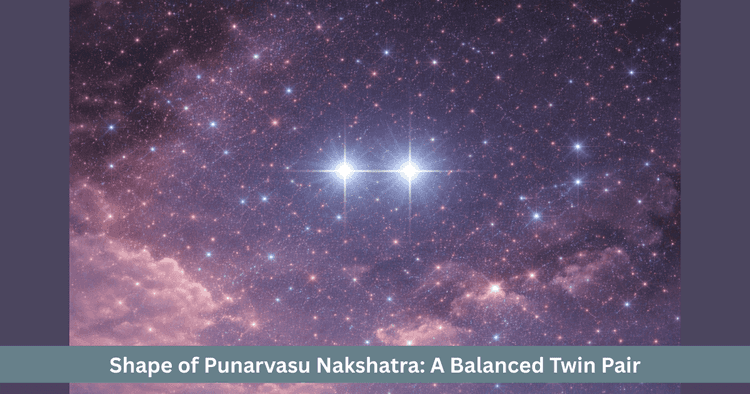
Table of Contents
In Vedic astrology, Punarvasu Nakshatra gives the sky a feeling of return to balance. After the strong single point impression of Ardra, the eyes move into a region that feels far more clean, settled and comforting. Punarvasu is easy to recognise because it does not rely on a large cluster or a scattered set of faint stars. Instead it presents itself as two steady lights that sit side by side in a clear and harmonious way.
Punarvasu spans the Gemini Cancer region and as a sky experience it carries a very simple message. The pattern looks like a matched set, a pair that feels complete. To the viewer it often seems as if something in the sky that had been intense or singular has now settled back into a balanced form.
What the Actual Shape of Punarvasu Looks Like
In the night sky, Punarvasu is identified through the two main bright stars of Gemini. To the viewer these appear as a clear twin pair. They are close enough to be seen as connected, yet separated enough to be recognised as two distinct points of light.
The simplest and most accurate description of Punarvasu’s sky shape is this.
Two bright stars sitting side by side, forming a clean twin pair that stands out.
There is no need to draw lines or imagine a complex outline. The moment the eyes rest on these two stars, the shape is already understood. This very simplicity is one of the great strengths of Punarvasu.
Sky Experience of Ardra and Punarvasu
| Nakshatra | Apparent sky shape | Feeling it gives to a viewer |
|---|---|---|
| Ardra | Single dominant bright star in a known region | Deep, intense, concentrated centre of energy |
| Punarvasu | Balanced twin pair of bright stars in Gemini | Calm, harmonious, restored and complete feeling |
This comparison shows that while Ardra emphasises a single strong centre, Punarvasu expresses balance in duality and shared presence.
Why This Shape Is So Easy for Viewers
Many Nakshatras require patience to recognise because their stars may be faint or widely spread. Punarvasu is different since the main pair is often clearly visible in ordinary conditions. Even under city skies, where many subtle stars fade into the background, these twin lights can still be seen in many cases.
For this reason Punarvasu is often included in beginner friendly sky guides. It gives confidence to new observers because the pattern is straightforward, bright and distinct. Without needing complex knowledge, a person can feel that an important Nakshatra has been identified successfully.
How to Spot Punarvasu in the Sky Like a Viewer
A simple and practical approach can help in locating Punarvasu directly.
- First identify the general Gemini region in the sky, the area associated with the two celestial twins.
- Within that region look for two prominent stars that shine more clearly than most of the surrounding points.
- Notice how these two stars appear as a twin pair, close enough to feel linked, yet separate enough to remain visually distinct.
- When the balance of this pair becomes obvious and the eyes keep returning to these two points together, it is a strong sign that you are looking at the core shape of Punarvasu.
A helpful viewer trick is to locate a known constellation first and then slowly move the gaze toward the Gemini area. As the gaze shifts, at some point two stars will stand out as a matching pair. That simple moment often marks the encounter with Punarvasu’s sky form.
What Makes the Shape of Punarvasu Interesting
The shape of Punarvasu is not only easy to recognise. It is also rich in experience. Looking at this pair brings a sense that something has been re established or reset. A pair naturally suggests completion and return. It feels like a pattern that has come back to a stable and shared form.
To the viewer, the pattern appears calm and composed. It does not look sharp like a triangle. It does not feel intense like a single dominant star. It looks like harmony held in two points. That is why many people find Punarvasu visually soothing. It is one of those star patterns that, once shown even briefly, tends to stay in memory.
The Viewer Feeling of Punarvasu
When someone looks at the twin pair with attention, the inner impressions can be described in many ways.
Two steady lights that seem to hold the surrounding sky together.
A shape that feels balanced rather than heavy.
A pattern that appears complete with just two points, without needing anything more.
This is the charm of Punarvasu. It shows that simplicity can be deeply memorable. Without many lines or scattered points, it leaves a strong imprint on both mind and heart.
A Simple Line to Remember the Shape of Punarvasu
One short line can help fix Punarvasu’s form in memory.
Punarvasu looks like two bright twin stars in the Gemini region, a clear balanced pair that stands out even to a casual viewer.
With this image in mind, anyone who turns toward Gemini will gradually start recognising Punarvasu as a reliable marker in the night sky.
The Ordered Presence of Punarvasu
Punarvasu Nakshatra helps one feel that the sky follows its own kind of order and arrangement. While looking at its twin pair, it is easier to understand why Punarvasu is remembered as a pattern linked with return, renewal and steady balance.
Without any complex outline, the sky offers a complete experience through just two bright points. From them comes a sense of peace, harmony and wholeness that can stay with the observer long after the actual viewing has ended.
Frequently Asked Questions
What is the main visible shape of Punarvasu Nakshatra in the sky
Punarvasu appears as a clear twin pair of bright stars in the Gemini region, forming a balanced and easily recognisable pattern.
How does the experience of Punarvasu differ from that of Ardra
Ardra is seen as one strong star with concentrated intensity, while Punarvasu shows two equal lights that convey balance, return and shared steadiness.
Can Punarvasu be seen in city skies as well
Often yes, because the main twin stars are bright enough that the pattern can still be visible even when many fainter stars are hidden by light pollution.
What kind of emotional impression does Punarvasu give to viewers
The pattern usually feels calm, ordered and balanced, giving an inner sense of quiet completeness rather than drama or sharp intensity.
What is the easiest visual cue for remembering Punarvasu
Remember that in the Gemini region, whenever two stars shine like matching twins close together, you are most likely looking at the core shape of Punarvasu.
What does Nakshatra reveal about me?
My NakshatraDid you like it?
Author

Pt. Sanjeev Sharma (63)
Experience: 20
Consults About: Family Planning, Career
Clients In: Punjab, Haryana, Delhi
Share this article with friends and family
About ZODIAQ
ZODIAQ is an online Vedic Astrology platform. It connects clients seeking astrological advice to experienced astrologers with deep knowledge. Our users also generate kundali and perform kundali milan for free. ZODIAQ also offers services to the Astrologers. Astrologers utilize various offerings by ZODIAQ to serve their clients effectively.
If you are a User
Consult with experienced astrologers and seek their guidance. You can also order handwritten Janm Patrika report with life prediction prepared by experienced astrologers. Generate accurate Kundali, perform Kundali Matching and check horoscope and muhurat. Utilize our online library for all the necessary astrological and spiritual information.
If you are an Astrologer
Create accurate kundali for your clients and perform Kundali Matching for up to 5 people at a time. Write comprehensive Janm Patrika report for your clients with ZODIAQ. Check client details anytime by saving it in client directory. Become more productive by tracking how many clients you guide every day.
WELCOME TO
ZODIAQ
Right Decisions at the right time with ZODIAQ
