The Sky Shape of Purva Phalguni Nakshatra: A Quiet Twin Pair within Leo
By Pt. Suvrat Sharma
How to recognise the neat two star pairing inside Leo that forms a subtle inner pattern within the larger curve
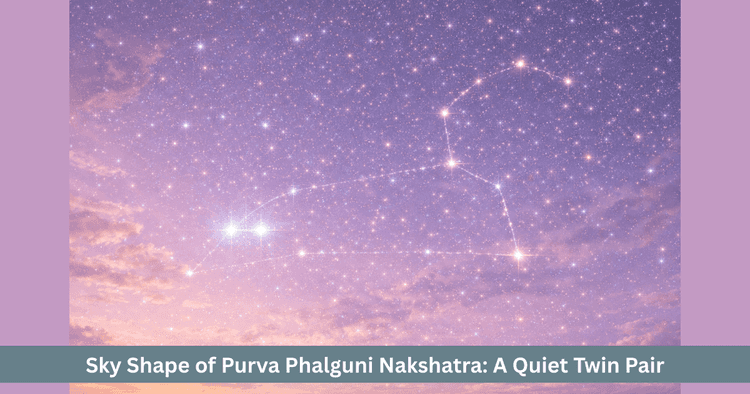
Table of Contents
In Vedic astrology, Purva Phalguni Nakshatra feels like a softer and more gentle part of the Leo sky. In Magha, a single bright anchor helps the viewer recognise the larger curve of Leo. After that firm signal, Purva Phalguni appears as a quieter pattern inside the same region. It does not depend on a single dominant point. Instead it is recognised through a small inner pairing that sits comfortably within Leo’s familiar outline.
For a viewer this change in focus is very pleasant. The sky experience moves away from a large obvious marker and shifts toward noticing a smaller neat arrangement inside an already known zone. Attention that was earlier fixed on the grand framework now begins to explore the finer details held within that framework.
What the Actual Shape of Purva Phalguni Looks Like
In the night sky, Purva Phalguni is best experienced as a two star pairing in the Leo region. The two stars associated with this area present themselves as a simple pair. They are not so close that they merge into a single point, yet they are not so far apart that they feel unrelated. Their spacing allows the viewer to sense them as one connected set inside Leo.
The sky shape of Purva Phalguni can be captured in a single line.
A neat two star pair within Leo that looks like a small linked set in the midst of the constellation.
Because this pattern is built from only two clear lights, it is visually very easy to understand. The eyes do not need to trace a long curve or collect many points. They simply notice and connect two nearby lights and the pattern is already complete.
Sky Experience of Magha and Purva Phalguni
| Nakshatra | Main visible form | Feeling it gives to a viewer |
|---|---|---|
| Magha | Bright anchor star with a gentle curve beginning there | Strong entrance marker, clear recognition of the area |
| Purva Phalguni | Quiet two star pair within the Leo outline | More intimate, light, a smaller inner pattern |
This comparison shows that while Magha helps one recognise Leo as a whole, Purva Phalguni invites attention to the inside of Leo.
How Purva Phalguni Appears Compared to Magha
Understanding the contrast with Magha makes the character of Purva Phalguni more vivid.
Magha feels like a bright anchor, a starting point from which the larger curve of Leo unfolds and the region as a whole becomes recognisable.
Purva Phalguni feels like a compact internal pairing, a small composed pattern that lives quietly inside that already identified Leo structure.
Thus, after locating the Leo region through Magha, Purva Phalguni becomes the next step in observation. It teaches the viewer how to shift from recognising big outlines to discovering smaller shapes inside the bigger map.
How to Spot Purva Phalguni in the Sky Like a Viewer
A viewer friendly flow can make the search for Purva Phalguni straightforward.
- First locate Leo using the brighter anchor point and the gentle curved outline that characterise the constellation.
- Once Leo is clear in the mind, look a little further along the region where the curve continues into its central part.
- In that area, search for two stars that seem to form a paired set, close enough to feel related and yet distinct as separate points.
- Allow the eyes to settle on them. As the scanning slows down, the sense of a pair becomes stronger and Purva Phalguni’s identity stands out.
Under average skies, this pair will usually be visible once Leo itself has been correctly found. In darker clearer skies, extra faint stars surrounding the pair confirm that the viewer is indeed looking in the right place within the constellation.
What Makes the Shape of Purva Phalguni Interesting
Purva Phalguni is interesting because it feels personal in a way that large patterns often do not. Big shapes can be impressive, yet small pairings feel like discoveries. A two star pair behaves like a short phrase inside a longer sentence. It rewards those who go beyond the broad outline and begin to read the finer script of the zodiac sky.
This is why Purva Phalguni works very well when described in careful sky guides. It carries the sense of moving deeper into the celestial map. The viewer progresses from obvious landmarks to more subtle internal patterns and this change of scale makes the relationship with the sky more intimate.
The Viewer Feeling of Purva Phalguni
When a viewer finally sees the characteristic pair of Purva Phalguni, the impression often feels like this.
A calm area inside Leo where two points sit together in quiet balance.
A shape that feels lighter and simpler than the strong anchor of Magha.
A small connected pattern that, once noticed, becomes very easy to remember and return to.
It feels as though the sky has moved from a grand entrance into a quiet inner room, where the design is smaller, closer and more personal.
A Simple Line to Remember the Shape of Purva Phalguni
One concise sentence can help keep the image of Purva Phalguni clear in memory.
Purva Phalguni looks like a simple two star pair within the Leo region, a small linked set that becomes easier to notice once Leo itself has been located.
With this line in mind, anyone who has learned to recognise Leo through Magha will find that Purva Phalguni naturally appears as the next familiar marker within that same sky space.
The Inner Presence of Purva Phalguni
Purva Phalguni Nakshatra shows that the zodiac sky is not built only from large dramatic shapes. Some Nakshatras are expressed as subtle patterns that live inside broader constellations. Purva Phalguni is a clear example of such an inner sign, a two star pair that quietly anchors meaning within the larger form of Leo.
When a viewer first learns to see Leo as a whole and then learns to recognise this compact pair inside it, the relationship with the sky changes. It no longer feels like one is merely tracing a map. It feels as though one has started to read the fine writing that the map contains, line by line and light by light.
Frequently Asked Questions
What is the main visible shape of Purva Phalguni Nakshatra in the sky
Purva Phalguni appears as a clear pair of two stars within the Leo region, forming a small but distinct linked pattern.
How does the experience of Purva Phalguni differ from that of Magha
Magha shows a bright anchor star that opens the curve of Leo, while Purva Phalguni presents a quieter two star pair inside Leo, giving a more intimate and gentle feeling.
Why is it helpful to identify Leo before searching for Purva Phalguni
Because Purva Phalguni is defined not by a single beacon but by an inner pair inside Leo, recognising the constellation first makes it much easier to find the correct two star set.
Can Purva Phalguni be seen from typical city skies
Often yes, if Leo has already been found and the sky is not extremely washed out. In such cases the two star pair can usually be picked out even if fainter neighbours are hidden.
What is the simplest visual cue to remember Purva Phalguni’s shape
Remember that inside the curved outline of Leo, wherever two nearby stars form a neat joined pair in a calmer part of the pattern, you are very likely looking at Purva Phalguni.
What does Nakshatra reveal about me?
My NakshatraDid you like it?
Author

Pt. Suvrat Sharma (63)
Experience: 20
Consults About: Family Planning, Career
Clients In: Punjab, Haryana, Delhi
Share this article with friends and family
About ZODIAQ
ZODIAQ is an online Vedic Astrology platform. It connects clients seeking astrological advice to experienced astrologers with deep knowledge. Our users also generate kundali and perform kundali milan for free. ZODIAQ also offers services to the Astrologers. Astrologers utilize various offerings by ZODIAQ to serve their clients effectively.
If you are a User
Consult with experienced astrologers and seek their guidance. You can also order handwritten Janm Patrika report with life prediction prepared by experienced astrologers. Generate accurate Kundali, perform Kundali Matching and check horoscope and muhurat. Utilize our online library for all the necessary astrological and spiritual information.
If you are an Astrologer
Create accurate kundali for your clients and perform Kundali Matching for up to 5 people at a time. Write comprehensive Janm Patrika report for your clients with ZODIAQ. Check client details anytime by saving it in client directory. Become more productive by tracking how many clients you guide every day.
WELCOME TO
ZODIAQ
Right Decisions at the right time with ZODIAQ
