Shravana Nakshatra: Linear Sky in Capricorn
By Pt. Abhishek Sharma
Linear and Guiding Presence of Shravana in Capricorn
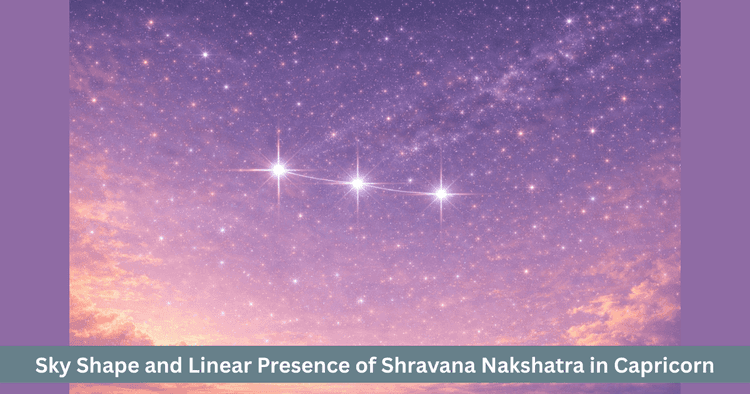
Table of Contents
Shravana Nakshatra gives the feeling that the sky has become more linear and more clearly guided. After the paired impressions in Sagittarius, Shravana offers the viewer a pattern that looks like a small chain rather than a pair. It feels as if the zodiac path is now drawn as a short line, a sequence of points that the eyes naturally follow in a single direction.
Shravana lies in the Capricorn region. As a viewing experience, it does not behave like a bright showpiece constellation, yet its shape becomes very clear once it is learnt. Shravana belongs to those Nakshatras that become easier with every new viewing, because the mind remembers the line and quickly recognises it again.
What Does the Actual Sky Shape of Shravana Look Like?
Shravana Nakshatra is best understood as a three star aligned pattern. Instead of forming a triangle or a box, its main stars appear in a nearly straight line or a gentle short chain. The viewer usually senses one point as slightly stronger or more dominant and the other points support it, together creating the impression of a small aligned sequence.
The simplest description can be that Shravana is a short three star chain in the Capricorn zone which looks like a compact line or an ordered sequence. It is not a long line stretching widely across the sky. The line remains compact in size, yet its direction feels very clear. The viewer senses that this pattern flows from one end to the other and the eyes move instinctively along that direction.
How Can One Understand the Line of Shravana in Capricorn?
To understand the line of Shravana, it helps to remember that it does not present a closed figure. It gives a sense of movement instead. The three points together create the feeling of a small path drawn in the sky. One end begins the experience, the second point acts as a bridge in the middle and the third completes the direction.
This entire experience can also be felt as if the shape of Shravana is not a picture that sits in one place but a hint that invites the eyes to move forward. A soft memory forms in the mind that in this region there are three points forming a chain that shows a way, not a loop, not a circle where the gaze gets locked.
For a quick comparison, see this summary table of Uttara Ashadha and Shravana
| Aspect | Experience of Uttara Ashadha | Experience of Shravana Nakshatra |
|---|---|---|
| Basic shape | Two star **pair** | Three star **short line** |
| Number of key points | Two distinct points | Three points linked in order |
| Visual feeling | A stable pair | A forward **path like** impression |
| Mental action | Joining two points | Reading a small **chain** in sequence |
| Learning role | Starting point through a pair | Direction finding through a simple line |
When this comparison settles in the mind, recognising Shravana after Uttara Ashadha becomes much easier.
How Does the Experience Shift from Uttara Ashadha to Shravana?
In the Sagittarius zone, Uttara Ashadha Nakshatra appears like a simple two star pair. There the viewer connects two points and receives the feeling of a calm, steady marker. When the gaze moves forward and enters Shravana, the inner experience slowly changes. Now three points appear that ask to be traced as a line.
The habit of the eyes also shifts. Earlier the focus was on the relationship between two stars. Now the eyes read a small sequence of three. The viewer feels that the experience has moved from only connecting points to moving in a direction. For many people this feels similar to reading. Just as words are seen one after another in a row, the three points of Shravana come into awareness one after another.
This difference makes Shravana engaging for readers and observers. The shift from two points to three points and from a pair to a line feels like the next step in learning. The sky seems to invite a more active kind of following.
How Can a Viewer Spot Shravana Nakshatra Step by Step?
A practical and simple method works best for identifying Shravana. Those who wish to understand Nakshatras by direct viewing can repeat this process until it becomes natural.
Steps to find Shravana in the sky.
- After leaving the Sagittarius region in your mental map, allow the gaze to move gently into Capricorn. This is where Shravana follows after Uttara Ashadha in sequence.
- In the Capricorn zone, search for three stars that appear roughly aligned, not suggesting a triangular figure.
- Lightly connect these three points in the mind with an imagined line. If the eyes move mostly in a single direction, then this may be the Shravana line impression.
- Hold the gaze steady for a few moments. Once the eyes stop scanning in all directions, this short three star chain becomes clearer and more defined.
In city skies, where there is heavy artificial light, often only the stronger or brighter points are visible. Even in such conditions the line of Shravana can sometimes be sensed, because one or two strong points already suggest a hint of direction. In clearer open skies, the supporting points also appear and the small chain feels more definite. The more often a viewer traces this pattern, the more firmly the line memory settles in the mind.
What Makes the Shape of Shravana So Interesting?
Shravana is interesting because it looks like a path rather than a static design. A line in the sky naturally creates a sense of direction. This small chain of three points gives the feeling that something is being carried from one star to the next. That is why Shravana is very friendly as a viewing concept.
It can be described as a Nakshatra that is not seen as a shape sitting in one place but as a sequence that the eyes follow. For readers this becomes engaging because it is easy to imagine. Everyone understands how a line feels. One point is seen, then the next and the mind senses the connection. Shravana translates this ordinary human experience into a celestial form that can be visualised with very little effort.
What Do Viewers Commonly Feel While Observing Shravana?
When viewers give a little time to Shravana, they usually report certain recurring impressions.
- A calm region where stars form a modest but clear alignment.
- A short chain which gently guides the eyes forward along itself.
- A pattern that behaves like a simple route rather than a closed figure.
These qualities make Shravana memorable even though it is not a loud or highly dramatic part of the sky. The three point line leaves a light yet steady impression that stays in awareness.
A Simple Line to Remember the Shape of Shravana
To remember Shravana Nakshatra, one helpful sentence is that it looks like a short three star line in the Capricorn region, a small aligned chain that the viewer naturally traces from one point to the next. Anyone who carries this line in mind finds it much easier to meet Shravana in the sky and to recognise it again during future observations.
Short Questions and Answers on Shravana Nakshatra
What is the basic shape of Shravana Nakshatra?
The basic shape of Shravana is a short line of three stars, a compact chain that does not form a triangle or any closed figure.
How does the experience of Shravana differ from Uttara Ashadha?
Uttara Ashadha feels like a two star pair, whereas Shravana feels like a three point line where the eyes move step by step along a sequence.
What should one notice in Capricorn while searching for Shravana?
Look for three stars that stand almost in one line, do not create a triangle and give the impression of a small chain that leads in a single direction.
Is Shravana easy to identify in bright city skies?
In bright skies usually only the stronger points stand out, yet if two or three stars hint at a faint line, the Shravana impression can still be sensed.
Why is Shravana considered easy to remember visually?
Because it is a simple linear pattern. A small chain of three points, a gentle sense of direction and a calm region together make Shravana stay in the memory.
What does Nakshatra reveal about me?
My NakshatraDid you like it?
Author

Pt. Abhishek Sharma (63)
Experience: 20
Consults About: Family Planning, Career
Clients In: Punjab, Haryana, Delhi
Share this article with friends and family
About ZODIAQ
ZODIAQ is an online Vedic Astrology platform. It connects clients seeking astrological advice to experienced astrologers with deep knowledge. Our users also generate kundali and perform kundali milan for free. ZODIAQ also offers services to the Astrologers. Astrologers utilize various offerings by ZODIAQ to serve their clients effectively.
If you are a User
Consult with experienced astrologers and seek their guidance. You can also order handwritten Janm Patrika report with life prediction prepared by experienced astrologers. Generate accurate Kundali, perform Kundali Matching and check horoscope and muhurat. Utilize our online library for all the necessary astrological and spiritual information.
If you are an Astrologer
Create accurate kundali for your clients and perform Kundali Matching for up to 5 people at a time. Write comprehensive Janm Patrika report for your clients with ZODIAQ. Check client details anytime by saving it in client directory. Become more productive by tracking how many clients you guide every day.
WELCOME TO
ZODIAQ
Right Decisions at the right time with ZODIAQ
