The Sky Shape of Vishakha Nakshatra: A Branching Form in the Libra Scorpius Region
By Pt. Narendra Sharma
Vishakha Nakshatra connects multiple stars, serving as a celestial bridge between Libra and Scorpius
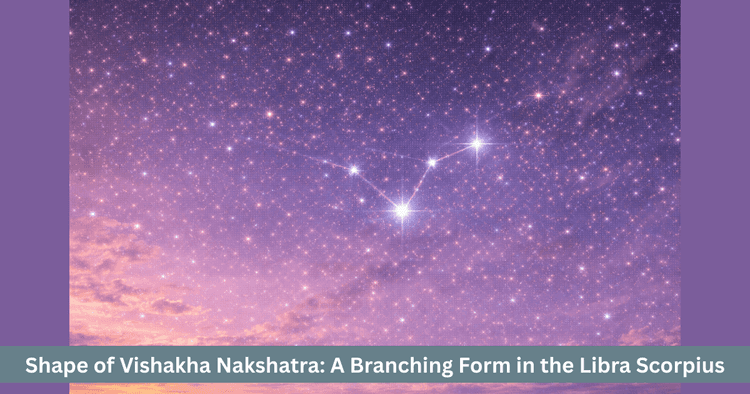
Table of Contents
In Vedic astrology, Vishakha Nakshatra feels like the moment when the sky starts becoming structured again. After Swati, which appears as a solitary bright presence, Vishakha brings the eyes back to a multi star formation. The viewing experience changes. The gaze no longer searches for just one dominant point. It begins to connect several points to discover a shape. This shift makes Vishakha a very engaging part of the zodiac sky.
Vishakha lies in the Libra and Scorpius transition zone. This is the part of the sky that often behaves like a bridge between the lighter feel of the Libra region and the deeper, denser star patterns that follow in Scorpius. Because of this, Vishakha frequently feels like a celestial link between two very different sky moods.
What the Actual Shape of Vishakha Looks Like
In the night sky, Vishakha is best experienced as a four star grouping that creates a branching or fork like impression. Unlike Hasta, which forms a neat box like quadrilateral, the stars of Vishakha do not close into a simple frame. Instead, they are placed in such a way that they seem to split into two directions, as if a path has reached a point where it divides.
When these stars are mentally joined, the figure can resemble a wide V shape with one arm extended further, almost like a path that opens into two ways. The sense is less of a closed container and more of an open structure that leads the eye outward.
The simplest line for remembering Vishakha’s sky form can be stated in this way.
A small group of stars in the Libra region that forms a fork like branching outline, suggesting two possible directions.
Vishakha is neither a tight cluster nor a single anchor point. Its identity rests on the shape that arises when multiple points are connected and this is what makes it visually distinctive.
Key Features of Vishakha’s Sky Pattern
| Feature | Experience in the sky |
|---|---|
| Core structure | Grouping of four main stars |
| Shape impression | Branching or fork like outline opening in two directions |
| Nature | Neither solitary nor box like but an open two way form |
| Overall feeling | Sense of direction, division and movement in the pattern |
This overview shows that Vishakha is recognised through its branching form and the directional feeling that the shape naturally carries.
Why Does This Shape Feel Unique to a Viewer
Many viewers remember Vishakha easily because its pattern does not feel symmetrical. A pair carries a sense of balance. A box looks complete and evenly framed. Vishakha, on the other hand, feels directional. It looks as though the shape is pointing in two ways at once.
The viewer does not merely see a set of stars. There is a subtle sense of decision like movement in the outline. The eyes instinctively trace one branch, then the other and this act of following the forks makes Vishakha feel active rather than still. It is as if the sky is showing more than one way forward.
How to Spot Vishakha in the Sky Like a Viewer
A practical step wise method can help locate Vishakha with confidence.
- First identify the Libra region and use the strong anchor of Swati as a starting reference. Swati, with its solitary bright star, provides a reliable guide point.
- From the area of Swati, move the gaze gradually toward the zone where the sky begins to feel denser and deeper as it approaches Scorpius. This is the transition belt where Vishakha is likely to be found.
- In this region, look for a small collection of four stars that can be connected into a branching outline, rather than into a closed box. The arrangement will often suggest a wide V like figure with one line stretching further.
- Keep the gaze steady on this group for a few moments and mentally draw lines between the stars. As the scanning slows down, the fork like pattern of Vishakha becomes clearer and easier to recognise.
Under brighter city skies, fewer stars may be visible, which can make the fork impression slightly weaker but some sense of branching may still appear. Under darker, clearer skies, the branching outline stands out more fully and the Vishakha pattern becomes more obvious.
What Makes Vishakha Interesting for Readers
Vishakha is interesting because it feels like a transition point in the sky’s story. The viewer senses that the zodiac is moving from relatively open space into richer star territory. The sky begins to feel layered, as if one part is gently handing the journey over to the next.
Visually, Vishakha offers a feeling of direction and choice through its branching outline. This makes it easy to describe in an engaging way. One is not only saying that there are four stars in this region. One is explaining how the eye experiences them, moving from one branch to the other and that makes the description more vivid.
The Viewer Feeling of Vishakha
When viewers spend time observing Vishakha, their impressions often converge in a few recognisable ways.
A sense of a structured group rather than a solitary point.
A shape that clearly seems to split or branch into two paths.
A feeling that the sky is subtly guiding the eyes in more than one direction.
This is exactly what makes Vishakha feel different from Swati. Swati feels calm and alone. Vishakha feels active and shaped, like a signpost drawn in light.
A Simple Line to Remember the Shape of Vishakha
One short line can help hold Vishakha’s form firmly in memory.
Vishakha looks like a branching group of stars in the Libra region, forming a fork like outline that the viewer can trace in two directions.
Anyone who carries this sentence while scanning the Libra Scorpius border will gradually find that the same branching figure keeps appearing and defining Vishakha in the mind.
The Direction Giving Presence of Vishakha Nakshatra
Vishakha Nakshatra reminds the observer that the zodiac sky is never repetitive. The patterns keep shifting. When one moves from the calm solitary light of Swati to the branching formation of Vishakha, the sky begins to feel more layered and dynamic.
The experience is no longer only about one point of brightness. It becomes about connection and structure, about how several stars together can suggest a choice of ways. Vishakha turns into that step on the zodiac path where the sky seems to say that direction and division are also part of its language.
Frequently Asked Questions
What is the main visible shape of Vishakha Nakshatra in the sky
Vishakha Nakshatra appears as a small four star group that forms a branching or fork like outline, suggesting two ways rather than a closed frame.
How does the experience of Vishakha differ from that of Swati
Swati is recognised through one solitary bright star in an open area, while Vishakha is recognised through a branching multi star pattern that gives a sense of direction and division.
What is the most practical sequence for identifying Vishakha while stargazing
First locate the Libra region and the anchor of Swati, then move toward the denser Scorpius side and search for four stars that join into a clear fork like outline.
Can the shape of Vishakha be seen clearly from city skies
In bright city skies some of the stars may be faint, so the full fork impression may soften, yet parts of the branching group can still appear if the sky is not heavily washed out.
What is the simplest cue to remember Vishakha’s sky shape
One can remember that between Libra and Scorpius, wherever a few stars combine into a V like branching form that guides the eyes in two directions, that region holds the essence of Vishakha Nakshatra.
What does Nakshatra reveal about me?
My NakshatraDid you like it?
Author

Pt. Narendra Sharma (63)
Experience: 20
Consults About: Family Planning, Career
Clients In: Punjab, Haryana, Delhi
Share this article with friends and family
About ZODIAQ
ZODIAQ is an online Vedic Astrology platform. It connects clients seeking astrological advice to experienced astrologers with deep knowledge. Our users also generate kundali and perform kundali milan for free. ZODIAQ also offers services to the Astrologers. Astrologers utilize various offerings by ZODIAQ to serve their clients effectively.
If you are a User
Consult with experienced astrologers and seek their guidance. You can also order handwritten Janm Patrika report with life prediction prepared by experienced astrologers. Generate accurate Kundali, perform Kundali Matching and check horoscope and muhurat. Utilize our online library for all the necessary astrological and spiritual information.
If you are an Astrologer
Create accurate kundali for your clients and perform Kundali Matching for up to 5 people at a time. Write comprehensive Janm Patrika report for your clients with ZODIAQ. Check client details anytime by saving it in client directory. Become more productive by tracking how many clients you guide every day.
WELCOME TO
ZODIAQ
Right Decisions at the right time with ZODIAQ
