Ashtakavarga: The Cosmic Scorecard Measuring Planetary Strength and Life's Karmic Blueprint
By Pt. Narendra Sharma
Learn Which Life Areas Are Easy and Which Are Challenging Through Vedic Astrology's Numerical Prediction System
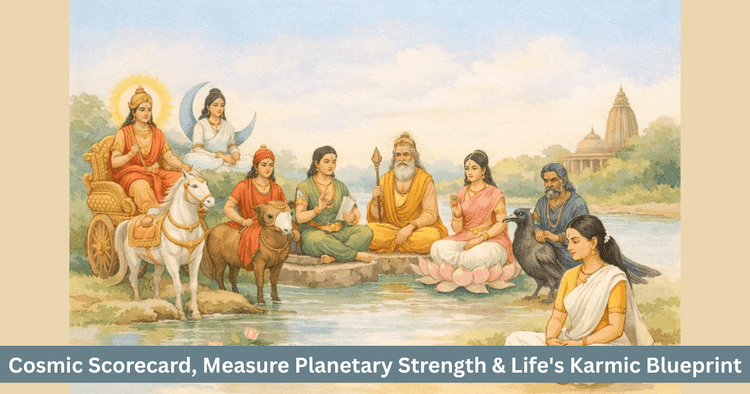
Table of Contents
Foundational Understanding
Vedic astrology is a highly detailed and scientific discipline incorporating numerous calculation methods. Among these systems, Ashtakavarga stands as a unique approach that quantifies planetary and house strength through numerical points. This system possesses the ability to make personalized and precise predictions that extend far beyond generic astrological interpretations. Ashtakavarga means the eightfold division or eight-source analysis. These eight sources are the seven classical planets namely Sun, Moon, Mars, Mercury, Jupiter, Venus, and Saturn, plus the eighth source which is the Ascendant or Lagna. Each house receives points from these eight sources, and the point total determines which planets or houses prove strong or weak. This system reveals life areas where success flows naturally and where sustained effort proves necessary.
The Core Essence of Ashtakavarga
Word Meaning and Philosophical Foundation
The word Ashta means eight and Varga means division or source. Thus Ashtakavarga literally translates as the eightfold division. This system functions as a cosmic scorecard measuring the following aspects. First, which planets are inherently strong or weak. Second, which houses represent sources of flow or struggle in life. Third, how planetary transits will unfold based on house strength. Fourth, which life periods prove golden and which demand effort. Fifth, this represents the karmic balance sheet from previous births now manifesting. This constitutes a mathematical and scientific approach making destiny measurable and comprehensible.
The Working Mechanism of the Cosmic Scorecard
In the Ashtakavarga system, each house receives points from eight sources. If a planet occupies a favorable position relative to a specific source, that house receives one point. If the favorable position does not exist, no point is awarded. Thus any house can receive zero to eight points. Higher points indicate greater strength, more positive energy, and greater success. Lower points indicate weakness, struggle, and effort requirement. This system measures not only planetary strength but also house strength, which traditional astrology often overlooks.
Two Layers of Analysis
First Layer: Bhinna Ashtakavarga
In Bhinna Ashtakavarga, each planet possesses its separate scorecard showing beneficial influence across all twelve houses. This system examines from eight perspectives where each planet proves auspicious. For example, Jupiter is considered auspicious in the 5th, 7th, 9th, 11th, and 12th houses from its position. Saturn proves auspicious in the 3rd, 6th, 10th, and 11th houses as these represent labor and growth houses. For each house meeting the condition, one point or Bindu is placed.
Strength Levels According to Bindu Scores: If any house contains zero to three Bindus for a planet, that planet remains weak in that house. With four Bindus, medium strength exists. With five to seven Bindus, the planet proves powerful. With eight Bindus, this represents exceptional and maximum strength. This proves extremely rare and symbolizes special blessing in life.
Practical Use and Application: When Saturn begins its Dasha period or transits a sign, Saturn's Bhinna Ashtakavarga requires examination. If Saturn possesses six or more Bindus in that house, the period or transit becomes extraordinarily positive. With only one or two Bindus, the period or transit proves challenging. This personal analysis provides far greater accuracy than generic predictions.
Second Layer: Sarva Ashtakavarga
Sarva Ashtakavarga represents the collective or master scorecard combining all seven planets' individual contributions into one master chart. This constitutes the system's most important and powerful component.
Key Statistics and Data: The complete system contains three hundred thirty-seven Bindus distributed across twelve houses. Average Bindus per house equal three hundred thirty-seven divided by twelve, approximately twenty-eight. This twenty-eight Bindu number is considered magical as it represents average strength.
| Sarva Ashtakavarga Score | House Status | Life Experience |
|---|---|---|
| Below 25 Bindus | Weak | Challenges, obstacles, constant struggle |
| 25 to 28 Bindus | Medium | Moderate results, sometimes good sometimes difficult |
| Above 28 Bindus | Strong | Favorable outcomes, smooth flow |
| Above 30 Bindus | Very Strong Power Center | Natural success, effortless flow |
Profound Insight and Understanding: If any house contains thirty-five or more Bindus, it represents a power center. Life naturally provides opportunities, success, and effortless flow in that area. For example, if the 10th house (career house) contains forty Bindus, the person receives jobs, promotions, and success without excessive effort. Conversely, if any house contains fewer than twenty-five Bindus, it represents lifelong karmic struggle requiring conscious effort.
Ashtakavarga's Advantage Over Traditional Methods
Limitations of Traditional Analysis
Traditional astrology predictions often remain generic. For example, statements like Jupiter transiting your 7th house favors marriage. However, this generic statement fails to consider each person's individual birth chart. What if that person's 7th house proves very weak? Will Jupiter's transit remain beneficial then?
Ashtakavarga's Personalized Analysis
Ashtakavarga analysis asks how many of the eight sources actually support Jupiter's 7th house transit in your specific chart. Is the 7th house strong (thirty or more Bindus) or weak (twenty Bindus)? This system personalizes predictions dramatically. An auspicious transit into a weak house may produce minimal results. A challenging transit into a strong house may still yield favorable outcomes because house strength overpowers planetary weakness.
Accuracy and Reliability
Ashtakavarga predictions prove more accurate than traditional methods because they are numerical. Numbers never lie. If any house contains twenty Bindus, it remains weak regardless of which benefic planets occupy it. If it contains forty Bindus, it proves powerful regardless of which malefic planets occupy it. This objectivity makes Ashtakavarga extremely reliable.
Life's Easy and Hard Areas
High-Scoring Houses: The Path of Least Resistance
When examining your Sarva Ashtakavarga chart, you instantly see life's terrain. Houses containing thirty or more Bindus represent natural talent and easy success areas. These are paths of least resistance where life flows easily.
Practical Examples: If the 10th house contains forty Bindus, career naturally flows. Jobs arrive easily. Promotions come without excessive effort. Seniors and colleagues provide support. This represents karmic blessing. If the 5th house contains thirty-five Bindus, children arrive easily, education proceeds smoothly, and creativity manifests naturally.
Low-Scoring Houses: Lifelong Karmic Challenges
Houses containing fewer than twenty-five Bindus represent lifelong karmic challenges. These are areas requiring conscious, sustained effort. These represent incomplete karmas from previous births that must complete in this life.
Practical Examples: If the 7th house contains twenty-two Bindus, relationships demand deep work. Partnerships prove complex. Marriage faces challenges. This represents a karmic lesson teaching patience, understanding, and love. If the 2nd house (wealth house) contains twenty Bindus, wealth accumulation proves difficult. Income fluctuates. Financial stability requires constant effort.
Life Phases and House Analysis
Houses 1 through 4 represent early life support and family foundation. If these houses prove strong, childhood remains happy, secure, and prosperous. Houses 5 through 9 represent education, children, and life purpose. Houses 10 and 11 represent career and material gains. The 11th house particularly serves as the wealth indicator.
Practical Applications
Transit and Dasha Predictions
This represents Ashtakavarga's primary use. When any planet begins a Dasha period or transits, both Bhinna Ashtakavarga and Sarva Ashtakavarga require examination.
Bhinna Ashtakavarga Analysis: Saturn's Sade Sati (seven-and-half-year transit over Moon) proves far less painful if Saturn's Bhinna Ashtakavarga shows five or more Bindus in the 12th, 1st, and 2nd houses. This indicates Saturn proves powerful in those houses and brings growth and maturity rather than harsh times.
Sarva Ashtakavarga Analysis: Any planet, whether benefic or malefic, transiting a high Sarva Ashtakavarga house (thirty-five or more Bindus) produces favorable results due to house strength. Conversely, even Jupiter transiting a low Sarva Ashtakavarga house (twenty Bindus) proves weak and unable to deliver promised benefits.
Identifying Golden Periods
Examine Sarva Ashtakavarga point patterns across all twelve houses. High-score clusters indicate natural success periods. Low-score clusters indicate periods requiring caution and effort. This knowledge proves extremely valuable for life planning.
Dasha Period Strength
When any Dasha begins, assess the following. First, what is the house strength? Where does the planet sit? High Sarva Ashtakavarga means strong Dasha. Low Sarva Ashtakavarga means weak Dasha. Second, what is the planet's inherent strength? What is the total Bhinna Ashtakavarga score for that planet?
Marriage and Relationship Compatibility
Compare Jupiter scores in the 7th house of both partners' charts. Venus in males and Jupiter in females should possess five or more Bindus in the 7th house for harmonious relationships. If the 7th and 8th houses collectively contain twenty-five to twenty-eight or more Bindus, marriage proves prosperous and stable.
Remedial Measures and Strengthening
High Bhinna Ashtakavarga scores in afflicted planet placements mitigate negative effects. Low Bhinna Ashtakavarga scores indicate specific remedies (mantras, gemstones, pujas) required. For example, if someone's Saturn proves weak with low Bhinna Ashtakavarga Bindus, wearing blue sapphire gemstone, chanting Saturn mantras, or performing Saturn puja proves beneficial.
Financial and Professional Planning
The 11th house (gains house) containing fifty or more Bindus indicates billionaire-level wealth potential. This proves extremely rare but when occurring, the person accumulates extraordinary wealth. Even moderate 10th or 12th house scores improve if the 2nd, 9th, or 11th houses possess high scores.
The Party Analogy: Understanding Ashtakavarga
Imagining Twelve Party Rooms
A simple analogy helps understand Ashtakavarga. Imagine twelve party rooms representing the twelve houses. Each room contains different crowds. The room's Sarva Ashtakavarga score represents the number of people in the room, indicating energy level. For example, the 10th house represents an amazing party with forty people (forty Sarva Ashtakavarga Bindus). This means career success flows. The 7th house represents a dead party with only twenty people (twenty Sarva Ashtakavarga Bindus). This means relationships struggle.
Seven Planets as Special Guests
Seven planets are special guests walking room to room. Bhinna Ashtakavarga scores represent each guest's personal guest list. This indicates how many hosts await that planet in that particular room.
Prediction Scenario
When Saturn (normally challenging) enters the dead 7th house room (twenty Sarva Ashtakavarga) with only one of eight hosts present (one Bhinna Ashtakavarga Bindu), it becomes a lonely, depressing transit. However, when Saturn enters the thriving 10th house room (forty Sarva Ashtakavarga) with seven of eight hosts waiting (seven Bhinna Ashtakavarga Bindus), he receives royal treatment. This becomes a powerful, successful transit. This analogy explains Ashtakavarga's nature very simply.
The Karmic Balance Sheet
Karmic Accounting from Previous Births
Ashtakavarga represents accumulated karmic balance from previous births manifesting in this life. High Bindus reflect positive karma deposits. Low Bindus reflect pending karmic lessons. The scorecard reveals where effort flows easily and where resistance demands growth.
Balancing Karma and Free Will
Ashtakavarga teaches that destiny is not blind but rather a dynamic pattern of planetary cooperation that proves measurable and calculable. When properly understood, it empowers the seeker to align with the mathematical pulse of the universe. This represents walking the middle path between free will and fate. Bindus do not determine your future. They illuminate it, showing where cosmic currents flow and where you must consciously row.
The Path of Self-Improvement
When someone understands their Ashtakavarga, they accept their weaknesses and work on them. If any house proves weak, that area requires more effort, attention, and remedies. This self-awareness makes the person better. This represents the path of spiritual growth.
Advanced Interpretation and Deep Knowledge
House Strength Overpowers Planetary Weakness
The magic of Ashtakavarga reveals that despite apparently bad planetary placements in a traditional chart, if Ashtakavarga shows high points (thirty or more) in that house, the native still achieves favorable outcomes. House strength overpowers planetary weakness. For example, a malefic in the 2nd house traditionally suggests financial difficulty. However, if that house contains thirty-five Sarva Ashtakavarga Bindus, the person achieves strong financial status, possibly after initial delays.
Complexity and Expertise Required
Ashtakavarga proves highly advanced and requires precise computational accuracy because even small errors compound. Deep knowledge of traditional sutras proves essential. Careful cross-referencing with Shadbala (six-fold planetary strength) proves essential. Experience interpreting nuanced patterns proves necessary. Therefore, Ashtakavarga analysis always requires consulting an experienced and skilled astrologer.
Combination with Shadbala
Ashtakavarga should be viewed in combination with Shadbala. Shadbala measures six types of planetary strength. When both Ashtakavarga and Shadbala show a planet or house as powerful, results prove extraordinary. If both show weakness, results prove challenging. If one shows strength and the other weakness, mixed results occur.
The Mathematical Pulse of Life
Arithmetic Expression of the Universe
Ashtakavarga represents the place where Vedic astrology becomes both science and meditation. It reveals that destiny is not blind fate but rather a dynamic pattern of planetary cooperation, quantifiable and measurable. When properly understood, it empowers the seeker to align with the mathematical pulse of the universe.
The Middle Path Between Free Will and Fate
Ashtakavarga represents the middle path between free will and fate. Bindus do not determine your future. They illuminate it, showing where cosmic currents flow and where you must consciously row. This knowledge enables wisdom, preparation, and conscious partnership with the stars.
Life's Complete View
Ashtakavarga provides a complete view of life. It examines not just one planet or one house but the entire birth chart as an integrated system. This holistic approach leads to more accurate and useful predictions.
Living Life with Ashtakavarga
Daily Life Application
Ashtakavarga is not merely a theoretical system. It can be applied to daily life. When you know which houses prove strong and which weak, you can direct your efforts accordingly. Invest more time and energy in strong houses. Work with patience, understanding, and remedies in weak houses.
Future Planning
Ashtakavarga proves extremely valuable for future planning. When you know which upcoming transits will prove favorable and which challenging, you can prepare accordingly. Make important decisions during favorable transits, start new projects, and take risks. During challenging transits, remain cautious, stay grounded, and focus on remedies.
The Wisdom of Ashtakavarga: Final Reflection
Ashtakavarga represents one of the most powerful and accurate prediction systems in Vedic astrology. It reveals life as a numerical pattern where cosmic energies can be measured. This system not only predicts but also empowers. It shows which life areas will naturally succeed and which demand effort. This knowledge makes the person captain of their life, working in harmony with cosmic currents. Ashtakavarga teaches that destiny is not predetermined but dynamic, and through the combination of conscious effort and cosmic support, anyone can shape their fate.
Frequently Asked Questions
What is Ashtakavarga and why is it important?
Ashtakavarga is a numerical prediction system in Vedic astrology that measures planetary and house strength. It works by allocating points from eight sources (seven planets and Lagna). It proves important because it provides personalized and accurate predictions that extend beyond traditional methods. It shows which life areas will prove easy and which challenging.
What is the difference between Bhinna and Sarva Ashtakavarga?
Bhinna Ashtakavarga represents each planet's individual scorecard showing its specific strength. Sarva Ashtakavarga represents the collective sum of all seven planets' Bindus showing each house's total strength. Bhinna Ashtakavarga is used for individual planet analysis, while Sarva Ashtakavarga is used for overall life patterns and house strength.
Is success possible in a house with low Bindus?
Yes, success is possible in a house with low Bindus but it demands more effort, patience, and remedies. Low Bindus reflect karmic lessons from previous births. With conscious effort, appropriate remedies (mantras, gemstones, pujas), and dedication, a person can achieve significant accomplishment even in low Bindu houses. It proves difficult but not impossible.
How many Bindus in the 11th house are good for wealth?
The 11th house represents gains and income. If it contains twenty-eight Bindus or more, financial status proves good. Thirty to thirty-five Bindus prove very good and indicate strong wealth accumulation. Forty Bindus or more represent extraordinary wealth potential. Fifty or more Bindus prove extremely rare and indicate billionaire-level wealth possibility.
Is Ashtakavarga sufficient for transit prediction?
Ashtakavarga proves extremely powerful for transit prediction but should not be viewed alone. It should be combined with the Dasha system, yoga analysis, and traditional planetary positions. Ashtakavarga complements and refines traditional analysis. An experienced astrologer combining all methods provides the most accurate predictions.
Get your accurate Kundali
Generate KundaliDid you like it?
Author

Pt. Narendra Sharma (63)
Experience: 20
Consults About: Family Planning, Career
Clients In: Punjab, Haryana, Delhi
Share this article with friends and family
About ZODIAQ
ZODIAQ is an online Vedic Astrology platform. It connects clients seeking astrological advice to experienced astrologers with deep knowledge. Our users also generate kundali and perform kundali milan for free. ZODIAQ also offers services to the Astrologers. Astrologers utilize various offerings by ZODIAQ to serve their clients effectively.
If you are a User
Consult with experienced astrologers and seek their guidance. You can also order handwritten Janm Patrika report with life prediction prepared by experienced astrologers. Generate accurate Kundali, perform Kundali Matching and check horoscope and muhurat. Utilize our online library for all the necessary astrological and spiritual information.
If you are an Astrologer
Create accurate kundali for your clients and perform Kundali Matching for up to 5 people at a time. Write comprehensive Janm Patrika report for your clients with ZODIAQ. Check client details anytime by saving it in client directory. Become more productive by tracking how many clients you guide every day.
WELCOME TO
ZODIAQ
Right Decisions at the right time with ZODIAQ
