Chhinnamasta Rahu and Kundalini Power
By Pt. Sanjeev Sharma
How cutting ego turns desire into ojas and inner vision
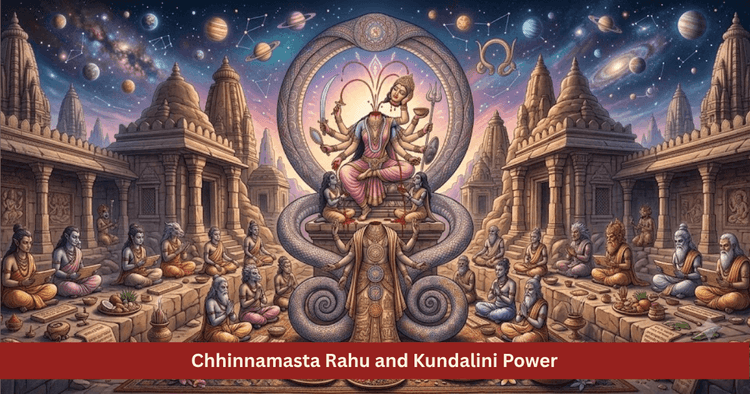
Table of Contents
Sadhana muhurat and basic rules
- Best day: Saturday
- Paksha: Krishna Paksha, Ashtami or Amavasya especially favourable
- Nakshatra: Swati, Shatabhisha, Ardra
- Time: Brahma muhurta or a quiet night after sunset
- Direction: Face south or west
- Attire: Red or deep red clean clothes
- Lamp: Sesame oil lamp or ghee lamp
- Offerings: Red flowers, sindoor, jaggery, sesame, red gram
- Root mantra: Om Hreem Chhinnamastayai Namah (108 times)
- Dhyana beej: Om Shreem Hreem Kleem Aim Vajravairochanyai Svaha (11 or 21 times, only with restraint)
- Duration: At least 40 days without a break
- Basic discipline: Celibacy or marital restraint, truthful speech, fierce tantric rites without a guru are forbidden, any wish to harm another is fully prohibited
When the head is cut and awareness remains
Some forms first shake the eye and later quiet the intellect. The form of Maa Chhinnamasta is the sharpest among them. She cuts her own head. She holds the severed head in one hand. Three streams issue from the neck. Two streams nourish her attendants. The third stream returns into her own severed mouth. This vision is not a festival of violence. It is the picture of the moment when the centre of ego breaks and prana still continues to flow.
In Vedic astrology Rahu is the planet of that severed head. Rahu is a head without a torso. There is desire, yet there is no completeness. There is seeing, yet there is no steady base. Therefore when Rahu becomes uncontrolled the mind runs toward mania. A person wants more, displays more, compares more and finally becomes trapped in their own thoughts. Desire increases. Sleep breaks. Decisions crack. Fame arrives suddenly and suddenly turns into shame.
Maa Chhinnamasta does not merely destroy that Rahu force. She refines it. She teaches that cutting the head is not the destruction of the body. Cutting the head is the offering of ego. When the sense of I is cut, the same energy that earlier scattered as lust becomes ojas and rises. In Tantra Shastra this upward movement is called the awakening of Kundalini. When this shakti opens at Sahasrara, a person receives that seeing which common speech calls extraordinary. In truth that seeing is not outer magic. It is the clean capacity to look within.
The story form of Maa Chhinnamasta and its hidden meaning
A narrative appears in the Pranatosini Tantra and in Shakta tradition. The Goddess walks by the Mandakini. The attendants Dakini and Varnini, also named Jaya and Vijaya in some tellings, become deeply restless and hungry. They ask the Mother for the rasa of life. Without delay the Mother cuts her own head with her nails. Three streams of blood spring forth. Two satisfy the attendants. One stream returns into the Mothers severed mouth. Hunger is stilled. Awareness does not end.
This story is also a subtle lesson for household life. When inner powers remain hungry, a human being begins to steal energy from others. They want honour. They want enjoyment. They want control. Maa Chhinnamasta teaches that true fullness does not come by draining others. True fullness comes when the seeker cuts ego and shares their own power in a pure form. Blood here is not violence. Blood is prana. When prana flows in balance through Ida, Pingala and Sushumna, life itself becomes a yajna.
The standing of the Mother is also meaningful. She is described as standing upon Kama and Rati. This does not mean contempt for enjoyment. It means authority over enjoyment. Desire is below. Awareness is above. The person who is a servant of desire is danced by Rahu. The person who can see desire and can cut it receives subtle vision from Rahu.
What Rahu actually cuts
Many people take Rahu as only inauspicious. That view is incomplete. Rahu magnifies. Rahu is the karaka of foreign fields, technique, crowds, fame, secrecy, addiction and mental speed. When Rahu is restrained in a shubha house it can give research, insight, public reach and uncommon success. When Rahu is afflicted or uncontrolled the same force becomes mania.
Mental signs of uncontrolled Rahu
- The same thought circling again and again without release
- Excess attachment to fame, body, wealth or relationships
- Sudden anger, fear, suspicion or comparison
- Broken sleep, disturbed dreams and mental fatigue
- Addiction, excess enjoyment or a hidden guilt mood
- Speech and conduct that drain the energy of others
- Hunger for impact more than hunger for truth
Rahu is a head without a trunk. Therefore it keeps eating and is not filled. Ketu is a trunk without a head. Ketu cuts and gives emptiness. Chhinnamasta is the bridge between the two. She holds the head in her hand. That means the mind is not fully destroyed. The mind becomes a witness. This is the gentlest and hardest siddhi in Jyotisha.
Rahu in houses and the purifying fruit of Chhinnamasta
| House | Uncontrolled Rahu | Likely purification through Chhinnamasta dhyana |
|---|---|---|
| First | Ego, hunger for image | Natural radiance without display |
| Fifth | Sensual clinging, restless intellect | Ojas, one pointedness, mantra shakti |
| Eighth | Hidden fear, mania, sudden trouble | Restrained rise of Kundalini |
| Ninth | Hostility to the guru, stubborn opinion | True shraddha and viveka |
| Twelfth | Sleep defects, addiction, escape | Peace like samadhi and tyaga |
Kundalini, the three streams and Sahasrara
In Tantra the body is not flesh alone. The body is a city of nadis. There are three principal nadis. Ida is the cool lunar current. Pingala is the warm solar current. Sushumna is the silent upward current in the middle. The three blood streams of Maa Chhinnamasta are read as the visible form of these three nadis. The two attendants are Ida and Pingala. The Mother herself is Sushumna. When the middle current opens, shakti rises from Muladhara to Sahasrara.
Sahasrara is called the thousand petaled lotus at the crown. Here the last knot of ego opens. Therefore the place of the Mothers severed head also gives this sign. What is cut is the head that keeps saying I am. What remains is the awareness that sees. Rahu can also agitate this very crown field. Uncontrolled Rahu fills the head with noise. Restrained Rahu fills the head with light. Chhinnamasta dhyana takes Rahu from noise toward light.
The journey from desire to ojas
Shastra says that virya, mind and prana are three forms of one power. When this power scatters below it is called vasana. When this power ripens through restraint it is called ojas. Ojas gives peace in the eyes. It gives weight in speech. It gives vitality in the body. It gives sharpness in intellect. Rahu increases vasana and steals ojas. Maa Chhinnamasta returns that stolen power.
This return does not happen by a magic wand. This return happens by daily restraint. Less useless speech. Less useless gazing. Less useless comparison. More silence. More truth. More service. Then the mantra finds soil. Without soil the mantra remains only vibration and Rahu becomes even more restless.
How Chhinnamasta dhyana should be done
The full tantric vidhi of a fierce Mahavidya should not be done without a guru. For a householder sattvic dhyana is enough and safe. Dhyana means sitting with understanding of the form, not copying blood in an outer way.
Order of sattvic dhyana
| Step | Act | Inner bhava |
|---|---|---|
| 1 | Bathe and wear red clothes | Honour of shakti |
| 2 | Sit in a steady asana with a straight spine | Opening the path of Sushumna |
| 3 | Light a lamp and offer red flowers | Giving the senses one direction |
| 4 | Remember the three breath nadis | Ida Pingala Sushumna |
| 5 | Imagine the knot of ego being cut | Cutting the head means leaving I ness |
| 6 | Chant Om Hreem Chhinnamastayai Namah 108 times | Pacifying Rahu through nada |
| 7 | Gently attend to white light at Sahasrara | Seed of extraordinary vision |
| 8 | Donate food to a hungry person | Worldly form of feeding the attendants |
In dhyana the severed head of the Mother should be seen with gratitude, not with fear. That head is in the hand. That means the mind is under the seeker. The mind is not riding upon the seeker. This is the secret sutra of victory over Rahu.
Helpful rules for the householder
- On Saturday donate sesame, a blanket or dark grain
- Reduce night waking and irregular sleep
- Leave harsh visuals, intoxication and addiction
- Keep a vow of speech, one silent period in the week
- Do not insult the guru, the mother or truth
- Do not force Kundalini through fierce experiments
Mental mania and the astrological logic
When Rahu swallows the Moon in a kundali the mind drowns in waves. When Rahu swallows Mercury, thought turns toward falsehood and cleverness. When Rahu is fierce in the fifth or the eighth, craving and hidden fear walk together. Where medicine is needed, medicine is mandatory. Mantra is not a substitute for medicine. Mantra gives meaning to the mind. When meaning arrives, both medicine and restraint bear fruit.
Chhinnamasta dhyana works because it speaks the language of Rahu. Rahu does not respect a merely mild form. Rahu respects a sharp symbol. The severed head is a sharp symbol. That symbol shocks the mind and asks who you are. When this question sits with honesty, the speed of mania slows. The person begins to see a thought as a thought. This is the first stage of extraordinary vision.
Extraordinary vision does not mean a show of future telling. It means seeing deceit as deceit. Seeing inner hunger as hunger. Seeing the drama of others as drama. With such vision error reduces even in livelihood. Deceit stings less in relationship. Ego enters sadhana less.
Who receives special fruit from this sadhana
- Those whose Rahu dasha or Rahu transit is bringing heavy upheaval
- Those caught in the cycle of fame, enjoyment or comparison
- Those whose vasana is destroying ojas
- Those who wish to meditate but carry noise in the head
- Those with hidden fear and sudden crisis in the eighth house
- Those who speak of Kundalini but do not keep restraint
- Those who wish to see truth even if it cuts ego
What should not be done
- No smashana sadhana, blood offering or fierce yantra work without a guru
- No japa to control or harm a person
- No Chhinnamasta dhyana in a state of intoxication
- No claim of awakening Kundalini only to display power
- No gruesome display that spreads fear in the family
- No lying, adultery or bitter sarcasm during the sadhana period
The Mother cuts her own head. She does not ask for the head of another. The seeker who goes out to cut others is not speaking with the Mother. That seeker is speaking with their own Rahu.
FAQ
Why does Maa Chhinnamasta cut her own head?
Cutting the head is the offering of ego and limited I ness. Awareness is not destroyed. Prana flows in three streams and nourishes the attendants and her own mouth.
What is the link between Chhinnamasta and Rahu?
Rahu is the severed head, desire without a complete body. Chhinnamasta holds that severed head as a witness and turns the mania of Rahu into ojas.
How do Kundalini and Sahasrara relate to this form?
The three blood streams are Ida, Pingala and Sushumna. When the middle current opens, shakti rises to Sahasrara. Cutting the head is a sign of that high centre opening.
How should Chhinnamasta dhyana be done if Rahu causes mental mania?
In the sattvic way chant Om Hreem Chhinnamastayai Namah 108 times, keep restraint, donate and steady the breath. Do not force fierce tantra or Kundalini. Consult a physician when needed.
How does vasana become ojas?
By cutting sensory haste through silence, celibacy or marital restraint and truth, prana rises. That ripened power becomes ojas and cleanses vision.
The severed head and the light that remains
The world worships the head the most. The head holds a name. The head holds a title. The head holds an opinion. Rahu sits in the head and says I am everything. Maa Chhinnamasta cuts that very head with love and holds it in her hand. Cutting is not hatred. Cutting is freedom. Holding it in the hand is the faith that the mind can become a servant, not an enemy.
When Rahu brings mania into life, more plans do not help. What helps is one clean cut. A cut of addiction. A cut of comparison. A cut of false image. The emptiness that comes after that cut is the door of Kundalini. The seeker who fills that emptiness with shraddha, not with fear, finds vasana becoming ojas. Their vision does not beg for outer glitter. It can see through to the inside.
This yoga of Maa Chhinnamasta and Rahu is not only a table of planets. It is an answer to the deepest human fear. The fear is that if I am cut I will not remain. The truth is that when I is cut, what remains is light. In that light the seeker walks, tends the home, does karma and still does not remain a servant of any false head.
Get your accurate Kundali
Generate KundaliDid you like it?
Author
Pt. Sanjeev Sharma (63)
Experience: 20
Consults About: Family Planning, Career
Clients In: Punjab, Haryana, Delhi
Share this article with friends and family
About ZODIAQ
ZODIAQ is an online Vedic Astrology platform. It connects clients seeking astrological advice to experienced astrologers with deep knowledge. Our users also generate kundali and perform kundali milan for free. ZODIAQ also offers services to the Astrologers. Astrologers utilize various offerings by ZODIAQ to serve their clients effectively.
If you are a User
Consult with experienced astrologers and seek their guidance. You can also order handwritten Janm Patrika report with life prediction prepared by experienced astrologers. Generate accurate Kundali, perform Kundali Matching and check horoscope and muhurat. Utilize our online library for all the necessary astrological and spiritual information.
If you are an Astrologer
Create accurate kundali for your clients and perform Kundali Matching for up to 5 people at a time. Write comprehensive Janm Patrika report for your clients with ZODIAQ. Check client details anytime by saving it in client directory. Become more productive by tracking how many clients you guide every day.
WELCOME TO
ZODIAQ
Right Decisions at the right time with ZODIAQ
