Tvashta and Chitra Creative Craft
By Pt. Sanjeev Sharma
The Vishvakarma secret behind art architecture and design
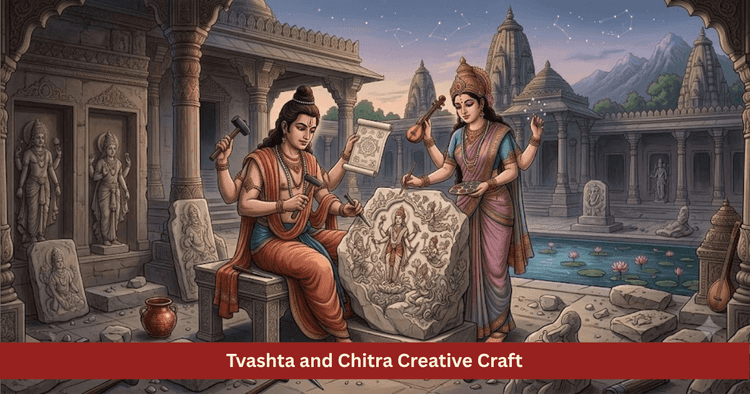
Table of Contents
Chitra Nakshatra is like a shining jewel in which thought, beauty and the power of creation appear together. In Vedic astrology its presiding deity is Tvashta, the divine craftsman who is also remembered through the form of Vishvakarma. Mangala rules this nakshatra. Mangala gives energy, courage, instruments and the power to build. Tvashta gives that force shape, proportion, usefulness and beauty.
A person influenced by Chitra may hold a strong desire to create something new. The person does not make only an object. Through lines, colours, metal, stone, cloth, buildings or words the person creates an experience. When Chitra is strong in the kundali of an architect, fashion designer, engineer, sculptor, painter or craftsperson, creative talent may receive public recognition.
The shining pearl of Chitra symbolises outer beauty as well as hidden inner quality. Every shine does not represent real value. True craft joins form with durability, usefulness and soul. This is the spiritual principle of Chitra Nakshatra.
What is the core identity of Chitra Nakshatra
Chitra lies across the regions of Kanya and Tula rashis, corresponding to Virgo and Libra. Its first two padas are considered to fall in Kanya and its final two padas in Tula. Kanya gives detailed observation, technical knowledge, purity and efficiency. Tula gives balance, beauty, relationship and art. Their union gives Chitra the power of both creation and presentation.
Mangala rules Chitra. Mangala gives the energy to turn an idea into action. If Mangala is weak, imagination may remain greater than construction. If Mangala is strong and receives support from Budha, Shukra or Chandra, the native may produce excellent design, structure and artistic expression.
Principal elements of the nakshatra
| Element | Details |
|---|---|
| Nakshatra | Chitra |
| Rashi region | Kanya and Tula |
| Ruling graha | Mangala |
| Presiding deity | Tvashta or Vishvakarma |
| Symbol | Shining pearl |
| Main shakti | Beautiful and useful creation |
| Main qualities | Art, architecture, design, engineering and craft |
| Main challenges | Display, perfectionism and impatience |
It is incomplete to call Chitra only a nakshatra of beauty. It is the nakshatra that gives structure to beauty. Here imagination is brought to earth through measurement, technique and labour.
The craft principle of Tvashta and Vishvakarma
Tvashta is regarded in the Vedic tradition as the divine craftsman and creator of form. He is also remembered through the name Vishvakarma. He is worshipped as the creator of divine buildings, chariots, weapons, cities and extraordinary structures. His craft is not decoration alone. It is a union of cosmic order, usefulness and beauty.
The principle of Vishvakarma teaches that creation needs vision first. After vision comes planning. After planning come suitable materials, labour and time. Great work does not arise from talent alone. Talent needs the foundation of discipline.
Craft principles of Tvashta
- Giving clear form to an idea
- Choosing suitable materials
- Respecting measurement and proportion
- Joining usefulness with beauty
- Maintaining patience and purity in work
- Including public benefit in creation
- Preserving the work after construction
When a Chitra native follows these principles, the creation does not remain merely attractive. It may become useful, memorable and lasting.
The symbol of the shining pearl
The symbol of Chitra is a shining pearl. A pearl forms in the depth of the sea over a long period. A small irritation slowly turns into beautiful layers. This is an important indication for a Chitra native. Great creation often arises from experience, struggle or inner restlessness.
A pearl appears calm and beautiful from the outside, yet time and patience remain hidden behind its formation. In the same way the work of Chitra may look beautiful suddenly, yet it is supported by a long process of practice, failure and subtle correction.
Life principles from the pearl
- Keep depth behind outer shine.
- Turn failure into material for creation.
- Treat time as an ally of craft.
- Keep patience while correcting small errors.
- Develop a personal style beyond imitation.
The beauty of Chitra is not fixed. It matures through experience.
The relationship between Mangala and Chitra
Mangala gives Chitra movement, energy and courage. Mangala is especially useful in architecture, engineering, metal, machines, surgery, military structures and technical construction. Yet the intensity of Mangala needs the balance of Shukra and Budha.
Mangala alone can bring hardness and haste into design. Shukra gives beauty. Budha gives measurement, logic and communication. Chandra gives emotional touch. Guru gives purpose and an ethical view.
| Planetary connection | Possible influence | Caution |
|---|---|---|
| Strong Mangala | Construction, courage and technical ability | Avoid impatience |
| Mangala with Shukra | Fashion, art and attractive design | Do not become trapped in display |
| Mangala with Budha | Engineering, planning and technical writing | Avoid excessive analysis |
| Mangala with Chandra | Sculpture, art and emotional creation | Avoid emotional instability |
| Mangala with Guru | Ethical architecture and public benefit | Do not impose personal vision on others |
The complete result of a kundali is understood through house, aspect, dasha and navamsha. Even so the strength of Mangala in Chitra provides the basic force for bringing creation into form.
Chitra in architecture and design
Chitra is deeply connected with architecture. A building is not only a collection of walls. Direction, light, air, proportion, usefulness and the mental state of those who live there must also be considered. A Chitra native may understand these subtle matters.
For an architect, Chitra means creating a place on earth that gives both safety and beauty. For a designer it means giving an object a form that remains attractive while being useful. For an engineer it means structural strength. For a sculptor it means awakening feeling in lifeless stone.
Main foundations of architecture and design
- Study of space and direction
- Balance of light and air
- Quality of materials
- Safety of the structure
- Comfort of the user
- Beauty and proportion
- Responsibility toward the environment
- A plan for long term preservation
A creation that looks beautiful but is difficult to use does not express the higher form of Chitra. True design makes life simpler and more beautiful.
Success in fashion and visual art
Chitra is also connected with clothing, colour, jewellery, appearance and visual presentation. The influence of Tula makes it special for fashion, beauty and social presentation. The precision of Kanya appears in stitching, material and refinement.
A Chitra designer may prepare a form according to the body, personality, time and occasion of a person. The person understands that beauty does not arise only from bright colours. Colour, texture, proportion and personality must come together.
Possible roles in fashion
- Fashion designer
- Clothing producer
- Jewellery designer
- Makeup and appearance specialist
- Style adviser
- Textile illustrator
- Stage costume creator
- Brand presentation specialist
In this field a Chitra native should hold ethics beside outer attraction. Distance from exploitation, imitation and unnecessary consumption gives greater respect to craft.
Chitra and sculpture
A sculptor recognises the hidden form in stone. Extra material is removed and the inner figure is brought forward. This process resembles the inner practice of Chitra Nakshatra. A person can also reveal the true personality by removing unnecessary fear, doubt and display from within.
Patience is the greatest quality in sculpture. One wrong strike can damage the whole work. Therefore the force of Mangala must join the restraint and care of Budha.
Principles of craft practice
- Work after understanding the material.
- Respect the instruments.
- Inspect after every stage.
- Reduce the desire for quick results.
- Learn from a guru or experienced craftsperson.
- Add feeling and purpose to the creation.
The craft of Chitra remains alive when both the awareness of the maker and meaning for the viewer are present.
Engineering and technical creation
Chitra Nakshatra is also connected with engineering. Mangala gives machines, metal and technical courage. Kanya gives detail, calculation and quality control. Therefore a Chitra native may progress in buildings, vehicles, machines, industrial structures, energy and technical design.
Technical work requires rules along with imagination. An attractive construction made by compromising safety does not express the higher form of Chitra. The craft of Vishvakarma was beautiful and reliable.
Foundations of technical success
- Accuracy in calculation
- Testing of materials
- Following safety standards
- Timely inspection
- Clear communication with the team
- Planning for future repair
- Attention to environmental impact
A Chitra native should balance creative expression with technical responsibility.
Perfectionism and its shadow
The detailed vision of Chitra leads toward high quality. Yet the same vision can become perfectionism. The native may become disturbed by every small flaw. Even after completion the person may feel that something remains unfinished. The person may begin to expect the impossible from self and others.
Signs of perfectionism
- Unnecessary delay in submitting work
- Excessive disappointment over a small error
- Inability to accept the style of colleagues
- Difficulty in accepting criticism of personal work
- Constant comparison
- Placing beauty above usefulness
True craft pursues perfection yet also understands limits of time and circumstance. Unfinished work holds the possibility of improvement. At times an opportunity disappears while waiting for perfection.
Vishvakarma worship and remedies for Chitra
The mood of Vishvakarma worship is gratitude toward instruments, craft, labour and construction. This worship is not limited to factories or technical institutions. The writers pen, the artists brush, the architects measuring instrument, the craftspeoples tools and the students book are all instruments of craft.
Simple worship method
- Clean the workplace.
- Arrange instruments, machines or creative materials properly.
- Light a lamp and remember Tvashta or Vishvakarma.
- Resolve to work with safety and honesty.
- Honour a craftsperson, worker or student.
- Resolve not to misuse instruments.
- Hold the feeling of using creation for social good.
Remedies for Chitra Nakshatra
| Remedy | Vidhi | Direction of fruit |
|---|---|---|
| Vishvakarma remembrance | Pray before beginning work | Creative clarity |
| Mangala shanti | Labour, exercise and discipline | Balance of energy |
| Care of instruments | Clean and preserve tools | Stability in work |
| Gift of craft | Help a student or craftsperson | Growth of talent |
| Practice of beauty | Keep home and workplace orderly | Balance of mind |
| Honest construction | Avoid deceit in material and quality | Lasting reputation |
The greatest remedy for Chitra is absence of deceit in creation. Hiding weak material behind a beautiful covering is not craft. It is illusion.
Professional success and public recognition
A Chitra native can build recognition through creation. If the tenth house, lagna, Mangala, Shukra and Budha connect favourably, name may arise through design, art, technology, industry or construction. The persons work may become a standard for others.
Public recognition also brings criticism. A Chitra native should understand that every person will not view the work in the same way. Useful signs may be hidden in criticism. Receiving them can strengthen personal style.
Principles for lasting recognition
- Develop an original style.
- Respect the craft of others.
- Place quality above publicity.
- Complete work on time.
- Give credit to collaborators.
- Continue learning.
- Understand the social effect of creation.
The value of craft does not exist only in fame. A small instrument, a safe building or a beautiful book may improve the lives of thousands.
The beauty of Mangala and the dharma of creation
Mangala is generally regarded as the graha of war, courage and struggle. In Chitra another form of Mangala appears. The same force shapes stone, turns iron into an instrument and changes empty space into a home. Creation is also a struggle. Producing beauty among resistant materials, limited time and restricted means is the craft form of Mangala.
When Mangala joins dharma, creation becomes useful to society. When it joins ego, the maker turns talent into a means of proving superiority. Remembrance of Vishvakarma turns this ego toward service.
Creation maturing like a pearl
Chitra Nakshatra teaches that beauty is formed through time. A shining pearl is not created in one day. The creator also passes through layers of thought, practice, failure and correction. These layers give personal style its uniqueness.
A native who develops creation not only for praise but also for usefulness and meaning can leave a lasting effect. The work does not become old quickly. Its structure allows it to speak with changing generations.
From craft to spiritual practice
The highest message of Chitra Nakshatra is that creation can become spiritual practice. When a craftsperson respects the instrument, an architect honours the earth, an engineer gives priority to safety and an artist keeps truth in the work, labour becomes worship.
Tvashta or Vishvakarma reminds us that the world itself is a great craft. Body, building, society, music and thought are all processes of creation. The power given to human beings to create is not only for private pride. It also carries the responsibility of making life more beautiful, safe and meaningful.
The pearl of Chitra shines fully when art joins compassion, beauty joins usefulness and the power of Mangala joins dharma. This is the blessing of Vishvakarma and the lasting mystery of Chitra Nakshatra.
FAQ
Who are the lord and presiding deity of Chitra Nakshatra
The lord of Chitra Nakshatra is Mangala and its presiding deity is Tvashta, who is also remembered through the form of Vishvakarma.
In which fields can Chitra Nakshatra give success
Chitra can support success in architecture, engineering, fashion design, sculpture, painting, craft, technical design and construction.
What is the symbol of Chitra Nakshatra
The symbol of Chitra Nakshatra is a shining pearl. It indicates depth, patience, beauty and excellence formed through long practice.
What is the spiritual meaning of Vishvakarma worship
Vishvakarma worship expresses gratitude toward instruments, labour, craft, construction and technical knowledge. It inspires honest creation for the benefit of society.
How can one avoid the shadow of Chitra Nakshatra
Perfectionism, display, impatience and discomfort with criticism should be balanced through usefulness, discipline, quality and cooperation.
Get your accurate Kundali
Generate KundaliDid you like it?
Author

Pt. Sanjeev Sharma (63)
Experience: 20
Consults About: Family Planning, Career
Clients In: Punjab, Haryana, Delhi
Share this article with friends and family
About ZODIAQ
ZODIAQ is an online Vedic Astrology platform. It connects clients seeking astrological advice to experienced astrologers with deep knowledge. Our users also generate kundali and perform kundali milan for free. ZODIAQ also offers services to the Astrologers. Astrologers utilize various offerings by ZODIAQ to serve their clients effectively.
If you are a User
Consult with experienced astrologers and seek their guidance. You can also order handwritten Janm Patrika report with life prediction prepared by experienced astrologers. Generate accurate Kundali, perform Kundali Matching and check horoscope and muhurat. Utilize our online library for all the necessary astrological and spiritual information.
If you are an Astrologer
Create accurate kundali for your clients and perform Kundali Matching for up to 5 people at a time. Write comprehensive Janm Patrika report for your clients with ZODIAQ. Check client details anytime by saving it in client directory. Become more productive by tracking how many clients you guide every day.
WELCOME TO
ZODIAQ
Right Decisions at the right time with ZODIAQ
