Dhanishta and the Wealth of Eight Vasus
By Pt. Nilesh Sharma
The deeper astrological link between music wealth property and Mangala
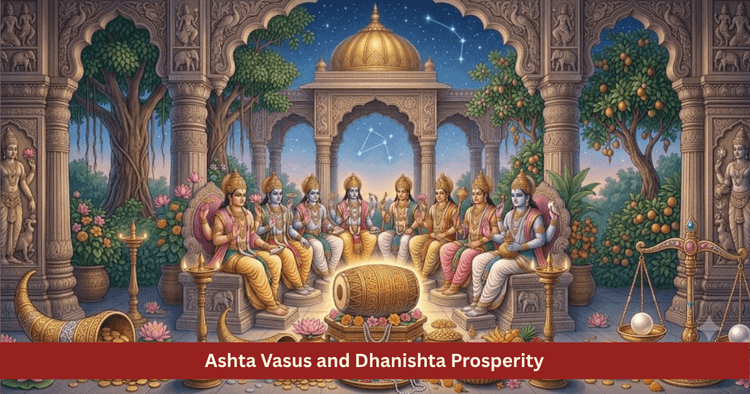
Table of Contents
The name Dhanishta Nakshatra brings together images of prosperity, music, land, industry and honour. In Vedic astrology this nakshatra is not considered only an indicator of wealth. It represents the ability to recognise resources organise them and create something lasting through them. Its presiding deities are the Ashta Vasus, who symbolise the primal elements and the forces that sustain life.
Dhanishta is traditionally understood as the most wealthy, highly prosperous and richly endowed. This nakshatra is associated with music, rhythm, metals, land, buildings organisation, leadership and wealth accumulation. Its ruling graha is Mangala. Mangala gives courage, energy, land, construction, struggle and decision making power. When the active force of Mangala joins the stable and nourishing power of the Ashta Vasus, a person may not only earn wealth. The person may also become a creator of wealth, art, industry or property.
The energy of Dhanishta contains both movement and rhythm. It gives the ability to recognise opportunities, use time wisely and guide collective strength. When its connection in the kundali is favourable, major achievements may arise through music, industry, property, administration, technology or finance. When the energy is disturbed, wealth may come with pride, harshness, anger and excessive competition.
The astrological structure of Dhanishta Nakshatra
Dhanishta Nakshatra lies across Makara and Kumbha rashis, corresponding to Capricorn and Aquarius. Its first two padas are placed in Makara and its final two padas are placed in Kumbha. This position makes the nakshatra an important bridge between personal action and collective influence.
Makara is connected with discipline, labour, structure and lasting achievement. Kumbha represents society, groups, ideas, innovation and a broad vision. Therefore a Dhanishta native may rise personally while also developing an institution, business, musical tradition or social system.
Main elements of Dhanishta
| Element | Details |
|---|---|
| Nakshatra | Dhanishta |
| Ruling graha | Mangala |
| Presiding deities | Ashta Vasus |
| Symbol | Drum, kettle drum or musical instrument |
| Rashi region | Makara and Kumbha |
| Main shakti | Prosperity and coordination of resources |
| Main qualities | Wealth, music, leadership, land organisation and fame |
| Main challenges | Pride, anger, harshness and misuse of wealth |
The symbol of Dhanishta is a musical instrument. A musical instrument produces a pleasing sound only when rhythm, movement and discipline remain balanced. This is the deeper secret of the nakshatra. Even abundant resources can turn into restlessness when life has no rhythm. With limited resources and proper planning, the same means can become the foundation of great success.
The Ashta Vasus and eight forces of nature
The Ashta Vasus are regarded in the Vedic tradition as symbols of the primal forces of nature. Different scriptures give some variations in their names, yet they are commonly connected with earth, fire, air, space, the Sun, the sky, the Moon and the stars.
These eight forces represent the physical and subtle foundations of life:
- Earth represents stability, land and property.
- Fire represents energy, transformation and courage.
- Air represents movement, communication and thought.
- Space represents expansion, opportunity and possibility.
- The Sun represents radiance, leadership and honour.
- The sky represents broad vision and consciousness.
- The Moon represents mind, art, rhythm and emotion.
- The stars represent time, destiny and cosmic order.
A symbolic union of these forces can be seen in Dhanishta Nakshatra. Therefore Dhanishta is not merely a nakshatra of wealth. It is the nakshatra of harmonious use of resources. A person who uses land, energy, time, intelligence and social relationships properly can achieve more lasting growth.
The meaning of Dhanishta and its deeper indication
The word wealth in Dhanishta does not mean only currency or money held in a bank. Wealth can also mean knowledge, art, land, honour, relationships, time, skill and opportunity. A person who holds a balanced collection of these forms of prosperity may be called truly wealthy.
This nakshatra is also connected with music and rhythm. Success in life does not come from hard work alone. The right time, the right speed and the right direction are also needed. Mangala gives speed while Dhanishta teaches how to bring that speed into rhythm and discipline.
A person influenced by Dhanishta may often:
- Recognise opportunities quickly.
- Take decisions during difficult conditions.
- Give direction to a group.
- Expand wealth and resources.
- Build a distinct identity in art or business.
- Establish systems that continue for a long time.
When this energy becomes disturbed, the person begins to mistake speed for success. Decisions may be taken without preparation. Hastiness in investment and the constant wish to move ahead of others can increase stress. The true lesson of Dhanishta is that speed becomes fruitful only when supported by planning and restraint.
The relationship between Mangala and Dhanishta
Mangala is the lord of Dhanishta Nakshatra. Mangala is connected with land, courage, construction, machines, technology, energy, competition and struggle. In Dhanishta the force of Mangala receives a direction through music organisation and social construction.
Mangala awakens a strong desire to move forward. Dhanishta teaches that individual effort must also receive the support of a group and a system. Therefore the favourable influence of this nakshatra can give leadership ability. Such leadership does not merely issue commands. It organises people around a shared purpose.
Effects according to the condition of Mangala
| Condition of Mangala | Possible effect on Dhanishta |
|---|---|
| Strong and benefic Mangala | Courage, construction, leadership and wealth growth |
| Influence of Guru on Mangala | Ethics, protection and righteous conduct |
| Influence of Shukra on Mangala | Music, art, design and charm |
| Harsh influence of Shani on Mangala | Struggle, delay and a hard temperament |
| Influence of Rahu on Mangala | Risk, greed and uncontrolled ambition |
| Connection of Mangala with Chandra | Music, rhythm and emotional energy |
The result of a nakshatra cannot be decided by looking at one graha or one position alone. The bhava, planetary aspects, dasha, navamsha and the complete kundali require consideration. Even so, Mangala in Dhanishta has a special ability to make a person active, courageous and focused on achievement.
The potential for excellence in music
The symbol of Dhanishta is a musical instrument. Therefore this nakshatra is considered deeply connected with music, rhythm, melody and group performance. If Chandra, Shukra, Budha and Mangala share favourable relationships, the native may achieve distinction in singing, instrumental music, composition, direction or management.
Music contains more than notes. It holds a balance of time, breath, movement, discipline and emotion. A Dhanishta native may understand this harmony naturally. The native may create sound that touches the mind of a listener or organise a large musical group with clear direction.
Possible roles in music
- Singer or instrumentalist
- Music director
- Specialist in rhythm instruments
- Artist connected with dance and stage performance
- Music teacher
- Sound arranger
- Director of a cultural institution
- Producer in the music industry
If Chandra is weak and Mangala is excessively fierce, music may lack feeling and performance may become hard. Support from Shukra can increase sweetness, beauty and popularity. A strong Budha can help with music theory, technology and communication.
Dhanishta, land and immovable property
One reason Dhanishta is linked with property and resources is its connection with Makara. Makara represents karma, structure and lasting construction. Mangala is associated with land and buildings. The Ashta Vasus represent the power of earth and material elements. Together these indications can support progress in construction, industry and immovable property.
A Dhanishta native may succeed in land purchase, building construction, minerals, metals, machines, energy, transport and large industrial structures. If the fourth house, tenth house, Mangala and Shani are favourably placed, the ability to create property may become stronger.
Possible property related fields
- Buying and selling land
- Building construction
- Architecture and engineering
- Mineral and metal industries
- Vehicles and transport
- Energy production
- Industrial plants
- Agricultural land
- Warehouses and commercial premises
- Government or institutional construction
Haste should be avoided in property decisions. Mangala can encourage quick action, yet matters of land and buildings require examination of documents, ownership, debt and legal status. A Jyotish indication may show an opportunity but practical judgement keeps that opportunity safe.
How can the possibility of immense wealth arise
The name Dhanishta itself points toward prosperity, yet immense wealth cannot be judged from this nakshatra alone. The second, fifth, ninth, tenth and eleventh houses, their lords, dhana yogas, gains, dasha and planetary strength must also be studied.
If Dhanishta connects with favourable wealth and karma houses, opportunities for accumulation, business, talent and gains may increase. A connection with the eighth house may indicate inheritance, insurance, minerals, research or resources received unexpectedly. An afflicted connection with the twelfth house may allow luxury, display and uncontrolled expenditure to block wealth.
Principles for lasting wealth creation
- Understand income sources before expanding them wisely.
- Make long term investments in land, industry or skill.
- Understand the difference between display and real assets.
- Keep rules and responsibilities clear in partnerships.
- Assess debt and risk properly.
- Direct a portion of wealth toward service, protection and social benefit.
The higher form of Dhanishta is one in which wealth does not merely make a person appear greater. It makes larger works possible. If wealth becomes display, the energy of Mangala creates conflict. If wealth becomes an instrument, the blessing of the Ashta Vasus becomes stable.
Social influence and leadership
Dhanishta gives collective influence along with personal prosperity. Its final padas fall in Kumbha, which is connected with society, groups and broad thought. Therefore a Dhanishta native may organise an institution, community, business group or cultural movement.
Such a person may show the following leadership qualities:
- Ability to decide during a crisis
- Ability to gather people for a goal
- Clear division of tasks
- Effective management of resources
- Willingness to work hard
- Pressure to complete work on time
The success of leadership depends on whether the person treats others as instruments or as partners. The Ashta Vasus are collective powers of nature. They teach that every great construction is completed through the cooperation of many elements. One person may imagine a building, yet many hands are needed to construct it.
The psychological side of Dhanishta
A Dhanishta native may hold a strong desire for achievement and recognition. The person wants society to accept the work. Through music, wealth, property or position the person may try to prove personal value.
When directed correctly this desire becomes an inspiration toward excellence. In the wrong direction it increases comparison, envy and dissatisfaction. The person begins to see the success of others as proof of personal deficiency. The inner practice of Dhanishta is to understand self worth separately from outer achievement.
Methods for mental balance
- Keep time each day for silence and self observation.
- Practise an art simply for joy.
- Understand identity beyond wealth and fame.
- Acknowledge the contribution of colleagues at work.
- Do not compare personal rhythm with the rhythm of others.
- Balance stored physical stress through exercise, music or pranayama.
Inner peace arrives for Dhanishta when a person understands that life is not only a competition. Every person has a different rhythm. One persons beat may be fast while another persons beat may be deep. Both have their own value.
Worship and practice for the Ashta Vasus
Worship of the Ashta Vasus expresses gratitude toward nature and its fundamental elements. Along with the wish for outer prosperity, the practice remembers that no wealth has meaning without earth, water, fire, air and space.
People connected with Dhanishta may adopt the following practices:
- Plant trees as a service to the earth.
- Light a lamp with respect for fire and avoid misuse of fire.
- Resolve to reduce pollution for the purity of air.
- Meditate on the vastness of the sky and space.
- Offer water to the Sun in the morning.
- Practise quiet japa on Monday for the coolness of the Moon.
- Look at the stars at night with reverence.
- Protect water sources and offer water to thirsty beings.
Simple worship method
- Bathe in the morning and clean the place of worship.
- Light a lamp and remember earth, fire, air, space, the Sun, the Moon and the stars.
- Mentally bow to the Ashta Vasus.
- Remember Mangala and pray for courage with restraint.
- Give food, water or a useful object to a person in need.
- Resolve to avoid anger, waste and pride throughout the day.
The real meaning of practice for Dhanishta is to understand that wealth and power cannot be separated from the laws of nature. One who receives from the earth should also hold the feeling of giving back to the earth.
Remedies for Mangala and ethical discipline
Since Mangala influences Dhanishta, remedies connected with Mangala may help. Mantra recitation and charity alone are not sufficient. Balance of Mangala also arises through conduct.
Useful remedies
- Remember Hanuman on Tuesday.
- Respect people who perform physical labour.
- Participate in blood donation or service work with proper guidance.
- Maintain honesty in matters of land and buildings.
- Avoid making decisions while angry.
- Include sports, exercise or physical labour in life.
- Honour brothers, soldiers, workers and technical professionals.
The power of Mangala should not be suppressed. It should be given a useful direction. Disciplined Mangala builds. Uncontrolled Mangala may destroy. For a Dhanishta native this is the most important distinction.
Guarding against the shadow of Dhanishta
Every nakshatra has a higher form and an unbalanced form. The higher form of Dhanishta is music, prosperity, leadership and construction. Its shadow may appear as display of wealth, harsh speech, excessive competition and disregard for others.
Signs that require attention
- Treating every success as proof of superiority
- Using wealth as a means of prestige instead of security
- Underestimating the role of colleagues
- Hesitating to apologise after anger
- Treating relationships according to usefulness
- Remaining constantly busy without recognising inner exhaustion
When these signs appear the energy of Dhanishta must be brought back into rhythm. When a note goes wrong in music the instrument is not blamed. The rhythm is corrected. Life requires the same process of correction.
The true sound of prosperity
Dhanishta Nakshatra teaches that prosperity is not merely the act of collecting. True prosperity allows wealth to create, music to bring peace to the mind, land to support life and leadership to offer opportunities to others.
The Ashta Vasus remind us that the world moves through the balanced cooperation of many elements. Without earth there is no building. Without fire there is no transformation. Without air there is no movement. Without space there is no expansion and without the Moon emotional rhythm remains incomplete. In the same way success is formed through the combined support of talent, labour, time, relationships and ethics.
The highest expression of Dhanishta appears in a person who remains a servant of nature while possessing property. The person may hold wealth yet retain humility in the heart. Music may fill life yet the person does not forget to hear the pain of others. The person may own land and buildings yet also creates space for society. Such prosperity becomes lasting and this is the true blessing of the Ashta Vasus.
FAQ
Who are the presiding deities of Dhanishta Nakshatra
The presiding deities of Dhanishta Nakshatra are the Ashta Vasus. They symbolise fundamental forces such as earth, fire, air, space, the Sun, the sky, the Moon and the stars.
Which graha rules Dhanishta Nakshatra
Mangala rules Dhanishta Nakshatra. Mangala gives this nakshatra courage, land, construction, energy, competition and decision making power.
Can Dhanishta Nakshatra give success in music
The symbol of Dhanishta is a musical instrument. When Chandra, Shukra, Budha and Mangala are favourably placed the native may succeed in singing, instrumental music, direction, dance or culture.
How is Dhanishta connected with wealth and property
Dhanishta is linked with prosperity. Through Makara, Mangala and the earth principle of the Ashta Vasus it may support gains through land, buildings, industry, metals and resources.
How are the Ashta Vasus worshipped
Worship of the Ashta Vasus is practised through gratitude toward the elements of nature. Tree planting, water conservation, lighting a lamp, offering water to the Sun, remembering the Moon and serving people in need are simple forms.
Get your accurate Kundali
Generate KundaliDid you like it?
Author

Pt. Nilesh Sharma (63)
Experience: 20
Consults About: Family Planning, Career
Clients In: Punjab, Haryana, Delhi
Share this article with friends and family
About ZODIAQ
ZODIAQ is an online Vedic Astrology platform. It connects clients seeking astrological advice to experienced astrologers with deep knowledge. Our users also generate kundali and perform kundali milan for free. ZODIAQ also offers services to the Astrologers. Astrologers utilize various offerings by ZODIAQ to serve their clients effectively.
If you are a User
Consult with experienced astrologers and seek their guidance. You can also order handwritten Janm Patrika report with life prediction prepared by experienced astrologers. Generate accurate Kundali, perform Kundali Matching and check horoscope and muhurat. Utilize our online library for all the necessary astrological and spiritual information.
If you are an Astrologer
Create accurate kundali for your clients and perform Kundali Matching for up to 5 people at a time. Write comprehensive Janm Patrika report for your clients with ZODIAQ. Check client details anytime by saving it in client directory. Become more productive by tracking how many clients you guide every day.
WELCOME TO
ZODIAQ
Right Decisions at the right time with ZODIAQ
