Maa Dhumavati and Ketu Supreme Detachment
By Pt. Narendra Sharma
How supreme peace and liberation are attained in Alakshmi bhava
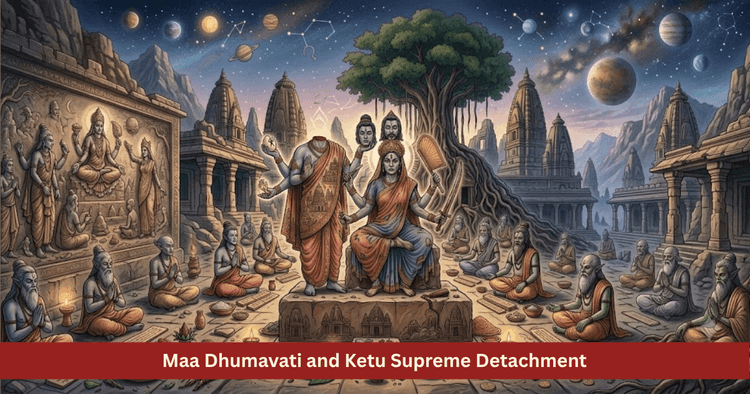
Table of Contents
Sadhana muhurat and basic rules
- Best days: Saturday or Tuesday
- Paksha: Krishna Paksha, Ashtami or Amavasya especially favourable
- Nakshatra: Ashwini, Magha, Mula
- Time: Night, midnight to 3 am
- Direction: Face south
- Attire: Black, deep blue or grey clean clothes
- Lamp: Sesame oil lamp
- Offerings: Sesame seeds, black cloth, black urad, incense, ash
- Root mantra: Om Dhoom Dhoom Dhumavati Devyai Svaha (108 times)
- Beej mantra: Om Dhoom Dhumavatyai Namah (11, 21 or 108 times)
- Duration: At least 40 days without a break
- Basic discipline: Truthful speech, surrender of ego, charity and silence practice
When everything seems to stop
There come periods in life when all doors of success appear closed. Efforts yield no result. People drift away. Silence settles in the home. Wealth diminishes. Health declines. A strange sense of emptiness arises in the mind. It feels as if the universe itself has turned hostile. The shastra calls this state Alakshmi bhava. This is not merely poverty. This is a consciousness where all worldly joys cease and the human being remains alone with only their existence.
When this Alakshmi bhava is interpreted in a divine form, Maa Dhumavati appears. Among the ten Mahavidyas, the seventh Maa Dhumavati is worshipped as a widow. Her form is described as old, angry, hungry and poor. This description is not meant to frighten anyone. It is a profound sign that when all rasas of life dry up, the consciousness that remains is what leads towards supreme truth. Dhumavati means the smoky one. Smoke covers everything. Similarly, in Maa Dhumavati's grace, worldly maya gets covered and only the soul remains.
In Vedic astrology, Ketu is considered the significator of liberation. Ketu is the headless planet. This means Ketu is beyond intellect and ego. Ketu brings sudden endings. Ketu breaks illusion. Ketu makes a person lonely. Ketu takes away wealth. Ketu snatches health. Yet Ketu's ultimate purpose is not destruction. Ketu's purpose is supreme detachment. When a person loses everything, then they remain only with God. This is Ketu's supreme detachment.
This writing opens that subtle relation. It is not mantra alone. It holds the logic of prarabdha karmas, the psychology of Alakshmi bhava, the spiritual meaning of vairagya and the astrological ground on which Maa Dhumavati's sattvic worship burns all prarabdha karmas and grants supreme peace.
Who is Maa Dhumavati and what does her widow form signify
Maa Dhumavati is considered the most unconventional among the ten Mahavidyas. Other goddesses are beautiful, youthful and endowed with grace. Maa Dhumavati is old, angry, hungry and a widow. In her hands are the varada and abhaya mudras. She is of smoky colour. Her flag has a crow perched on it. The crow is considered a symbol of death and inauspiciousness. Yet this very inauspiciousness is Maa Dhumavati's glory.
The widow form means freedom from relationships. A widow is a woman whose husband is no more. In the shastric view, husband is not only a person. Husband is everything to which a woman's existence is linked. When all that is snatched away, the woman remains only with her existence. Maa Dhumavati's widow form is a symbol of this very consciousness. She teaches that when all relationships break, what remains is the soul.
Jyestha month is considered the month of Alakshmi bhava. In this month, Lakshmi is not worshipped. This month symbolizes poverty, suffering and separation. Maa Dhumavati is the presiding deity of this month. She teaches that life without Lakshmi is the real life. When there is no wealth, no honour, no people, then the human being remains only with their karmas. This is the time when prarabdha karmas are burnt.
The Astrological Mystery of Ketu and Supreme Detachment
In Vedic astrology, Ketu is considered a shadow planet. Ketu is the opposite pole of Rahu. Where Rahu is the significator of illusion and desire, Ketu is the significator of illusion dissolution and detachment. When Ketu's influence is strong in someone's horoscope, the person has to face sudden endings, loneliness, grief and separation.
Major Effects of Ketu
- Sudden endings: Sudden termination of relationships, work, wealth or health
- Loneliness: Distance from people, isolation from society, tendency to live alone
- Grief and separation: Separation from loved ones, death, loss
- Illusion and fear: Mental confusion, fear, unclearness, lack of direction
- Spiritual inclination: Attraction towards dharma, liberation, renunciation, penance
- Exhaustion of prarabdha karmas: Experiencing the fruit of past karmas and their end
When Ketu is afflicted, these effects become excessive. The person feels life is meaningless. There is no purpose. There is no direction. This state is the eve of supreme detachment. Ketu brings a person to this very point where they become ready to leave everything. This is the point where Maa Dhumavati's grace begins.
Ketu's Position in Houses and Results
| House | Effect | Form of Detachment |
|---|---|---|
| First | Ego dissolution, bodily suffering | Detachment from self |
| Fourth | Loss of home and mental peace | Domestic detachment |
| Seventh | Separation in marital bond | Marital detachment |
| Eighth | Death, mystery, sudden change | Death detachment |
| Twelfth | Liberation, renunciation, solitude, foreign lands | Supreme detachment |
When Ketu is strong in these houses, the person experiences detachment in that very area. Maa Dhumavati's sadhana gives positive direction to this very detachment.
Spiritual Meaning of Alakshmi Bhava and Poverty
Alakshmi means absence of Lakshmi. Lakshmi is the goddess of wealth, prosperity, beauty, comfort and abundance. Alakshmi is that state when all these elements cease. In shastra, Alakshmi is not considered a goddess but a bhava. This bhava becomes strong in Jyestha month. In this month, Lakshmi worship is forbidden.
Poverty has two forms. One is external poverty. In this there is lack of wealth, clothes, food and shelter. The second is internal poverty. In this there is lack of mental peace, love, honour and spiritual rasa. Maa Dhumavati is the goddess of both forms. She teaches acceptance of external poverty and burns internal poverty.
When a person goes through continuous failure, loneliness and grief, they enter Alakshmi bhava. In this bhava, the person has two paths. One path is rebellion, anger, jealousy and adharma. The second path is acceptance, surrender, faith and dharma. Maa Dhumavati's sattvic worship shows the person the second path.
How Prarabdha Karmas are Burnt
Prarabdha karmas are those karmas which are destined to be experienced in this birth. They cannot be avoided. They have to be experienced. Yet shastra says that sattvic sadhana makes the fruit of prarabdha karmas lighter. Some karmas are completely burnt.
Maa Dhumavati's sadhana is a powerful remedy for burning prarabdha karmas. When a person remembers Maa Dhumavati with faith, surrender and truthful feeling, the following process begins.
Process of Prarabdha Exhaustion
- Acceptance: The person accepts their karmas. Rebellion ends.
- Surrender: The person leaves desire for fruit and only does sadhana.
- Burning: The fruit of old karmas gradually ends.
- Peace: Deep peace comes to the mind. Fear and illusion depart.
- Detachment: Worldly desires weaken. Spiritual consciousness increases.
- Liberation: Finally the person moves towards moksha.
This process does not happen overnight. Minimum 40 days of continuous sadhana is necessary. Some natives take several months. Yet the person who walks this path definitely attains supreme peace.
Method of Maa Dhumavati Sattvic Worship
Maa Dhumavati's sadhana should be sattvic, not ugra. Ugra sadhana further afflicts Ketu. Sattvic sadhana calms Ketu and makes detachment positive.
Daily Sadhana Method
| Step | Act | Bhava |
|---|---|---|
| 1 | Bathe and wear black or grey clothes | Surrender of ego |
| 2 | Sit facing south direction | Direction of Ketu |
| 3 | Light a sesame oil lamp | Destruction of darkness |
| 4 | Offer sesame, black cloth, black urad | Acceptance of poverty |
| 5 | Use incense and ash | Smoky form of maya |
| 6 | Chant Om Dhoom Dhoom Dhumavati Devyai Svaha 108 times | Mantra siddhi |
| 7 | Chant Om Dhoom Dhumavatyai Namah 11 or 21 times | Beej mantra |
| 8 | Sit silent for some moments | Peace of Ketu |
| 9 | Donate to a poor person | Removal of Alakshmi |
Special Rules of Sadhana
- Do sadhana at night, midnight to 3 am
- Special fruit on Krishna Paksha, Ashtami or Amavasya
- Begin on Saturday or Tuesday
- Stay away from meat, alcohol, lies and adharma during sadhana
- Surrender ego, jealousy and anger
- Donate regularly, especially sesame, black cloth, food
Special Benefits of Sattvic Worship
The following benefits are obtained from Maa Dhumavati's sattvic worship.
- Exhaustion of prarabdha karmas: Fruit of old karmas becomes light or ends.
- Ketu dosha peace: Relief from afflicted effects of Ketu.
- Poverty removal: Both external and internal poverty are removed.
- Destruction of enemies: Hidden enemies and black magic effects end.
- Pitru dosha peace: Blessings of ancestral karmas are received.
- Spiritual awakening: Movement towards detachment, meditation and liberation increases.
- Supreme peace: Deep peace and freedom from fear are attained.
Who Receives Special Fruit from This Sadhana
- Those whose horoscope has afflicted Ketu and are facing continuous failure
- Those afflicted by loneliness, grief and separation
- Those in whom prarabdha karmas have strong effect
- Those struggling with poverty, debt and financial crisis
- Those with strong pitru dosha or graha dosha
- Those who wish to walk the spiritual path but face obstacles
- Those in the state of supreme detachment and desire liberation
What Should Not Be Done
- Do not do ugra tantric sadhana without a guru
- Do not use mantras to harm anyone
- Do not indulge in meat, alcohol, lies and adharma during sadhana
- Do not do sadhana only for wealth attainment
- Do not do sadhana with ego and jealousy
- Do not leave sadhana in between
Maa Dhumavati is pleased with sattvic feeling. She becomes angry with ugra feeling.
FAQ
Who is Maa Dhumavati and why is her form that of a widow?
Maa Dhumavati is the seventh goddess among the ten Mahavidyas. Her widow form symbolizes freedom from relationships and self consciousness.
What is the relation between Ketu and Maa Dhumavati?
Ketu is the significator of detachment and liberation. Maa Dhumavati is the presiding deity of Ketu and both represent supreme detachment.
What is Alakshmi bhava and how is it removed?
Alakshmi bhava is absence of Lakshmi. Through Maa Dhumavati's sattvic worship, this bhava is removed and acceptance of poverty becomes spiritual strength.
How can prarabdha karmas be burnt?
Through Maa Dhumavati's sattvic worship, truthful feeling, surrender and regular charity, the fruit of prarabdha karmas becomes light or is burnt.
What is the root mantra of Maa Dhumavati and how should one chant it?
The root mantra is Om Dhoom Dhoom Dhumavati Devyai Svaha. Chant it 108 times at night on Saturday or Tuesday for at least 40 days.
That Smoke Which Covers Everything
Maa Dhumavati's form is like smoke. Smoke covers everything. Form gets covered. Name gets covered. Identity gets covered. Only existence remains. When continuous failure, loneliness and grief come in a person's life, they stand in smoke. They see nothing. They see only their existence.
This is the very point where Maa Dhumavati's grace begins. She tells the person that what got covered was maya. What remains is truth. The person who accepts this truth, all their prarabdha karmas get burnt. They attain supreme peace.
Ketu is the planet of that very smoke. Ketu snatches everything. Yet Ketu's purpose is not to make a person empty. Ketu's purpose is to give a person supreme detachment. When a person loses everything, then they remain only with God. This is Ketu's supreme detachment.
The relation between Maa Dhumavati and Ketu is not merely an astrological calculation. It is a profound spiritual truth. A person who does Maa Dhumavati's sattvic worship with faith and surrender never has to face despair. Maa Dhumavati herself comes and removes their crisis. She gives them detachment, grants peace and leads them towards liberation.
therefore a person afflicted by continuous failure, loneliness and grief should definitely do Maa Dhumavati's sattvic worship. This worship will completely transform their life and rescue them from crisis.
Get your accurate Kundali
Generate KundaliDid you like it?
Author

Pt. Narendra Sharma (63)
Experience: 20
Consults About: Family Planning, Career
Clients In: Punjab, Haryana, Delhi
Share this article with friends and family
About ZODIAQ
ZODIAQ is an online Vedic Astrology platform. It connects clients seeking astrological advice to experienced astrologers with deep knowledge. Our users also generate kundali and perform kundali milan for free. ZODIAQ also offers services to the Astrologers. Astrologers utilize various offerings by ZODIAQ to serve their clients effectively.
If you are a User
Consult with experienced astrologers and seek their guidance. You can also order handwritten Janm Patrika report with life prediction prepared by experienced astrologers. Generate accurate Kundali, perform Kundali Matching and check horoscope and muhurat. Utilize our online library for all the necessary astrological and spiritual information.
If you are an Astrologer
Create accurate kundali for your clients and perform Kundali Matching for up to 5 people at a time. Write comprehensive Janm Patrika report for your clients with ZODIAQ. Check client details anytime by saving it in client directory. Become more productive by tracking how many clients you guide every day.
WELCOME TO
ZODIAQ
Right Decisions at the right time with ZODIAQ
