Indra and Jyeshtha Royal Throne
By Pt. Amitabh Sharma
Humility beside power keeps the throne steady
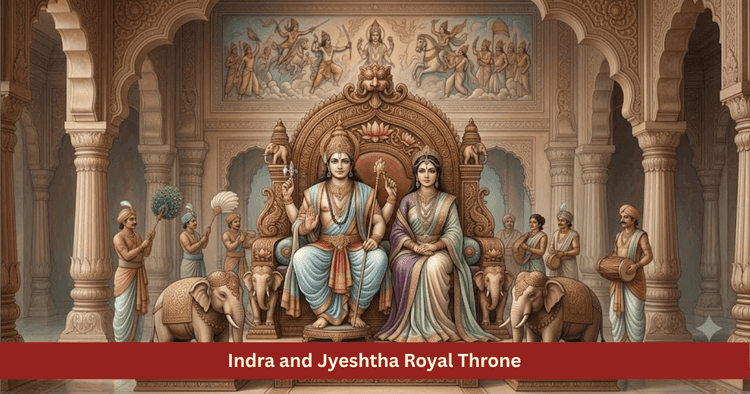
Table of Contents
Budha linked Jyeshtha Nakshatra stands in the sky like that point where rank looks highest and danger also stands nearest. Its presiding deity is Devaraja Indra. He is regarded as the lord of authority, splendour, rain, victory and the highest seat. At the same time the Puranas again and again show that his seat does not remain still. When this nakshatra gains strength in a birth chart the native may receive a top station in life. If that same station bends under pride then a fall may also arrive soon. This article opens that very tension. How power arrives, how honour remains and how a person may stay free from the intoxication of authority, these are the principles explained here in depth.
Jyeshtha itself means the elder, the most senior and the one who stands ahead of others. The elder brother in a family, the chairperson in an office, the king in a state and Indra in the assembly of the gods are all forms of one inner landscape. This nakshatra sits in Vrischika rashi and is joined to Budha. Budha grants intellect, speech, calculation and strategy. Vrischika grants depth, secrecy, control and intense feeling. From their union a personality is formed that quietly reaches the summit. After arrival the test begins. The test is not of the post. The test is of pride.
What is the core identity of Jyeshtha Nakshatra
The lord of Jyeshtha is Budha and the deity is Indra. The nakshatra spreads through the later portion of Vrischika rashi. Its symbols are the royal umbrella, the cymbal of honour or the senior seat. The umbrella throws shade over a kings head. The cymbal is a mark of dignity. Both signs show that this nakshatra gives protection and prestige, yet protection lasts only while the head remains bowed. The moment the head rises the shade leaves.
The nature of this nakshatra is sharp, senior, competitive and extremely alert. Those born here or those running its dasha often lift the heaviest duty in a family or an institution. They cannot easily bear the faults of others. They see themselves as guardians. This quality makes a leader. The same quality when it hardens can also make a tyrant. Therefore in Vedic astrology Jyeshtha is not called merely fortunate. It is called a nakshatra of trial.
Principal elements of the nakshatra
- Rashi: Vrischika
- Ruling graha: Budha
- Presiding deity: Indra
- Symbol: royal canopy and the senior seat
- Guna: authority, strategy, honour, defence against envy and awareness of a fall
- Fields of karma: governance, management, law, confidential service, deep branches of medicine, strategy in commerce
These points are not a mere list. They are directions of life. When Chandra, the lagna or the tenth lord occupies Jyeshtha the native may receive public honour. When malefic grahas afflict the same point then honour arrives with loneliness, envy and intrigue. The stories of Indra are an expansion of this very truth.
Who is Indra and why does the seat shake
Indra is the king of the divine assembly. He bears the vajra, the thunderbolt of decisive power. He commands the clouds. He is linked with the fruits of great yajnas such as Ashvamedha and Rajasuya. In the Vedic view he is not only a deity of the sky. He is that level of consciousness where a human being places the ego upon a throne. When the ego remains joined to dharma Indra nourishes like rain. When the ego worships only itself Indra is seen trembling even before Vritrasura.
In the Puranas Indra loses his seat again and again. At one time the vajra is formed from the bones of Dadhichi because his own strength is incomplete. At another time the curse of Gautama stains the body. At another time heaven is taken before Bali. At another time the child Krishna lifts Govardhana and pride is crushed. These narratives are not entertainment. They are the inner motion of Jyeshtha Nakshatra. The one who sits at the top, if he forgets that office is service, is shaken by nature itself.
The spiritual meaning of authority
Authority is not only a chair. Authority is the capacity through which decisions touch the destiny of others. The word of a Jyeshtha native carries weight. One signature may save a livelihood or ruin it. One glance may raise a person. Therefore this nakshatra opens a heavy field of karma. Decisions born of compassion and justice become punya. Decisions made only to protect prestige become debt. Indra puja does not mean merely placing flowers before an image. It means that power must be conducted like a yajna. In a yajna the offering is of the self, not of others.
What happens when Jyeshtha is active in the kundali
When Chandra occupies Jyeshtha in the birth chart the mind longs for seniority. The native does not rest in a small post. Whether in business or in service the hunger for leadership awakens. When the lagna is joined to Jyeshtha the personality shows brilliance, sharp humour and a wish to control. When the tenth house or its lord occupies Jyeshtha then rank arrives early in career. Government service, banking, the army, courts, hospital administration and large corporations are fields where this yoga often ripens.
The fruit remains good only when Budha is strong and Guru or Shukra grant some softness. If Mangala is too fierce and Shani casts a hard glance the native may reach the summit and still stand alone. Colleagues feel fear, the family draws away and within there remains an empty palace. The Amaravati of Indra was full of splendour yet peace was rarely seen there. This same psychology descends into the life of the Jyeshtha native.
| Chart position | Likely fruit | Caution |
|---|---|---|
| Birth Chandra in Jyeshtha | Honour, responsibility, sharp intellect | Envy and suspicion in feeling |
| Lagna or lagnesha in Jyeshtha | Radiant personality, a leaders gait | Breaking of bonds through pride |
| Tenth house in Jyeshtha | High office, fame, command | Moral slip in the intoxication of rank |
| Seventh house in Jyeshtha | A powerful spouse or rival | A contest of control |
| Budha dasha with Jyeshtha emphasis | Success through speech, policy and trade | Enmity through harsh words |
This table is not a verdict. It is a direction. Every kundali is read in full view. Still experience teaches that Jyeshtha remains incomplete without humility.
How a fall through pride begins
A fall does not arrive in a single day. First a small victory comes. Then praise comes. Then the person stops listening to counsel. In Jyeshtha Nakshatra this sequence is very clear. The native is truly capable. The problem is not capacity. The problem is the display of capacity. He wants the last word in every meeting. He wants to remain king even at home. Slowly people nod in front and step aside behind. One day when crisis arrives no shield remains.
In the Vedic view pride is not only a moral fault. It is a planetary distortion. When Budha joins the ego speech becomes cutting. When Mangala touches the same point anger becomes policy. If Rahu exerts influence then even deceit for the sake of rank begins to look acceptable. If Ketu is harsh the person feels empty even while seated on a throne. All these colours appear in the life of Indra. Therefore the remedy is not worship alone. The remedy is the correction of temperament.
Signs that appear in daily life
- Gratitude growing thin after success
- Taking criticism as enmity
- Turning the labour of juniors into ones own glory
- The language of command increasing at home
- Little sleep, much anxiety and fear of losing prestige
- Using charity or service as a stage for display
If these signs appear the nakshatra should not be blamed. The signs are warnings. If humility arrives upon the warning the throne is saved.
Indra puja and remedies that free pride
Remedies linked to Jyeshtha are simple yet they ask for regularity. The aim is not to beg for a throne. The aim is to ask for the fitness to hold a throne. Budhvara, Wednesday, is considered special for this work because the nakshatra lord is Budha. Sadhana also deepens on those tithis when the mind remembers rain, sky and rajadharma, the duty of righteous rule. Indra is also joined to water and cloud therefore the gift of water remains highly auspicious.
Foundational discipline
- After a clean bath at dawn remember both Indra and Vishnu because even a king remains under dharma
- On Wednesday keep green cloth and sattvic food
- Observe a vow of speech and stop at least one harsh word in the day
- Offer public praise for the labour of a junior colleague
- Sit in silence near a peepal or a water source and take a resolve to set pride down
Table of Jyotish remedies
| Remedy | Vidhi | Direction of fruit |
|---|---|---|
| Indra smaranam | Meditation on rajadharma, service not vanity | Stability of office |
| Budha shanti | Gift of learning, respect for books, truthful speech | Clear intellect |
| Jala dana | Water to the thirsty, to the cow, to birds | Cooling of the ego |
| Giving up the vajra mood | Waiting one night before a harsh decision | Protection from regret |
| Honour to Guru | Respect for teacher, parents and seasoned counsel | Rescue from a fall |
These remedies are not magic. They turn temperament. When temperament turns the fruit of grahas also grows gentle. Jyeshtha then is not an enemy. It becomes a royal staff of dharma.
How honour remains
Honour is not outer applause. Honour is the trust that people keep in silence. If a Jyeshtha native remains just then an institution runs in that name for years. If he rules only through fear then the order collapses as soon as he leaves. In the assembly of Indra Brihaspati is the guru. Without a guru a king is incomplete. In the kundali as well authority without sound discrimination is incomplete. Therefore the greatest remedy is to hold learning and counsel as greater than the self.
In household life this nakshatra makes husband or wife a pillar of the family. A pillar lifts weight, yet if a pillar begins to swell the roof cracks. Language of pride before children, harshness toward helpers and display in society are three cracks that most often lower the honour of a home. In contrast service, forgiveness and secret charity deepen honour. Deep honour does not make noise. Like rain it quietly revives the field.
Lesson of the story: Govardhana and royal pride
Once Indra thought that the rain of Gokula came only from yajna offered to him. On the counsel of Krishna the villagers worshipped Govardhana. In anger Indra released the clouds. Krishna lifted the mountain. The scene may look like a childs play yet in the view of Jyotish it is the lesson of Jyeshtha. Nature does not remain subject to one ego. Whoever thinks himself the owner of rain loses the canopy one day. Whoever lifts the earth, meaning patience and service, receives the shade of all. For the Jyeshtha native the Govardhana mood is this: keep office on the shoulder, not on the head. Office on the head becomes a crown and grows heavy. Office on the shoulder becomes responsibility and allows one to walk.
Jyeshtha in practical fields of work
In modern life this nakshatra shines in politics, administration, the army, surgery, confidential branches of research, financial control and the justice system. The native knows how to form policy. He takes a swift decision in crisis. In the market he reads a rival. These are blessings. Blessings become a curse when policy exists only for victory and not for the welfare of people.
At the workplace three rules help the Jyeshtha native. First, give the credit of success to the team. Second, do not delay in accepting a fault. Third, stop the censure of a rival. These small rules are greater than the vajra of Indra because they cut the asura within. The asura within is pride. That is Vritra who stops the waters, meaning the flow. When flow stops the kingdom dries. When speech and kindness flow the kingdom stays green.
Astrology of the mind and the inner throne
An outer post may be taken away. The inner throne should not be taken away. The inner throne is that steady buddhi which remains the same in praise and in blame. When Jyeshtha Nakshatra is purified through sadhana the native lives like a royal yogi. Even in the marketplace he keeps the gaze of a sannyasi. He knows that the crown is on loan. Nature that lends also collects. Therefore he treats every gain as nyasa, a trust held for others. A trust does not admit a claim of ownership.
From the view of dhyana it is helpful for the Jyeshtha native to practise looking at the sky at dusk. The sky is the field of Indra. Under the vast sky the crown begins to look small. Letting the breath move like water, letting anger rain like a cloud and then becoming clear, this is inner Indra puja. The temple bell remains incomplete without it.
The last seat of viveka
Jyeshtha Nakshatra teaches that the greatest king is the one who rules the self. The splendour of Indra is beautiful only when it is joined to indriya nigraha, restraint of the senses. A yoga in the kundali is auspicious only when speech remains gentle and judgement remains fair. If rank comes let service increase. If honour comes let the head bow. If authority comes let justice awaken. The native who walks these three lines is saved from a fall. He does not remain in history only as a name upon a chair. He remains like rain, remembered by the field and by the farmer alike.
FAQ
Who is the lord of Jyeshtha Nakshatra and who is the deity
The lord of Jyeshtha Nakshatra is Budha and the presiding deity is Devaraja Indra. This union grants authority, intellect and seniority and it also brings the test of pride.
Why does Jyeshtha in the kundali give high office
This nakshatra is the symbol of the senior seat and the royal canopy. When joined to lagna, Chandra or the tenth house the native moves toward leadership, management and public honour.
How does Indra puja reduce pride
The mood of Indra puja is rajadharma. Gift of water, truthful speech, praise of smaller people and giving up harsh words cool the ego so that office remains stable.
When does the danger of a fall increase in Jyeshtha Nakshatra
When gratitude ends after success, when criticism feels unbearable and when decisions are made only to protect prestige then the yoga of a fall gathers strength.
What is the simplest remedy for a Jyeshtha native
To remain sattvic on Wednesday, to give the gift of learning, to keep restraint in speech and to honour a guru or a seasoned elder are the simplest and most effective remedies.
Get your accurate Kundali
Generate KundaliDid you like it?
Author
Pt. Amitabh Sharma (56 Years)
Experience: 20
Consults About: Family Planning, Career
Clients In: Punjab, Haryana, Delhi
Share this article with friends and family
About ZODIAQ
ZODIAQ is an online Vedic Astrology platform. It connects clients seeking astrological advice to experienced astrologers with deep knowledge. Our users also generate kundali and perform kundali milan for free. ZODIAQ also offers services to the Astrologers. Astrologers utilize various offerings by ZODIAQ to serve their clients effectively.
If you are a User
Consult with experienced astrologers and seek their guidance. You can also order handwritten Janm Patrika report with life prediction prepared by experienced astrologers. Generate accurate Kundali, perform Kundali Matching and check horoscope and muhurat. Utilize our online library for all the necessary astrological and spiritual information.
If you are an Astrologer
Create accurate kundali for your clients and perform Kundali Matching for up to 5 people at a time. Write comprehensive Janm Patrika report for your clients with ZODIAQ. Check client details anytime by saving it in client directory. Become more productive by tracking how many clients you guide every day.
WELCOME TO
ZODIAQ
Right Decisions at the right time with ZODIAQ
