Vishvedeva and Uttarashadha Final Victory
By Pt. Amitabh Sharma
Turning a last moment loss through dharma and resolve
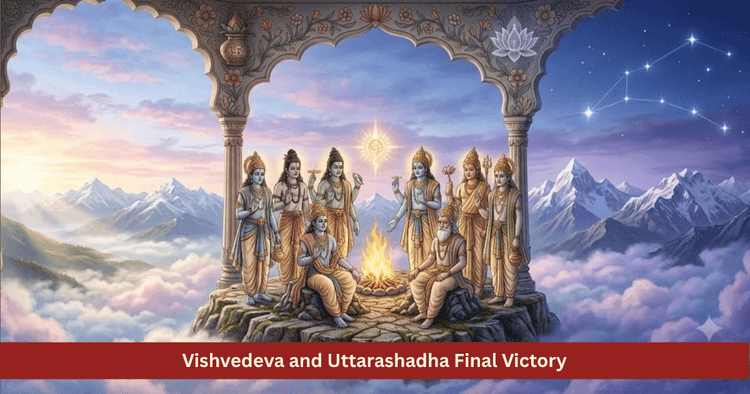
Table of Contents
Uttarashadha Nakshatra stands in the sky like that point where labour reaches its last test and victory remains possible even at the door of defeat. In Vedic astrology its lord is Surya and its presiding deities are the Vishvedevas. The Vishvedevas are ten universal deities joined to collective dharma, universal justice and complete siddhi, meaning fulfilled accomplishment. This nakshatra is called the symbol of final victory. For natives who appear to lose the game at the last turning of life, the mood of Uttarashadha is that the race remains incomplete while truth and resolve are still alive.
Surya grants soul, radiance, leadership and a clear aim. The Vishvedevas lift that radiance above personal ego and join it to public good and universal law. When this nakshatra connects with auspicious houses in the kundali, a person can arrive late and still complete the work. When afflicted, panic at the last moment, unfinished preparation or pride can let the game slip away. Worship of the Vishvedevas and the observances of Uttarashadha are sadhana for turning that last moment into historic victory. They do not purchase a result through magic. They awaken resolve, discipline and collective auspicious karma.
What is the core identity of Uttarashadha
Uttarashadha means the later invincible power, unconquered firmness and the resolve that remains even after the goal is in sight. Where Purva Ashadha holds the mood of early victory and expansion, Uttarashadha makes that victory proven and lasting. The symbol of an elephants tusk or the planks of a bed points to bearing weight, cutting a path and remaining until final rest. A tusk clears the forest. Planks support the bed. Together they say that strength is not only attack. Strength is also foundation.
This nakshatra spreads across the meeting region of Dhanu and Makara rashis. In Dhanu there is the faith, dharma and far sight of Guru. In Makara there is the karma, structure and patience of Shani. Surya lights the lamp of the soul between these two. Therefore the Uttarashadha native does not only dream. The native binds the dream to rule, time and public responsibility.
Principal elements of the nakshatra
| Element | Detail |
|---|---|
| Nakshatra | Uttarashadha |
| Rashi region | Dhanu and Makara |
| Ruling graha | Surya |
| Presiding deities | Vishvedevas |
| Symbol | Elephant tusk and steady planks |
| Main shakti | Final victory and unwavering resolve |
| Life fields | Governance, justice, army, sport, examination, institution building |
| Karma mood | Turning a lost game through dharma |
Uttarashadha natives often shine late. They may remain behind in the first run and still move ahead in the last cycle. This quality appears clearly in sport, examination, court, election and long projects. The condition is that ego should not sit down after accepting defeat.
Who are the Vishvedevas
Vishvedeva means the gods of the universe, the universal deities. In the Vedic tradition they are counted as ten. They are not guardians of one lineage alone. They protect the auspicious laws of the whole creation. Truth, yajna, time, resolve, dhriti meaning steadfast holding, dana and gathering people for good are moods joined to them. Where a personal deity may grant a personal blessing, the Vishvedevas grant collective fruit. Therefore the victory of Uttarashadha does not feel solitary. Hidden within it are companions, ancestors, law and the acceptance of the people.
When a person stands alone at the last turning, remembrance of the Vishvedevas recalls that dharma is never wholly alone. Some auspicious power remains standing nearby. The condition is that the resolve must be larger than self interest. A game of self interest can break at the last moment. A game of public good rises again and again.
Qualities joined to the Vishvedevas
- Respect for universal justice
- Performing karma in the mood of yajna
- Not placing personal defeat above collective dharma
- Remaining until the right time arrives
- Honouring companions
- Keeping word and alliance
- Not turning victory into pride
These qualities are the measure of the Uttarashadha native. Without them Surya gives burning. With them Surya shows the path.
The astrological meaning of final victory
Final victory does not mean winning at every cost. It means remaining until the point where the result bends toward dharma. Many natives grow tired in the middle of the path. Some panic at the last turning. Uttarashadha differs from both. This nakshatra teaches that the last curve of the race is the most sacred because display does not work there. Only stored karma, preparation and truth remain.
When the tenth house, ninth house, lagna or Surya join Uttarashadha in the kundali, a person may receive success late. When the sixth or eleventh house join, a reversal in competition becomes possible. When the eighth or twelfth are afflicted, fatigue, expense or hidden opposition at the last moment can become obstacles. Remedies close these very gaps.
| Chart yoga | Possible fruit | Caution |
|---|---|---|
| Benefic Surya in Uttarashadha | Leadership, clear aim, late great siddhi | Do not lose cooperation through pride |
| Support of Guru | Victory joined to dharma, grace of the guru | Do not call laziness faith |
| Support of Shani | Lasting rank after long struggle | Do not stop in disappointment |
| Support of Mangala | Courage and a decisive step | Do not break rules through haste |
| Pressure of Rahu | Confusion or deceit at the last moment | Do not compromise with truth |
This table is a direction. Full fruit is known from house, aspect, dasha and navamsha.
Those who lose the game at the last turning
Turns come in life when everything seems almost complete and then one slip ruins the whole. The last question of an examination, the last sentence of a contract, the last week of an election, carelessness while recovering from illness, these are the tests of Uttarashadha. The native has already laboured. Ego says it is already done. Surya says keep the soul awake even now. The Vishvedevas say the yajna is still incomplete.
At the psychological level a last defeat often comes not from lack of capacity but from lack of attention. The person begins to count future praise. One step of the present is missed. The lesson of Uttarashadha is that victory is counted not after the announcement but after the last duty is complete.
Signs of a slip at the last moment
- Leaving discipline after seeing the work as almost complete
- Treating a companion as no longer needed
- Breaking dialogue by taking small criticism as insult
- Treating fatigue as the end of destiny
- Celebrating before the result
- Seeking an easy path by breaking the rule
How unwavering resolve is formed
Resolve is not desire. Desire is a wave of the mind. Resolve is a ray of Surya that travels in one direction. In Uttarashadha resolve becomes unwavering when it is larger than personal winning. If a student studies only for marks, panic may come in the last paper. If learning is treated as dharma, even in fatigue one more page is read. If a player wants only a medal, a wound may cause collapse. If sport is treated as tapas, the player remains until the last ball.
The Vishvedevas are deities of collective resolve. Therefore the native should join the goal to some auspicious purpose. Care of family, service of an institution, protection of truth, these give the spine to resolve. Without a broken spine the body may bend. It does not fall.
Worship of the Vishvedevas and special anushthana
When defeat appears at the last turning of life, it is considered auspicious to begin anushthana, meaning a focused observance, at sunrise on Sunday. The aim is not only to ask for a win. The aim is to ask for the power to complete an unfinished yajna. Sunday is the day of Surya. Purnima or the seventh tithi of the bright fortnight is also considered helpful for a solar resolve. Water, wheat, jaggery, red flowers and truthful speech are pillars of these observances.
Core vidhi and rules
- After a morning bath, offer arghya to Surya facing the east
- Remember the Vishvedevas and offer ten lamps or ten grains of akshata
- On the same day move one unfinished auspicious work one step forward
- Honour a companion, guru or elder without condition
- For three days give up harsh speech and display
- Review the lost plan in writing and take one new practical step
Table of observances
| Anushthana | Vidhi | Direction of fruit |
|---|---|---|
| Surya arghya | Water, red flowers, namaskara | Radiance and removal of obstacles |
| Mood of Vishvedeva tarpana | Remembrance of the universal deities with water | Cooperation and public acceptance |
| Completion of unfinished karma | Finishing one small responsibility | Siddhi at the last turning |
| Anna dana | Food to the hungry | Turning the game through punya |
| Silent sankalpa | Remembering the goal through ten breaths at dawn | Unwavering dhriti |
A mantra may be spoken with reverence.
Om Vishvebhyo Devebhyo Namah
The meaning is a bow to all the Vishvedevas, guardians of universal dharma and siddhi.
Om Suryaya Namah
The meaning is a bow to Surya, lord of the soul and invincible radiance.
The count of japa may follow family or acharya tradition. Number without feeling is empty.
Narrative mood: the last curve of the race
In an old imagination two warriors run to the end of the field. One is ahead and slows after seeing the crown. The other is behind yet treats every breath as yajna. The Vishvedevas are imagined standing with the second because victory was treated as duty, not enjoyment. Surya throws light on the one who remains honest until the last step. History often remembers not the one who held first place but the one who did not leave dharma even in a lost game. Uttarashadha is the nakshatra of that memory.
This story descends from the sports field to the court. The advocate who reads the last document, the physician who performs the last check, the student who writes the last line, they are karmayogis of the Vishvedevas.
Uttarashadha in practical fields
In governance, the army, justice, sport, long construction, education boards, public service and institutional leadership this nakshatra can arrive late and still reach the top. The native understands the last line of policy. The native does not hurry a settlement. The native speaks when speech is necessary. If this power joins ego it becomes obstinacy. If it joins dharma it becomes history.
Principles of a power that does not accept final defeat
- Do not treat defeat as the last truth
- Keep one small auspicious step even after fatigue
- Do not treat cooperation as weakness
- Keep the rule larger than victory
- Remain regular like Surya
- Keep speech restrained until the result arrives
A power that does not accept final defeat does not mean winning every contest. It means that the resolve of the soul does not break. The body may lose. Rank may be taken away. If resolve is joined to dharma it walks even to the door of the next birth. That is invincible shakti.
From a lost game to historic victory
Historic victory is that which is written not only on a scoreboard but on character. When an Uttarashadha native honestly repairs a failed project, society remembers the person late yet rightly. The blessing of the Vishvedevas descends not in the noise of fame but in the quiet of a completed duty. The radiance of Surya is beautiful when it shows others the path and does not burn their eyes.
When remedy, observance and planetary dasha move together, panic at the last turning slowly becomes dhriti. Dhriti is that power joined to the Vishvedevas. Dhriti means holding on. The one who holds on arrives. If the one who arrives remains bowed, victory is not stained.
The quiet crown of invincible resolve
Uttarashadha Nakshatra teaches that victory does not live in the speed of the beginning. It lives in the honesty of the last step. Surya without humility becomes burning. The Vishvedevas without public dharma do not grant siddhi. The native who treats a lost game not as a wound of ego but as an offering into yajna sees new radiance rise from the ash. A mountain is that which remains standing even on the last rock. That remaining is the hidden splendour of Uttarashadha.
FAQ
Who are the lord and deities of Uttarashadha Nakshatra
The lord of Uttarashadha Nakshatra is Surya and the presiding deities are the Vishvedevas, regarded as ten universal gods.
Why is Uttarashadha called the nakshatra of final victory
This nakshatra moves beyond early success and makes the goal proven and lasting. Resolve that remains until the last turning is its central mood.
What remedies help when the game is lost at the last moment
Arghya to Surya, remembrance of the Vishvedevas, completion of unfinished auspicious karma, gift of food and regular sankalpa can turn the last turning toward siddhi.
How are the Vishvedevas worshipped
Arghya at Sunday sunrise, ten lamps or grains of akshata, a bow to the universal deities and honour of a companion are simple forms of Vishvedeva puja.
How does the Uttarashadha native receive a power that does not finally surrender
A goal joined to dharma, discipline, respect for cooperation and refusal to treat defeat as the last truth make the resolve of the soul invincible.
Get your accurate Kundali
Generate KundaliDid you like it?
Author
Pt. Amitabh Sharma (56 Years)
Experience: 20
Consults About: Family Planning, Career
Clients In: Punjab, Haryana, Delhi
Share this article with friends and family
About ZODIAQ
ZODIAQ is an online Vedic Astrology platform. It connects clients seeking astrological advice to experienced astrologers with deep knowledge. Our users also generate kundali and perform kundali milan for free. ZODIAQ also offers services to the Astrologers. Astrologers utilize various offerings by ZODIAQ to serve their clients effectively.
If you are a User
Consult with experienced astrologers and seek their guidance. You can also order handwritten Janm Patrika report with life prediction prepared by experienced astrologers. Generate accurate Kundali, perform Kundali Matching and check horoscope and muhurat. Utilize our online library for all the necessary astrological and spiritual information.
If you are an Astrologer
Create accurate kundali for your clients and perform Kundali Matching for up to 5 people at a time. Write comprehensive Janm Patrika report for your clients with ZODIAQ. Check client details anytime by saving it in client directory. Become more productive by tracking how many clients you guide every day.
WELCOME TO
ZODIAQ
Right Decisions at the right time with ZODIAQ
