Copper Vessel and Milk
By Aparna Patni
The scientific and Ayurvedic reason copper vessels are avoided for milk on the Shivling
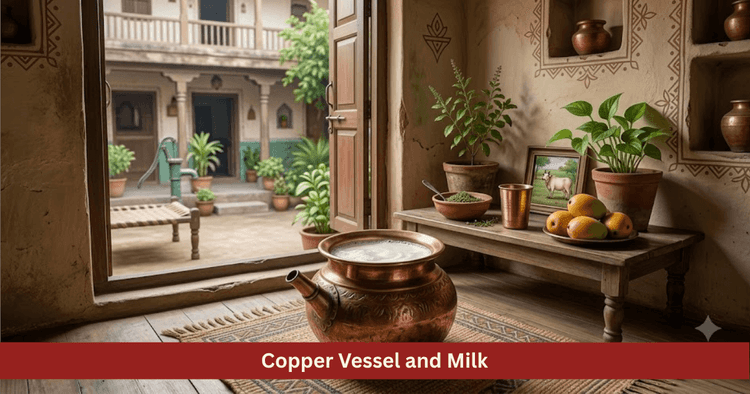
Table of Contents
Temple Discipline and Science
The tradition of offering milk on the Shivling is very old and full of devotion. In many temples, people bring milk or Panchamrit in a copper vessel and the priest stops them immediately. From the outside, this may look like a strict religious rule. In truth, its basis lies in chemistry and Ayurveda.
Copper and milk are not considered a safe combination. Copper is a reactive metal. When it comes in contact with milk or any acidic substance, a chemical reaction may occur. This can change the quality of the milk and make it harmful for health. Since the milk offered to the Shivling is often later distributed as charanamrit or returned to nature, this rule was formed so that the offering remains safe.
| Subject | Balanced understanding |
|---|---|
| Purpose of milk offering | Devotion and abhisheka |
| Copper vessel | Not suitable for milk |
| Reason | Chemical reaction |
| Possible result | Change in milk quality |
| Health view | Risk of toxicity |
| Appropriate vessels | Steel, brass or silver |
This rule is not about Lord Shiva’s displeasure. It is about protecting the devotee’s well being.
Why Copper and Milk Do Not Mix
Copper is a metal that reacts strongly with certain substances. Milk is a sensitive liquid and when it stays in contact with copper for some time, especially if there is even slight acidity, the reaction can become more noticeable. That is why the choice of vessel matters in food, medicine and religious use.
Ayurveda and traditional kitchen wisdom also recognise that not every metal suits every substance. Some metals may be useful for water or storage but they are not suitable for milk. For this reason, temple discipline stops the use of copper vessels at once, so that the purity and safety of the milk remain intact.
Keep these points in mind:
- Copper is not a safe vessel for milk.
- Reaction may be stronger with acidic substances.
- Milk quality can be affected.
- Charanamrit should not carry a health risk.
- The basis of the rule is safety, not blind custom.
- Every liquid needs the right vessel.
- Temple rules are meant to protect devotees.
Science and devotion are not opposing forces here.
What Is Appropriate for Shivling Abhisheka
During Shivling abhisheka, the purity and suitability of the vessel are given special importance. Milk, water, curd, honey, ghee and Panchamrit are brought in different kinds of vessels. If milk is to be offered, a steel, brass or silver vessel is considered more suitable. This helps preserve the chemical stability of the milk and keeps the offering safe.
This is not only an outer arrangement. It is also part of the dignity of worship. Just as the right vessel is chosen for cooking, the correct vessel must also be chosen for deity worship. That protects both the sanctity of the offering and health.
Brief note on suitable vessels
| Vessel | Use |
|---|---|
| Steel | Common and safe use |
| Brass | Suitable in religious tradition |
| Silver | Considered pure and auspicious |
| Copper | Not suitable for milk |
| Clay | Useful in some rituals |
| Glass | Possible in certain situations |
Choosing the right vessel strengthens both discipline and safety.
Is This a Religious Prohibition
Many people think this is a rule by which Lord Shiva rejects milk offered from a copper vessel. That understanding is not correct. The heart of Shiva devotion lies more in the devotee’s devotion than in the metal of the vessel. Yet the outer rules of worship are made to prevent harm. When health is involved, the rule should be understood as sacred discipline.
The aim of dharma shastra is not to create fear. It is to awaken wisdom. If a devotee unknowingly brings milk in a copper vessel, the right response is to explain the reason with calmness, not to insult the devotee. That is sensitive and true religiosity. Discipline becomes beautiful when wisdom and compassion support it.
| Misconception | Correct understanding |
|---|---|
| Copper vessel is disliked by Shiva | No, the rule is about health |
| This is only religious anger | No, it has scientific and Ayurvedic reasons |
| The vessel does not matter | The vessel does matter |
| Devotion alone is enough | Devotion plus correct method is needed |
| Stopping someone is insult | No, it is protection |
When wisdom joins devotion, worship becomes more pure.
Panchamrit and Health
Panchamrit has great importance in both offering and prasada. But if it is kept in a copper vessel, its quality may be affected. The charanamrit distributed in temples should be safe and healthy for devotees. That is why special care is taken about the metal of the vessel.
Shivling abhisheka is not only a religious act. It is also an act of collective devotion, service and prasada distribution. Even a small lapse can affect health. For that reason, old traditions must be understood alongside modern knowledge. That is true dharma.
Main points of care
- Do not keep milk in copper.
- Use safe vessels for Panchamrit.
- Maintain purity in prasada.
- Check the vessel before distribution.
- Respect temple tradition.
- Take health risk seriously.
- Devotees should receive correct information.
Prasada is complete only when it carries devotion and safety together.
The Ayurvedic View
Ayurveda looks carefully at the relationship between a metal and a substance. Every metal has a different effect. Copper may be useful for water in some settings but not for milk. Milk is nourishing, soft and sensitive. Contact with an unsuitable metal can reduce its sattvic quality.
For this reason, traditional homes and temples have preferred brass, silver or steel for milk and Panchamrit. This rule is not just outer discipline. It is the result of practical understanding. When tradition serves health, it becomes more trustworthy.
| Substance | Suitability |
|---|---|
| Milk | Soft and sensitive |
| Panchamrit | Safer in a pure vessel |
| Copper | Not suitable for milk |
| Brass | More suitable |
| Silver | Pure and safe |
| Steel | Practical and safe |
Ayurveda suggests that suitability protects purity.
Why Temples Stop It Immediately
When a priest or temple worker stops the act immediately, it is not meant as disrespect. Their purpose is to ensure that the milk remains safe and that no problem arises later in the distribution of prasada. Many devotees act from tradition and do not pay attention to the difference between a metal and the liquid. In such cases, immediate stopping becomes the proper service.
If this is explained calmly, devotees usually accept it easily. Real religious teaching is not harsh. It is clear, compassionate and useful. Offering milk on the Shivling is as much about devotion as it is about understanding health.
Good temple conduct
- Do not insult the devotee.
- Explain the reason calmly.
- Suggest the correct vessel.
- Pay attention to prasada purity.
- Explain the rule as service.
- Keep balance between tradition and science.
The finest form of discipline is filled with compassion.
Simple Advice for Choosing the Right Vessel
If milk or Panchamrit is to be offered to the Shivling, a steel, brass or silver vessel should be used. These vessels are considered more stable and safe. This reduces the chance of chemical reaction and preserves the sanctity of the abhisheka. The same care is helpful at home as well.
A devotee who learns this rule feels more confident in worship. Such a person also understands that dharma is not blind belief. Worship becomes more beautiful when devotion, knowledge and safety move together.
Simple rules
- Do not use copper for milk.
- Use steel, brass or silver.
- Keep the vessel clean.
- Offer prasada from a proper place after abhisheka.
- Follow temple instructions.
- Teach children the correct practice too.
A safe vessel helps keep worship pure and steady.
FAQ
Is putting milk in a copper vessel really forbidden
Yes, copper is not considered suitable for milk. The reason is chemical and health related, not merely religious.
Is it a sin to offer milk to the Shivling in a copper vessel
No, it is not called a sin. It is considered an unsafe and unsuitable method, so it is stopped.
Which vessel is right for offering milk
A steel, brass or silver vessel is considered more suitable.
Why do priests stop it immediately
So that the milk remains pure and does not become a health risk when later used as prasada or charanamrit.
Is this only a religious rule
No, it has a basis in both chemistry and Ayurveda.
Get your accurate Kundali
Generate KundaliDid you like it?
Author

Aparna Patni (63)
Experience: 20
Consults About: Family Planning, Career
Clients In: Punjab, Haryana, Delhi
Share this article with friends and family
About ZODIAQ
ZODIAQ is an online Vedic Astrology platform. It connects clients seeking astrological advice to experienced astrologers with deep knowledge. Our users also generate kundali and perform kundali milan for free. ZODIAQ also offers services to the Astrologers. Astrologers utilize various offerings by ZODIAQ to serve their clients effectively.
If you are a User
Consult with experienced astrologers and seek their guidance. You can also order handwritten Janm Patrika report with life prediction prepared by experienced astrologers. Generate accurate Kundali, perform Kundali Matching and check horoscope and muhurat. Utilize our online library for all the necessary astrological and spiritual information.
If you are an Astrologer
Create accurate kundali for your clients and perform Kundali Matching for up to 5 people at a time. Write comprehensive Janm Patrika report for your clients with ZODIAQ. Check client details anytime by saving it in client directory. Become more productive by tracking how many clients you guide every day.
WELCOME TO
ZODIAQ
Right Decisions at the right time with ZODIAQ
