Respectful Removal of Old Kalava
By Aparna Patni
Simple guidance for removing and respectfully disposing sacred thread
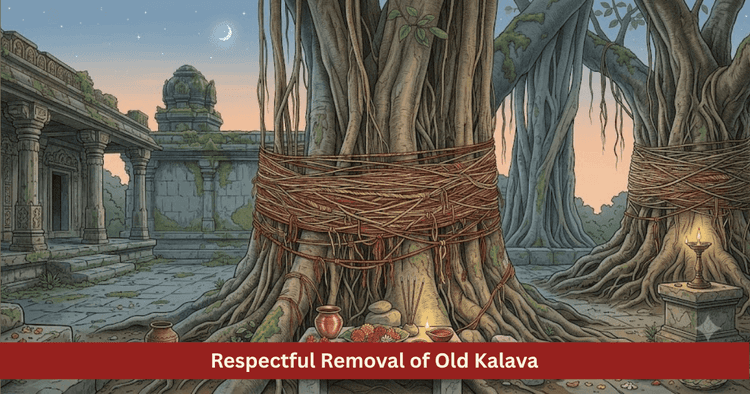
Table of Contents
The Deeper Meaning of Sacred Thread
The kalava, mauli or raksha sutra tied on the wrist during worship, yajna, fasting, a resolve or an auspicious occasion is not regarded as merely a coloured thread. It is a symbol of devotion, goodwill, protection and remembrance of God. Made with red, yellow and sometimes white colours, this thread reminds a person of their resolve, dignity and religious feeling.
When the kalava becomes old, dirty, loose or begins to break, many people become afraid to remove it. They worry that taking away the sacred thread may end their sense of protection or bring an inauspicious result. This fear is not necessary. Removing an old kalava is not considered inauspicious, especially when it is removed with respect, gratitude and a calm mind.
The strength of kalava does not lie only in the thread. It lies in the resolve, devotion and good conduct connected with it. If the thread has become old, it is entirely appropriate to remove it with dignity and tie a new raksha sutra, meaning protective sacred thread.
| Subject | Balanced understanding |
|---|---|
| Meaning of kalava | Protection, auspicious resolve and remembrance of God |
| Old kalava | Changing it with time is natural |
| Removing kalava | It is not inauspicious |
| Right feeling | Gratitude and respect |
| Respectful disposal | Place it in soil near the roots of a tree |
| New kalava | It may be tied with devotion |
Is Removing Old Kalava Inauspicious
Removing an old kalava is not inauspicious. The thread becoming old, dirty or broken is not a negative prediction about life. Clothes, flowers, worship materials and threads all complete their use with time. Their respectful disposal or replacement is the natural dignity of tradition.
Many people do not remove kalava for months or years because they feel that their protective shield will break if they do so. Such a belief may create more fear than devotion. Raksha sutra is a symbol that steadies a person in remembrance of dharma, restraint and God. Its real protection is also connected with a person’s conduct, honesty and awareness.
Keep these points in mind:
- Removing an old or dirty kalava is not improper.
- It is not necessary to keep a broken kalava on the wrist.
- Do not hold fear in the mind while removing kalava.
- Express gratitude to God with a peaceful feeling.
- Do not place the old kalava in a waste bin.
- Dispose of it respectfully in a clean place.
- Tying a new kalava is not compulsory and remains a matter of personal devotion.
- The feeling of protection appears more through life actions than through the thread.
Raksha sutra strengthens devotion, not fear.
Importance of Resolve in Kalava
A kalava tied during worship may be connected with a particular prayer, ritual, fast or wish for wellbeing. Mantra recitation, remembrance of God and the intention for a person’s welfare may be present with it. For this reason, it carries greater emotional and religious meaning than an ordinary thread.
Yet kalava is not a magical object that can replace a person’s karma, health, caution or decisions. Its purpose is to remind a person of awareness and dignity in life. When a person sees the kalava and remembers their resolve, promises, family and responsibility toward God, its religious meaning becomes more alive.
| Feeling connected with kalava | Form in life |
|---|---|
| Protection | Caution, restraint and right decisions |
| Resolve | Remaining true to one’s word |
| Devotion | Remembrance of God and humility |
| Auspiciousness | Good wishes for the family |
| Discipline | Regularity in worship and life |
| Gratitude | Respect for received grace |
Changing kalava does not end the resolve. If the feeling in the mind remains pure, a new thread can renew that resolve.
When to Remove Old Kalava
There is no need for special fear or rigid rules when removing an old kalava. It may be removed when it becomes very dirty, repeatedly gets caught in work, causes discomfort to the skin, breaks or when a new raksha sutra is to be tied after worship. Cleanliness and comfort are also part of religious life.
Some families change an old kalava during a special festival, after completion of a fast, on Raksha Bandhan, at a new worship ceremony or with a new resolve. This custom may differ from home to home. Respecting family practice is good but it is not appropriate to worry by calling an ordinary change inauspicious.
Suitable times to remove old kalava:
- When kalava becomes dirty or very old.
- When the thread breaks or becomes loose.
- When there is itching, redness or discomfort on the wrist.
- When a new raksha sutra is to be tied.
- After completing the resolve of a fast or worship.
- When it repeatedly causes difficulty during bathing or work.
- When it feels appropriate to change it respectfully with devotion.
Cleanliness and devotion should move together for religious discipline to remain natural.
Method of Respectful Disposal
Keep the mind calm while removing old kalava. First remember God and offer thanks for receiving the opportunity for protection, guidance and auspicious resolve in life. Then gently untie the thread. Even if it has already broken, it does not need to be thrown away like an ordinary object.
The kalava may be placed in soil near the roots of a clean tree. This method preserves the dignity of the thread and carries the feeling of offering it back to nature. If this is not possible, it may be kept in a clean paper or cloth at home and placed near the roots of a sacred tree at an appropriate time.
Simple Process for Removing Old Kalava
- Bathe or wash your hands and face to become clean.
- Remember God for a few moments in a calm place.
- Keep gratitude in the mind.
- Gently untie or remove the kalava.
- Do not place it in a waste bin, drain or unclean place.
- Put it in soil near the roots of a tree.
- Keep the place clean and do not leave unnecessary materials there.
- If desired, tie a new kalava with devotion.
The practice of releasing the thread in water is found in some places, yet care for water cleanliness is necessary. It is not appropriate to place materials with plastic, artificial decoration or other impurities into a river, pond or water body. Respectfully placing it in soil may be a simpler and more environmentally responsible method.
When to Tie New Kalava
A new kalava may be tied during worship, fasting, a resolve, a festival, house entry, yajna, travel or an auspicious work. Tying it is not compulsory, yet for those who see it as a means of devotion, a new raksha sutra may awaken an auspicious resolve in the mind.
While tying a new kalava, a person may pray for protection in life, family peace, health, good judgement and steadiness on the path of dharma. Instead of only tying an outer thread, taking a good practical resolve with it is more meaningful.
Useful resolves while tying new kalava:
- Try to speak truth.
- Do not use harsh words in anger.
- Fulfil responsibilities toward family.
- Maintain cleanliness of body and mind.
- Complete work on time.
- Maintain compassion toward a person in need.
- Do not disrespect money or food.
- Bring regularity into remembrance of God.
A new raksha sutra becomes more meaningful when it is joined with a resolve for better actions in life.
Difference Between Fear and Devotion
Respect for religious objects is necessary but respect does not mean living in constant fear. If an object becomes old, changing it is a natural process of life. After removing kalava, there is no need to keep mental restlessness, guilt or fear of misfortune.
Devotion makes a person calm, humble and responsible. Fear can make a person rigid, uncomfortable and dependent. therefore a balanced view should be adopted regarding kalava as well. Respect the thread but do not keep the mind bound by fear.
| Devotion | Fear |
|---|---|
| Inspired by gratitude | Inspired by worry |
| Steadies the mind | Disturbs the mind |
| Leads toward good conduct | May increase blind belief |
| Brings balance in life | Increases concern about small matters |
| Creates trust in God | Increases imagination of misfortune |
The purpose of raksha sutra is to strengthen a person inwardly. It does not take a person away from responsibility for life decisions.
Care for the Body Matters
If an old kalava causes red marks, itching, burning due to sweat or any sign of infection on the skin, it is appropriate to remove it immediately. It is not necessary to neglect hygiene and health in the name of religious practice. If a skin problem continues, seeking medical advice may be helpful.
Many people cannot wear a thread on the wrist because of workplace rules, school, sports, machinery or medical reasons. In such a situation, not wearing kalava does not show any lack of devotion. Remembrance of God, honest action and compassionate conduct are deeper religious qualities than any outer mark.
The Continuous Thread of Devotion
Removing an old kalava and disposing of it respectfully is not inauspicious. The thread may have completed its outer form, yet the prayer and auspicious resolve connected with it can remain alive in a person’s conduct. Placing it in soil near the roots of a tree instead of a waste bin or unclean place is a simple and respectful method.
If a new kalava is to be tied afterwards, tie it with devotion. Even if a new thread is not tied, maintain remembrance of God, truth, service and restraint in life. This is the real protective shield.
True protection lies not in the thread remaining on the wrist but in the dharma, wisdom and good conduct awakened within a person.
FAQ
Is it inauspicious to remove old kalava by yourself
No, removing an old, dirty or broken kalava by yourself is not inauspicious. It may be removed with a calm mind and respect.
Where should old kalava be placed
Do not put it in a waste bin or drain. Placing it in soil near the roots of a clean tree is a respectful method.
Should a broken kalava remain on the wrist
No, it is not necessary to keep a broken kalava on the wrist. It may be respectfully removed and placed in a suitable location.
Is it necessary to tie a new kalava after removing the old one
No, tying a new kalava is not compulsory. It depends on personal devotion and family tradition.
What should be said while removing kalava
Remember God with a calm mind and offer thanks for the protection, guidance and auspicious resolve received in life.
Get your accurate Kundali
Generate KundaliDid you like it?
Author

Aparna Patni (63)
Experience: 20
Consults About: Family Planning, Career
Clients In: Punjab, Haryana, Delhi
Share this article with friends and family
About ZODIAQ
ZODIAQ is an online Vedic Astrology platform. It connects clients seeking astrological advice to experienced astrologers with deep knowledge. Our users also generate kundali and perform kundali milan for free. ZODIAQ also offers services to the Astrologers. Astrologers utilize various offerings by ZODIAQ to serve their clients effectively.
If you are a User
Consult with experienced astrologers and seek their guidance. You can also order handwritten Janm Patrika report with life prediction prepared by experienced astrologers. Generate accurate Kundali, perform Kundali Matching and check horoscope and muhurat. Utilize our online library for all the necessary astrological and spiritual information.
If you are an Astrologer
Create accurate kundali for your clients and perform Kundali Matching for up to 5 people at a time. Write comprehensive Janm Patrika report for your clients with ZODIAQ. Check client details anytime by saving it in client directory. Become more productive by tracking how many clients you guide every day.
WELCOME TO
ZODIAQ
Right Decisions at the right time with ZODIAQ
