The History of Astrology - Part 3: Astrology Across Cultures - The Making of a Global Tradition
By Pt. Suvrat Sharma
From Mesopotamia to China and the Maya - tracing astrology’s journey through world civilizations
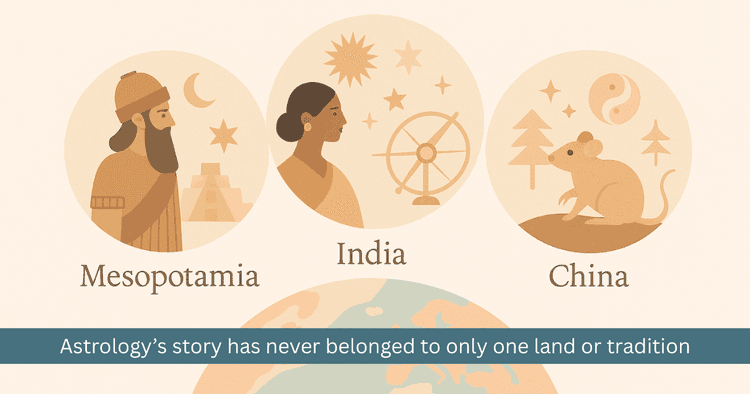
Table of Contents
Astrology’s story has never belonged to only one land or tradition. It has flourished, evolved and changed form across the world’s many cultures. In India, Vedic astrology has deep roots, while in the West it rests on the heritage of Mesopotamia and ancient Greece. Almost every civilization, at some time, has viewed celestial events as divine signs or as keys to deeper understanding of human life.
Ancient Roots and Early Expansion
Mesopotamia
The oldest traces of astrology are found in Mesopotamia. Here, priests read the positions of planets and stars to predict the fate of kings and states. Astrology served as both a religious and political instrument.
India
Indian astrology, also known as Vedic astrology or Jyotish Shastra, has been practiced for thousands of years. It goes beyond planetary positions, connecting deeply to the ideas of karma, life and rebirth.
China
Chinese astrology developed along a separate path, centering on a 12-animal cycle, five elements (wood, fire, earth, metal and water) and the balance of yin and yang. This system is deeply woven into Chinese culture and is still widely followed today.
- Chinese astrology is based on a 12-year lunar cycle, assigning each year to an animal sign.
- The system also connects with elements, each interacting with the animal signs.
- This approach is less about personality traits and more focused on cycles of life and fate.
Expansion and Development
Greek and Roman Influence
Greek philosophers like Plato and Aristotle reflected on astrological principles and organized them into a systematic body of knowledge. Later, astrology gained enormous popularity in the Roman Empire, where emperors relied on astrologers to assist major decisions.
The Islamic Golden Age
Between the 8th and 13th centuries, astrology flourished in the Islamic world. Scholars used astrology in astronomy and medicine. Many Greek and Indian texts were translated into Arabic and refined further.
Transatlantic Adaptations
As Europe and the Americas encountered other cultures, local knowledge blended with astrological ideas, creating even more diverse forms and traditions.
The History of Astrology - Part 1: A 5000-Year Journey Beginning in Mesopotamia
Diverse Perspectives and Traditions
In Hinduism
Astrology is much more than prediction - it is a tool to understand the four goals of life: dharma, artha, kama and moksha. It involves deep study of the horoscope, dasha cycles, planetary transits and nakshatras. In Islam
Islamic tradition holds a nuanced view. Some aspects like astronomy and determining direction are acknowledged, while prophecy and prediction are viewed with caution.
Other Cultures
- The Mayan, Tibetan and African traditions each developed unique astrological systems. These combine interpretations of celestial events with the powers of natural forces and local deities.
- The Mayan system, for example, was based on a 260-day calendar (Tzolk'in). Individuals were assigned a "day sign" affecting character and destiny.
- This system relied on complex calculations tracking the movements of the Sun and Moon.
Astrology in the Modern Era
Place in Popular Culture
Even today, astrology holds a place in daily life via newspapers, TV shows and social media. Reading horoscopes and identifying with a zodiac sign is common.
Personal Guidance
People turn to astrologers for advice on significant life decisions such as marriage, career or health. This guidance brings clarity and direction.
Scientific Debate
Scientists contest astrology’s validity and call for further research. It remains important to recognize that astrology continues to serve as a reflective and introspective tool for understanding human nature.
The Unbroken Thread
Astrology is not simply a system but a way humanity has searched for meaning - reflecting, connecting and reaching for the universe. Its forms may differ from place to place, yet the essential impulse is the same: a longing to understand the deeper secrets of life by looking to the sky.
Get your accurate Kundali
Generate KundaliDid you like it?
Author

Pt. Suvrat Sharma (63)
Experience: 20
Consults About: Family Planning, Career
Clients In: Punjab, Haryana, Delhi
Explore Related Articles
Explore All
Five Key Elements of Vedic Astrology and Their Role in Your Life
What is the Difference Between Vedic and Western Astrology? A Detailed Comparison
Moon Sign and Sun Sign: Which One Is More Impactful?

The Difference Between Vedic and Western Spirituality: A Comparative Perspective
The History of Astrology - Part 1: A 5000-Year Journey Beginning in Mesopotamia
वैदिक और पाश्चात्य आध्यात्मिकता में अंतर: एक तुलनात्मक दृष्टिकोण
Share this article with friends and family
About ZODIAQ
ZODIAQ is an online Vedic Astrology platform. It connects clients seeking astrological advice to experienced astrologers with deep knowledge. Our users also generate kundali and perform kundali milan for free. ZODIAQ also offers services to the Astrologers. Astrologers utilize various offerings by ZODIAQ to serve their clients effectively.
If you are a User
Consult with experienced astrologers and seek their guidance. You can also order handwritten Janm Patrika report with life prediction prepared by experienced astrologers. Generate accurate Kundali, perform Kundali Matching and check horoscope and muhurat. Utilize our online library for all the necessary astrological and spiritual information.
If you are an Astrologer
Create accurate kundali for your clients and perform Kundali Matching for up to 5 people at a time. Write comprehensive Janm Patrika report for your clients with ZODIAQ. Check client details anytime by saving it in client directory. Become more productive by tracking how many clients you guide every day.
WELCOME TO
ZODIAQ
Right Decisions at the right time with ZODIAQ
