Kaalpurusha Kundali: A Deeper Key to Time, Nature and Karma
By Pt. Abhishek Sharma
Analyzing Human and Global Consciousness through the Horoscope
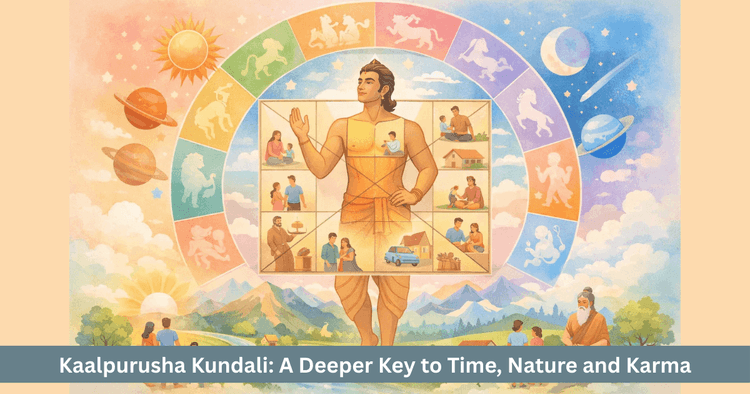
Table of Contents
From the Vedic viewpoint a birth chart is not only a diagram of planetary periods, it is seen as a reflection of the collective state of awareness at the moment of birth. At that instant the mental atmosphere around the child is recorded in twelve houses, which is why the same horoscope can show indications for mother, father, siblings, spouse, children, friends and even opponents.
When a normal birth chart is cast, the sign that rises in the east becomes the first house and the entire chart is built from there. The same principle applies for the horoscope of a nation or any event. The question then arises, how do we see the chart of the earth itself or of the global field of consciousness. Here the idea of the Kaalpurusha Kundali becomes relevant.
What Does the Kaalpurusha Kundali Show
The Kaalpurusha Kundali is a universal framework in which Mesha, Aries, is fixed on the first house and the remaining signs follow in natural order through the twelve houses.
For any given moment, the positions of planets in various signs can first be drawn in an ordinary transit chart using the local rising sign as lagna. If the same configuration is then rotated so that Aries becomes the first house, the figure turns into the Kaalpurusha chart, representing the collective state of the world at that time. In this sense the Kaalpurusha Kundali does not belong to any one individual. It is a picture of the global mind for that moment.
Why Is Aries the First House: Fire of Creation and Kaalpurusha
It is natural to ask why Aries alone is taken as the first house. In the combined language of jyotisha and Ayurveda, signs represent different climates and situations and planets represent dosha like energies expressing themselves according to those conditions.
When the universe first emerged, its state is described as extremely hot, dense and bright. Modern cosmology also speaks of an expansion from a very small, very hot point. This aligns well with the nature of Aries, ruled by Mars and full of fire.
In earlier cycles energy stored in signs like Dhanu, Makara, Kumbha and Meena can be imagined as a condensed potential. Under the heat of the Sun this energy begins to expand outward, appearing as the fiery surge of Aries. Therefore the first house of the Kaalpurusha chart carries Aries to show the original burst from which worldly time begins.
Here Kaal means time and Purusha points to the primal masculine principle from which Prakriti, the feminine creative energy, unfolds. The Kaalpurusha Kundali represents the collective awareness of the world at any given time. Each being affects this collective field and is affected by it in return.
Planets, Awareness and Direction within Maya
Every planet represents a specific shakti that moves our soul through the web of Maya in different directions.
- Large and slow moving planets indicate wide and slow changing layers of awareness. Jupiter shows expansion and gentle slowing down of impulses, shaping life vision over longer spans.
- Saturn introduces deeper slowing, careful observation and the pressure needed for the soul to learn and to leave its imprint on the web of experience.
- On the other hand Moon rules bodily fluids and changing moods and so it reflects the fast shifting energy of the world and the body.
For this reason when charts are cast for the same time and date at different locations, the positions of the big planets alter only slightly, while the Moon can shift by degrees, especially between far separated places. This hints that our collective awareness is constantly changing from moment to moment.
Kaalpurusha Kundali and Global Events
When major shifts occur in the Kaalpurusha Kundali, world level events are often seen to echo them.
For instance, the movement of Saturn from the ninth to the tenth sign or house in the Kaalpurusha scheme represents a transfer of emphasis from dharma and order to concrete karma and public structures. At one such transition combined with other alignments the world witnessed the spread of a pandemic and economic slowdown, showing how a change in the collective field can reduce material outcomes even in charts that otherwise promise gains.
This illustrates that individual horoscopes do not work in isolation. They are constantly interacting with the broader pattern shown by Kaalpurusha.
Karma, Evolution and Lines on the Palm
The deeper message is that the world is not static. It is a continuously self evolving field. The speed of its evolution depends on the karma of each individual and each person’s karma, in turn, is shaped by the evolving collective field.
Seen through palmistry, this explains why the lines on the right and left hands often differ. One palm, often called the karma hand, shows how we are currently moving under the influence of collective awareness, while the other reflects the original pattern of destiny with which we began this life.
Since karma can go astray when knowledge is lacking, the path forward lies in rising towards higher understanding instead of getting trapped in extreme material desire. The quicker we climb the inner ladder of evolution, the faster this plane called earth moves in its own evolution and the reverse is also true.
Kaalpurusha Kundali, Doshas and the Moment of Conception
On the individual level the Kaalpurusha Kundali of a person points to the dosha state at the moment of conception in the mother’s womb. This moment comes before birth, yet from then on the design of the body begins to crystallise.
The first house of the Kaalpurusha chart, occupied by Aries, is taken to represent the head and the dominant constitution and wiring of brain and body which later expand into a complete form. The second house, Taurus, relates to face and neck. The third, Mithuna, relates to arms and the nervous system. The sequence continues in a way that matches the meanings assigned to houses in lagna based horoscopes.
Because weather, planets and signs are linked in a chain of cause and effect, the first house of a native’s Kaalpurusha chart also indicates the dominant climatic condition at the time of conception, which shapes physical and mental tendencies for the future.
Mars, Aries and the Basic Structure of the Body
If the Kaalpurusha Kundali of a native shows Mars in Aries, this suggests that from the earliest fetal stage the growth process was strongly Mars dominated.
Such a placement can indicate plentiful blood, good circulation and strong inner heat. While the position of Aries in the birth chart may vary by house, Mars in Aries at the Kaalpurusha level points towards a fundamentally fiery prakriti in the body.
In Ayurvedic language the Kaalpurusha chart thus becomes a key to understanding the basic constitution of body and mind. It shows the deep wiring of physical and mental patterns and helps explain psychological and ethical tendencies, because planets, nature and consciousness are tightly interwoven.
Why the Moment of Conception Can Outweigh Birth Time
From this viewpoint the moment of conception can carry even greater weight than the and detail of birth time.
Birth is the instant when the fully formed body meets the outer world but for many months before that the womb environment, food, thoughts and medicines received by the mother all influence the forming structure.
For this reason it is advised that couples prepare themselves well in advance of planning a child. A truly sattvic lifestyle with careful diet and restraint for some months before conception helps purify the inner field. Wrong foods, unsuitable medicines and disturbed living patterns at that stage can leave imprints on the coming generation. The length of preparation needed varies with each person’s physical and mental health.
Why Both Kaalpurusha and Birth Charts Matter
It becomes clear that both the Kaalpurusha Kundali and the personal birth chart are important but they refer to different muhurta.
- The Kaalpurusha chart reflects the moment of conception, with Aries as the first house, mapping the initial expansion of body and constitution.
- The birth chart reflects the moment when the child first meets the outer world. The house rising then becomes the first house and shows the most visible aspect of psychology and external life.
One chart highlights the depth of nature, health and basic structure, while the other highlights circumstances and expression. Studied together they give a more complete understanding of a person’s karma, health and path of growth.
Common Questions on Kaalpurusha Kundali
What exactly is the Kaalpurusha Kundali and how is it different from a normal birth chart
In the Kaalpurusha scheme Aries is fixed as the first house and the signs follow in natural order. It is a chart of global structure and collective awareness, whereas an individual birth chart records the specific configuration at one person’s moment of birth.
Why is Aries chosen as the first house in this framework
The origin of the universe is described as extremely hot, dense and radiant, similar to the fiery nature of Aries ruled by Mars. Placing Aries on the first house symbolises the initial blast of energy from which worldly time and experience begin.
How do slow planets and the Moon reflect collective awareness in this chart
Jupiter and Saturn show slow changing layers of collective thought, law and structure, while the Moon reflects fast changing moods and flows. Hence the Moon’s degree varies noticeably across distant locations, pointing to the subtle variability of the collective field.
Why is the moment of conception given such importance for the Kaalpurusha chart of a native
Because from that point onward the basic design of body and brain starts forming. The Kaalpurusha chart records the dosha balance and climatic condition of that moment, which acts as the foundation of health, temperament and mental patterns.
How does using both Kaalpurusha and birth charts together help a seeker
The Kaalpurusha chart clarifies basic constitution and deep tendencies, while the birth chart shows outer life and psychological expression. Reading them together allows more accurate guidance for health, decisions and spiritual practice, making self work and remedies more effective.
Get your accurate Kundali
Generate KundaliDid you like it?
Author

Pt. Abhishek Sharma (63)
Experience: 20
Consults About: Family Planning, Career
Clients In: Punjab, Haryana, Delhi
Share this article with friends and family
About ZODIAQ
ZODIAQ is an online Vedic Astrology platform. It connects clients seeking astrological advice to experienced astrologers with deep knowledge. Our users also generate kundali and perform kundali milan for free. ZODIAQ also offers services to the Astrologers. Astrologers utilize various offerings by ZODIAQ to serve their clients effectively.
If you are a User
Consult with experienced astrologers and seek their guidance. You can also order handwritten Janm Patrika report with life prediction prepared by experienced astrologers. Generate accurate Kundali, perform Kundali Matching and check horoscope and muhurat. Utilize our online library for all the necessary astrological and spiritual information.
If you are an Astrologer
Create accurate kundali for your clients and perform Kundali Matching for up to 5 people at a time. Write comprehensive Janm Patrika report for your clients with ZODIAQ. Check client details anytime by saving it in client directory. Become more productive by tracking how many clients you guide every day.
WELCOME TO
ZODIAQ
Right Decisions at the right time with ZODIAQ
