Kalapurusha: Vedic Cosmic Body and the Life of the Native
By Pt. Amitabh Sharma
Understanding Cosmic Structure and Karma through Horoscope and Time
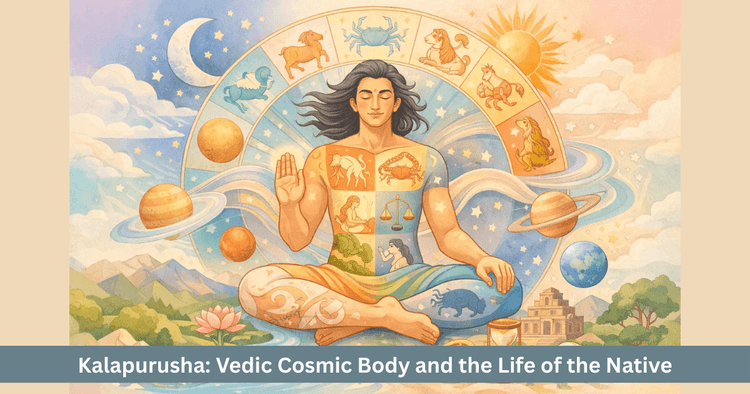
Table of Contents
In the Vedic tradition both Virat Purusha and Kala are treated as fundamental keys for understanding the structure of creation. The Purusha Sukta of the Rgveda describes this vast universal being whose body becomes the source of all that is mobile and immobile and that same Purusha later appears in jyotisha as the concept of Kalapurusha. The entire universe and the origin of all beings are traced back to this conscious cosmic person who, when seen together with time, becomes Kaalpurusha.
The Atharvaveda’s Kala Sukta presents a detailed and subtle vision of time. The seers of jyotisha accepted this same tradition and made it the foundation of their discipline. Without understanding Kalapurusha the deeper meanings of planets, signs and houses do not fully open, whether the discussion is about fate or about karma.
Why Is Kalapurusha Needed in Astrology
A famous verse from ancient texts on jyotisha states
"Vidhatra likhita ya asau lalate aksharamalika
Daivajnas ta pathed vyaktam hora nirmala chakshusha"
The meaning is that the string of letters written by the Creator on the forehead can be read by the astrologer through the clear eye of hora shastra. This hora stands upon a joint understanding of time and Purusha.
In works like Brihat Parashara Hora Shastra, Brihajjataka, Saravali, Phaladeepika, Jyotisha Kalpataru, Phalita Martanda, Hora Ratna and Sarvartha Chintamani, the doctrine of Kalapurusha appears repeatedly. All of them agree in treating Kalapurusha not as a mere metaphor but as something essentially one with the individual native.
Just as the human body has head, eyes, mouth, chest and abdomen, Kalapurusha also is imagined with many outer and inner organs. These organs are connected with the twelve signs from Mesha to Meena and with the planets from Surya onwards. Human life experiences pleasure, pain and triple kinds of distress and different shastras explain their causes in different ways. Jyotisha explains them by reading planets and signs through the body of Kalapurusha.
From this it becomes clear that there is a deep non difference between Kalapurusha and the native. Strength of self, mental firmness, the level of sattva, skill in speech, knowledge, joy and sorrow, all shape the direction of the future. For this reason the inner organs of Kalapurusha such as soul, mind, sattva, speech, knowledge, desire, happiness and sorrow are also imagined and each is connected to a particular planet.
Inner Divisions of Kalapurusha and Planetary Roles
The Kalapurusha described in jyotisha has inner organs grouped and mapped clearly to planets. The mapping may be understood as follows.
| Inner organ | Meaning in Kalapurusha | Planet ruler |
|---|---|---|
| Atma | Core consciousness, life | Surya |
| Manas or Chitta | Feelings, thoughts, memory | Chandra |
| Bala or Sattva | Courage, strength, valour | Mangala |
| Vak | Speech, expression, dialogue | Budha |
| Jnana | Knowledge, discrimination | Guru |
| Sukha | Comfort, enjoyment, pleasure | Shukra |
| Mada or Ahamkara | Pride, ego, intoxication | Rahu |
| Duhkha | Pain, obstacle, suffering | Shani |
The Rgveda says "Surya atma jagatas tasthushas ca", describing the Sun as the soul of all that moves and does not move. In the same spirit the Moon is taken as the mind of Kalapurusha, Mars as strength and sattva, Mercury as the voice, Jupiter as knowledge, Venus as happiness and Rahu as intoxication or ego. Shani is called the sorrow of Kalapurusha, hence the expression "Shanih kala narasya duhkham".
This division means that when these planets are strong or weak in a horoscope, the corresponding inner aspects of the native such as soul strength, mind, speech, knowledge, happiness and ego will also be altered in the same proportion. What happens within Kalapurusha is projected in a subtle way into the embodied human being.
Body Parts of Kalapurusha and the Zodiac
The classical texts do not limit themselves to inner organs. They also speak of the physical body of Kalapurusha, mentioning head, eyes, ears, nose, throat, cheeks, chin, mouth, neck, shoulders, arms, armpits, chest, stomach, navel, bladder, genitals, anus, testicles, thighs, knees, calves and feet. Each of these parts is linked with signs and houses.
Here the concept of dreshkana becomes very important. Every sign is divided into three dreshkanas and at the time of birth the dreshkana which rises with the lagna decides the sequence of Kalapurusha’s parts.
When the Lagna Is in the First Dreshkana
If the rising sign at birth is in its first dreshkana, the body parts of Kalapurusha are distributed as follows.
- The lagna house represents the head of Kalapurusha.
- The second house represents the right eye.
- The twelfth house represents the left eye.
- The third house stands for the right ear.
- The eleventh house stands for the left ear.
- The fourth and tenth houses together indicate the nose.
- The fifth and ninth houses stand for the cheeks.
- The sixth and eighth houses indicate the chin.
- The seventh house represents the mouth opening.
When the Lagna Is in the Second Dreshkana
If the rising sign occupies the second dreshkana, the mapping changes.
- The lagna house now indicates the throat or neck.
- The second and twelfth houses represent the shoulders.
- The third and eleventh houses stand for both arms.
- The fourth and tenth houses represent the armpits.
- The fifth and ninth houses indicate the chest.
- The sixth and eighth houses correspond to the stomach.
- The seventh house represents the navel of Kalapurusha.
When the Lagna Is in the Third Dreshkana
If the lagna sign is in its third dreshkana, a different pattern is used.
- The lagna house then indicates the bladder and the portion between genitals and navel.
- The second house represents the genitals.
- The twelfth house stands for the anus.
- The third and eleventh houses represent the testicles.
- The fourth and tenth houses correspond to the thighs.
- The fifth and ninth houses stand for the knees.
- The sixth and eighth houses indicate the calves.
- The seventh house represents the feet of Kalapurusha.
Through this structure Kalyana Varma and other teachers turned the subtle body map of Kalapurusha into a practical tool for diagnosing illness, injury and marks.
How Are Right and Left Sides of Kalapurusha Determined
A natural question arises when one considers paired organs such as eyes, ears, arms and legs. How does one decide which is the right and which is the left side in the horoscope. The tradition resolves this by looking at rising and setting halves.
The signs which lie below the horizon, that is those not yet risen, are taken as representing the right side of Kalapurusha. The signs which have already risen above the horizon are taken as the left side.
In practical observation it is often the right side of the human body that appears stronger and the left comparatively weaker. however in those who work predominantly with the left hand this pattern may invert. By dividing houses into the unrisen and risen halves from lagna to sixth and from seventh to twelfth, texts define this division more precisely and link it with physical strength and vulnerability.
Planetary Strength and the Inner Organs of Kalapurusha
When planets representing soul, mind, strength, speech, knowledge, happiness, pride and sorrow are placed in the birth chart, another question arises. How do these planets actually affect the native. The author of Saravali, Acharya Kalyana Varma, addresses this through the doctrine of planetary strength.
- If Surya is strong at birth, the atma of Kalapurusha is said to be powerful. Such a native enjoys high self confidence, steady purpose and clear awareness.
- If Chandra is weak, the mind or chitta tends to be weak, disturbed or easily shaken.
- The strength of Mangala directly influences sattva and valour. Courage, the readiness to struggle and the level of anger are all shaped by Mars.
- The condition of Budha affects speech and articulation. A strong Mercury yields clear, sweet and effective speech, while weakness can produce confusion or inconsistency.
- When Guru is strong, knowledge, discernment and sense of dharma are elevated. A weak Jupiter can obstruct the ability to learn and to apply wisdom.
- Shukra stands for happiness. His strength increases the flow of material and sensual pleasures, while his weakness reduces them.
- For Shani the rule is reversed, as Saravali says "Viparitam shaneh phalam". A weak Saturn can increase suffering, while a strong Saturn gives the power to bear organise and transcend difficulties, thereby reducing actual distress.
- A strong Rahu magnifies pride and intoxication of ego, whereas a weak Rahu allows ego to become softer or to be challenged and reduced.
Through this, planetary strength influences events but also the inner fabric of Kalapurusha and from there the mind, speech, knowledge and behaviour of the native.
Benefic and Malefic Planets, Marks and Disease on the Body
Since the signs occupy different parts of the body of Kalapurusha, planets placed in those signs show specific effects on bodily regions.
The principle is that signs holding malefic planets cause wounds, injuries or diseases in the organs linked with those signs in the body of Kalapurusha. Signs holding benefic planets are likely to show moles, birthmarks or special marks on the corresponding body parts.
Here planets are classified as follows.
- Benefics are Guru, Budha and Shukra.
- Malefics or cruel planets are Shani, Mangala and Surya.
- Budha is special. With malefics he behaves as malefic, with benefics he behaves as benefic.
- A full Moon is treated as benefic. A waning or weak Moon is counted among malefics.
The strength of the Moon is also analysed carefully.
- From the first tithi of the bright half up to Dashami he is considered moderately strong.
- From bright Ekadashi up to dark Panchami he is counted as fully strong.
- From dark Shashthi up to Amavasya he is treated as weak.
Some teachers say that from the middle of dark Ashtami up to the middle of bright Ashtami the Moon is waning or thin and that for the rest of the time he is strong. All of this shows that the effect of planets on the limbs of Kalapurusha depends on both position and strength.
When Do Marks and Wounds Appear on the Body
Another important question is about timing. Will the marks, moles, scars or illnesses appear on the body from birth or will they arise later in life. The texts offer a clear rule.
If the benefic or malefic planets that signify a body part are in their own sign or navamsha, then the corresponding marks are likely to be present from birth.
If the same planets are not in own sign or own navamsha, then they tend to give scars, wounds or illnesses during their dasha or antardasha periods through events or natural development. Thus by combining the organs of Kalapurusha, the signs and planetary strength, astrologers can estimate both location and time of bodily events.
Planets and the Outer Personality of Kalapurusha
Wherever the texts speak of Kalapurusha they also link the planets directly to his outer personality. Planetary strength influences not only shape but also role and social style.
- A strong Surya makes Kalapurusha behave like a king, full of leadership, authority and commanding presence.
- A strong Chandra also confers royal qualities, popularity and charm.
- A vigorous Budha gives princely traits, quick learning and graceful communication.
- A robust Mangala produces the traits of a commander, with courage, readiness for action and warlike ability.
- When Shukra and Guru are powerful, Kalapurusha gains the qualities of a minister, teacher or guide.
- A strong Shani gives the personality of a servant, that is, one used to labour, service, hardship and humility.
Through these combinations planetary strength shapes both the outer form of Kalapurusha and the style in which the native engages with the world.
Physical Form under the Influence of Surya
If Surya is particularly strong in the birth chart, the physical form of Kalapurusha gains certain features.
The hair may be somewhat curly, the intelligence and appearance attractive, the voice deep and weighty. Height is not necessarily great but moderate and firm. The eyes show redness, the temperament is brave and intense and the mind is steady and free from restlessness. The body may carry both red and dark shades, the feet appear somewhat hidden, pitta qualities are marked, bones are strong and the overall frame is square and serious.
The Form of Kalapurusha under Chandra
When Chandra is strong, Kalapurusha becomes gentle and pleasing.
The eyes are bright and beautiful, the speech is sweet, the complexion fair or clear and the body rather slender. There is a youthful radiance, small dark curly hair, learning, soft temperament and a predominance of sattva. Attractiveness, a mix of vata and kapha, deep affection for friends, strong blood, a tendency towards dislike or aversion in some matters, attraction towards older women and fondness for white garments all belong to such a Moon influenced form.
Mars Dominated Kalapurusha
With a powerful Mangala the Kalapurusha is full of energy and some degree of fierceness.
The stature may be short, eyes yellowish brown, body strong and compact, complexion like glowing embers, behaviour lively, fat or muscle well developed and red clothes preferred. Such a person tends to be clever, bold, accurate in speech, with short shining curly hair. Pitta nature is marked, tamas has some hold, courage and fighting skill are prominent and there is attraction towards red tinged or bright white colours.
Mercury’s Mark on Kalapurusha
A dominant Budha gives a very adaptable and capable Kalapurusha.
The eyes become somewhat large and reddish, the speech sweet and clear and the complexion like green grass, with a dark greenish tinge. The skin is strong, rajas is prominent, there is love of cleanliness and neat and articulate speech. The prakriti shows a balanced mix of vata, pitta and kapha. The mind is cheerful, the body of medium size and rounded, veins visible on the skin, dress and manner easily altered to match others and there is special liking for green clothes.
Features of a Jupiter Dominated Kalapurusha
When Guru exerts strong influence at birth, stability and dignity arise in Kalapurusha.
The eyes and ears may be slightly yellowish, the voice deep and lion like and sattva is clearly dominant. The body and complexion resemble polished gold. The chest is broad and raised, the stature comparatively short yet impressive and there is zeal for dharma. Humility, cleverness, steady and noble gaze, forgiving nature, love for yellow garments and a kapha dominant prakriti with well nourished fat are also indicated.
Venus Shaped Kalapurusha
Strong Shukra fills Kalapurusha with beauty, charm and capacity for enjoyment.
Such a form is pleasing to look at, with long arms, a broad chest and a well proportioned face. There is abundance of reproductive strength, lively movements, thin long curly dark hair and a complexion dark like grass. Interest in romance, a mix of vata and kapha, great fortune, love for many coloured garments, dominance of rajas, skill in the arts of love, large eyes and large shoulders all come under Venus’s rule.
Saturn’s Shadow on Kalapurusha
When Shani is very strong or strongly aspects the lagna, the form of Kalapurusha becomes more severe and heavy.
The eyes are deep brown, the body thin and tall, veins pronounced and the nature inclined to laziness. The complexion is dark, the constitution predominantly vata and there may be a tendency towards gossip, hard heartedness and lack of sensitivity. Nails and teeth are thick, clothing and appearance often look dirty, movement is slow, purity is neglected, tamas is dominant, the form is somewhat frightening, anger is strong, the overall impression is aged and there is preference for black clothes.
Time Strength of Kalapurusha and Day Night Energy
The working power of Kalapurusha, that is his strength by day and night, also depends on the strength of the planets.
- If Guru, Surya and Shukra are strong at birth, Kalapurusha is considered stronger during the day. The native then may feel more energetic and effective in daytime.
- If Budha is strong, Kalapurusha is strong in both day and night.
- When Shani, Chandra and Mangala are strong, Kalapurusha becomes night strong, so that vitality and alertness tend to rise in night hours.
Through this one can judge at what time of day a person is naturally better supported for important actions.
Food, Taste and the Preferences of Kalapurusha
Planets also rule the food preferences of Kalapurusha. From the strength of planets one can infer which taste or type of food will be most liked.
- Strong Surya points towards a liking for bitter taste.
- Strong Chandra suggests preference for alkaline or saline foods.
- Strong Mangala is linked with pungent or sharp tastes.
- Strong Budha gives taste for mixed or compound flavours.
- Strong Guru is associated with love of sweet and nourishing food.
- Strong Shukra indicates liking for sour or acidic taste.
- Strong Shani is connected with astringent or rough taste.
By studying these combinations, astrologers relate Kalapurusha to individual diet tendencies and health conditions.
Feminine, Neutral and Masculine Traits under Planetary Influence
Planetary strength not only shapes form and food but also the balance of feminine, neutral and masculine traits in Kalapurusha.
- When Chandra and Shukra are especially strong, feminine qualities increase. Softness, refinement, adornment and emotional warmth tend to dominate.
- When Budha and Shani are strong, neutral or non masculine traits increase, including a certain androgynous quality or mixed physical and mental tendencies.
- When Guru, Surya and Mangala are particularly powerful, masculine traits strengthen, such as courage, leadership, clarity and firmness.
This refers not only to external gender identity but also to the inner pattern of energy and behaviour.
Using Kalapurusha to Understand the Native’s Path
Taken together, the doctrine of Kalapurusha is far more than a philosophical idea. It is a subtle image of time in human form where planets, signs, houses, body and mind are interwoven.
When an astrologer studies a horoscope, the unseen backdrop is this very structure of Kalapurusha for that moment, whether explicitly named or not. Bodily organs, illness, physical marks, temperament, soul strength, happiness, sorrow, food preferences, day and night energy and even feminine or masculine traits can be read more clearly when the chart is interpreted through this lens.
Anyone who patiently understands this profound framework gains deeper insight not only for prediction but also for self knowledge. With that insight one can choose lifestyle, practice and behaviour more wisely and gradually bring body, mind and karma into better balance.
Common Questions on Kalapurusha
Is Kalapurusha only a metaphor or also a practical tool in astrology
The concept of Kalapurusha arises from the Vedic ideas of Virat Purusha and Kala but in jyotisha it is used very practically by linking planets, signs and body parts. It becomes a direct aid for understanding illness, marks, temperament and inner strength.
Why are subtle states like atma, manas, sattva and sukha assigned to specific planets
Because Surya, Chandra, Mangala, Budha, Guru, Shukra, Shani and Rahu each represent a distinct layer of human experience. Their placement and strength clearly show how self confidence, mind, knowledge, speech, happiness and ego are functioning in the native.
What is the practical benefit of seeing Kalapurusha’s limbs through dreshkanas
By using dreshkanas one can identify which part of the body is more likely to experience injury, disease or special marks. The dreshkana of the lagna and the planets placed there allow more refined judgement in medical and physical predictions.
Do marks like moles and scars always appear from birth or can they arise later
If the relevant planet is in its own sign or own navamsha the mark is likely from birth. If not, the mark or illness may appear during that planet’s dasha or antardasha, sometimes through clear events and sometimes gradually.
How does knowing the time strength and food preferences of Kalapurusha help a seeker
By recognising which planets give strength by day or night and which tastes they favour, a person can choose more suitable timings and diet. This supports health, practice and work efficiency and helps align daily living with the deeper pattern shown by the horoscope.
Get your accurate Kundali
Generate KundaliDid you like it?
Author
Pt. Amitabh Sharma (56 Years)
Experience: 20
Consults About: Family Planning, Career
Clients In: Punjab, Haryana, Delhi
Share this article with friends and family
About ZODIAQ
ZODIAQ is an online Vedic Astrology platform. It connects clients seeking astrological advice to experienced astrologers with deep knowledge. Our users also generate kundali and perform kundali milan for free. ZODIAQ also offers services to the Astrologers. Astrologers utilize various offerings by ZODIAQ to serve their clients effectively.
If you are a User
Consult with experienced astrologers and seek their guidance. You can also order handwritten Janm Patrika report with life prediction prepared by experienced astrologers. Generate accurate Kundali, perform Kundali Matching and check horoscope and muhurat. Utilize our online library for all the necessary astrological and spiritual information.
If you are an Astrologer
Create accurate kundali for your clients and perform Kundali Matching for up to 5 people at a time. Write comprehensive Janm Patrika report for your clients with ZODIAQ. Check client details anytime by saving it in client directory. Become more productive by tracking how many clients you guide every day.
WELCOME TO
ZODIAQ
Right Decisions at the right time with ZODIAQ
