Kalapurusha and Mangala Graha: Strength, Courage, and Active Life Energy
By Pt. Suvrat Sharma
In Vedic astrology, Mangala represents action, courage, and life energy
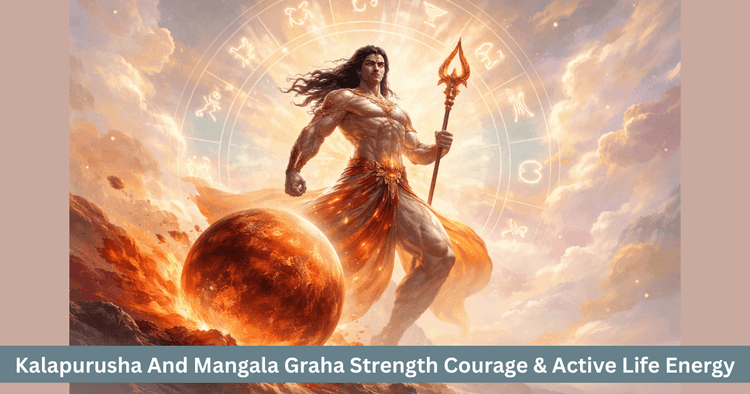
Table of Contents
In Vedic astrology Kalapurusha is viewed as a cosmic human in whose body the entire zodiac and all planets function as a living whole. In this divine form the twelve signs represent different limbs and the planets symbolise the powers and active energies that work through those limbs. Among these planets Mangala graha is especially regarded as the planet of strength, courage, struggle and action. Mars is the fire that activates the body of Kalapurusha, gives capacity for work and provides the courage needed to face challenges. Wherever quick decisions, a tendency to take risks and a strong urge to move forward are visible, the subtle working of Mangala can be felt.
How Was The Link Between Mangala And Kalapurusha Formed
When ancient astrologers observed Mars in the sky its red colour, sharp brightness and distinctive motion immediately drew attention. The reddish glow of Mangala reminded them of fire, blood and battle. Over time they also saw that during strong periods or transits of Mars people often showed more rapid reactions, intense energy and a greater tendency towards conflict or competition. From such experiences Mangala was connected with bodily factors related to power and action such as muscles, blood and physical energy. In Vedic philosophy Mars represents that side of life which grows through effort, struggle and persistent endeavour. From this view Mangala became the symbol of the force in the body of Kalapurusha that gives movement, protection and motivation for karma.
Place Of Mangala In The Body Of Kalapurusha And Its Signs
In the body of Kalapurusha Mangala is mainly linked with muscles, blood, bone marrow and physical strength. It holds natural rulership over two signs, Mesha rashi and Vrishchika rashi. In the natural zodiac Mesha represents the region of head and brain where initiative, decision and starting energy arise. Vrishchika signifies the generative organs, deep life force and powerful hidden will. In this way Mars is joined both with the upward, initiating energy at the top of the body and with the deeply rooted life force in the inner core.
Body Parts And Systems Ruled By Mangala
To understand the energy of Mars in the horoscope it is useful to see how it appears through different parts and systems of the Kalapurusha body.
Blood And Circulation
The most prominent association of Mangala is with blood. Blood carries oxygen and energy through the body and keeps activity, alertness and work capacity alive. The energy of Mars similarly brings enthusiasm, sharpness and readiness for action into life. For this reason disorders of blood, inflammation, sudden bleeding or pronounced redness are often read with reference to Mangala.
Muscles And Physical Strength
The strength of muscles and overall physical activity belongs to Mars. It symbolises the capacity to labour, to sustain hard work and to keep trying even under pressure. Competition, sports or physical labour express constructive Mars when its power is handled properly. When Mangala is balanced a person usually shows steady strength, stamina and a strong drive to complete tasks.
Bone Marrow And Inner Power
In Vedic astrology Mangala is also related with bone marrow. Bone marrow is crucial for blood formation and immune strength. At this deeper level Mars represents inner power and the ability to fight from within. It is the force that makes the body strong enough to withstand outer strain and challenge.
Head And The Initial Centre Of Energy
As ruler of Mesha, Mangala relates with the head and active mental energy. It indicates capacity for quick decision, tendency to begin actions suddenly and courage to take initiative. When both Mesha and Mars are strong in a chart, the native is naturally drawn towards leading, taking risks and opening new paths in life.
Astrological Meaning Of Mangala’s Position In The Horoscope
From the placement of Mars in a birth chart one can read levels of courage, energy, competitiveness and capacity for action. When Mangala is strong, benefic and well balanced it often shows clear courage and boldness, leadership ability, quick and decisive thinking and willingness to move ahead even where some risk is present. Such people do not retreat easily from challenges and often wish to hold a leading role in their field. When Mars is weak, debilitated or heavily afflicted or when its energy becomes too harsh, it may appear as low energy, tendency to leave work unfinished or in the opposite direction as excessive anger, aggression and quarrelsome behaviour. Sometimes the same force does not appear openly but turns inward as jealousy, irritation and restlessness. In this way Mars reveals how a person meets conflict, how deeply one applies energy in work and what type of reaction arises when situations do not go according to plan.
What Is The Spiritual Meaning Of Mangala Graha
From a spiritual perspective Mangala is not only the planet of outward battles, fighting or anger. It represents the inner warrior. This is the power that allows a person to confront fear, to overcome laziness and to stand against falsehood and injustice. When the energy of Mars is balanced one sees discipline, courage, self control and firm commitment to dharma. In such a state Mangala supports efficiency in action, respect for time and readiness to take the right step at the right moment. If this power lacks right direction the same energy can turn into impulse, impatience and unnecessary conflict. Therefore spiritual practice aims to guide Mars towards restraint, bravery and service so that its fire works for protection and building rather than for harm.
Health Tendencies Associated With Mangala
Classical Vedic astrology mentions certain health tendencies connected with Mars that should be treated as indications only. Under a highly afflicted or overheated Mangala there may be greater risk of injury, cuts, bruises or bleeding, redness, burning sensations, inflammation and disturbances related to excess body heat. At times over hasty behaviour, fast driving or taking risks without thought are also linked with intense Mars energy and can lead to accidents or sudden harm. In every such situation medical consultation and proper tests remain essential and astrological pointers are meant only for caution and awareness.
Deeper Message Of Kalapurusha And Mangala Graha
The relationship between Kalapurusha and Mangala teaches that thought and feeling alone are not enough to move life forward. For real progress one also needs strength, courage and active energy. Mangala is the power that inspires action, gives courage to face difficulties, awakens the will to prove oneself in competition and supports movement even in the midst of struggle. When Mars is balanced this energy becomes a protective force, a capacity for hard work and the courage to stand for oneself and for loved ones. For this reason Mangala is seen in the body of Kalapurusha as the fire that makes life dynamic, capable and truly engaged in karma.
Common Questions On Kalapurusha And Mangala Graha
Does every strong Mars make a person angry and quarrelsome
No. A strong Mars primarily gives energy and courage. When guided in the right direction it can produce discipline, hard work and a protective attitude. Anger and conflict usually rise when Mars is imbalanced or badly afflicted.
If Mars is weak in a chart will the native always remain fearful
A weak Mars may show hesitation and difficulty in taking bold steps, yet this is not fixed destiny. Through effort, exercise, disciplined routine and positive surroundings a person can gradually strengthen courage and industriousness.
Is Mangala related only with accidents and injuries
No. Its main field is energy, courage, effort and protection. Accidents or injuries are more likely when Mars is very uncontrolled, excessively hot or misdirected in expression.
What helps to keep Mars energy balanced
Regular physical exercise, constructive labour, sports, disciplined daily habits, moderate diet and the practice of responding with patience rather than instant anger all help to balance Mangala. Understanding one’s own temper and expressing it calmly is also important.
How does understanding Mars in Kalapurusha support practical life
When a person knows where energy is strong and where it may become unstable, work, struggle, decision making and risk taking can be guided more wisely. In this way correct understanding of Mangala helps to make life more active, balanced and meaningful.
Get your accurate Kundali
Generate KundaliDid you like it?
Author

Pt. Suvrat Sharma (63)
Experience: 20
Consults About: Family Planning, Career
Clients In: Punjab, Haryana, Delhi
Share this article with friends and family
About ZODIAQ
ZODIAQ is an online Vedic Astrology platform. It connects clients seeking astrological advice to experienced astrologers with deep knowledge. Our users also generate kundali and perform kundali milan for free. ZODIAQ also offers services to the Astrologers. Astrologers utilize various offerings by ZODIAQ to serve their clients effectively.
If you are a User
Consult with experienced astrologers and seek their guidance. You can also order handwritten Janm Patrika report with life prediction prepared by experienced astrologers. Generate accurate Kundali, perform Kundali Matching and check horoscope and muhurat. Utilize our online library for all the necessary astrological and spiritual information.
If you are an Astrologer
Create accurate kundali for your clients and perform Kundali Matching for up to 5 people at a time. Write comprehensive Janm Patrika report for your clients with ZODIAQ. Check client details anytime by saving it in client directory. Become more productive by tracking how many clients you guide every day.
WELCOME TO
ZODIAQ
Right Decisions at the right time with ZODIAQ
