The Deep Secret of Shatru Shadashtak
By Pt. Nilesh Sharma
A serious study of planetary enmity, elemental conflict, marital challenge and relational healing in 6 8 bonds
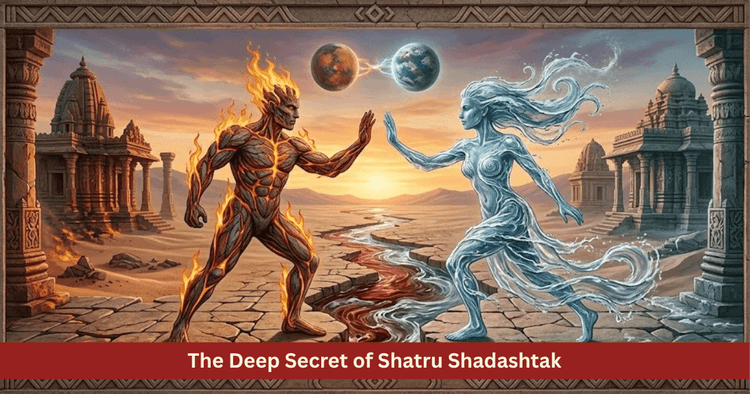
Table of Contents
Where conflict appears before closeness
Shatru Shadashtak is the difficult form of the 6 8 relationship in Vedic astrology where the issue is not only difference in temperament but an active opposition in root energy. When the ruling planets of both signs hold intense enmity toward each other and the elements of the signs also function in conflict, this condition is called Shatru Shadashtak. This bond is not only about ordinary disagreement. It points toward deep incompatibility in thought, reaction, sensitivity, decision making and life approach.
For this reason, Shatru Shadashtak is treated with great seriousness. In such relationships, one may see unspoken distrust, mental distance, emotional insecurity, repeated clashes and at times sudden separation without any fully visible cause. This does not mean every such bond must fail. It does mean that natural ease is usually not present from the beginning. Such a relationship requires more maturity, patience, awareness and complete chart analysis than usual.
What is Shatru Shadashtak
When 2 signs stand in a 6 8 relationship and their ruling planets are in intense enmity with each other, while the elements of the signs also strengthen conflict instead of harmony, Shatru Shadashtak is formed. Here the difficulty in the bond is not only behavioral. Its root lies in the opposition of energies. One person may reject the very language through which the other understands life.
That is why Shatru Shadashtak cannot be called only a surface disagreement. It is a condition of inner incompatibility. One side may find the other emotionally dry. The other may find the first impractical. One may feel the other is aggressive. The other may feel the first is too analytical or too emotional. This inner mismatch can slowly become exhaustion in the relationship.
| Aspect | Meaning |
|---|---|
| Shatru Shadashtak | Signs in a 6 8 relationship whose ruling planets are intense enemies |
| Main cause | Conflict between ruling planets and imbalance in elements |
| Early signs | Distrust, discomfort, confusion, mental distance |
| Possible effects | Conflict, bitterness, separation, fatigue in the bond |
This combination does not mean the bond is impossible. It means the bond will not move through natural ease and must be handled consciously.
Why Shatru Shadashtak is considered highly challenging
In astrology, the 6th house signifies debt, disease, struggle and opposition, while the 8th house indicates deep change, insecurity, hidden tension, crisis and unexpected events. When 2 signs come into a 6 8 relationship, the natural flow between them is already under strain. If the ruling planets are also hostile, the resistance becomes even stronger.
In such relationships, the damage often does not come from one major event alone but from many small repeated mental wounds. The way of explaining is different. The language of expectation is different. The expression of love is different. The method of handling conflict is different. As a result, both people may be correct from their own side and still become difficult for each other.
How this difficulty appears
- Distrust without clear reason
- Excessive reaction on small matters
- Lack of emotional safety
- Mentally exhausting arguments
- Doubts about each other's intention
- Inner distance even while staying together
That is why Shatru Shadashtak should be understood not only astrologically but also psychologically and energetically.
The meaning of planetary and elemental opposition
Shatru Shadashtak works on 2 levels. The first is enmity between ruling planets. The second is imbalance between elements. If energies like Mangal and Budh face each other, one side seeks direct action while the other seeks analysis. If Chandra and Shani face each other, one seeks emotional safety while the other emphasizes distance, neutrality or hard realism. This opposition makes the relationship complex.
The elements also play a major role. Fire, earth, air and water carry different natural tendencies. When they combine cooperatively, growth takes place. But when they come together through a 6 8 relation and hostile planetary rulership, the same elements may create conflict, misunderstanding and energy drain.
| Basis | Effect |
|---|---|
| Hostile ruling planets | Opposition in core life approach |
| Elemental conflict | Mismatch in reaction style |
| 6 8 relationship | Tension in life direction |
| Mental distance | Difficulty in building trust |
From this it becomes clear that Shatru Shadashtak is not merely outer disagreement but a sign of deep conflict in basic nature.
Major pairs of Shatru Shadashtak
According to the given basis, some sign pairs are considered examples of Shatru Shadashtak. In these pairs, the 6 8 relationship, opposition of ruling planets and elemental imbalance make the bond more difficult.
Main pairs
- Mesh and Kanya
- Mithun and Vrishchik
- Karka and Kumbha
- Simha and Makar
- Kanya and Kumbha
- Tula and Meen
- Dhanu and Vrishabh
The inner conflict of each pair is not identical. Every pair struggles for a different reason. Each one must therefore be understood separately.
Mesh and Kanya
Mesh is ruled by Mangal and Kanya is ruled by Budh. The nature of Mangal is direct, forceful, immediate and action oriented. Budh represents analysis, calculation, detail, doubt and logical refinement. Mesh feels work should begin at once. Kanya wants every matter to be checked, examined and arranged first.
This is where the conflict begins. Mesh may find Kanya overly critical and slow. Kanya may find Mesh impulsive, immature and careless in decision making. One wants action and the other wants precision. One wants speed and the other wants correctness.
Core conflict
- Aggression versus excessive critical thinking
- Quick decision versus careful analysis
- Direct expression versus mental filtering
What can intensify difficulty here
- Sharp language
- Impatience
- Constant criticism
- Lack of respect
If this pair is not conscious, both may exhaust the relationship by trying to correct each other.
Mithun and Vrishchik
Mithun is ruled by Budh and Vrishchik is ruled by Mangal. Mithun carries the air element and moves toward dialogue, curiosity, variety and lightness. Vrishchik represents the depth of water, secrecy, control, emotional intensity and silent power. Mithun understands through words. Vrishchik reads through silence.
This difference can make the relationship very hard. Mithun may find Vrishchik heavy, complex and controlling. Vrishchik may see Mithun as superficial, unstable and emotionally unreliable. One wants open exchange while the other wants deep emotional intensity.
Core conflict
- Intellectual restlessness versus deep mysterious stubbornness
- Open communication versus silent control
- Lightness versus intensity
Where caution is needed
- Speaking half truths
- Emotional testing
- Excessive checking
- Violation of personal boundaries
If this pair lacks maturity, attraction can quickly turn into distrust.
Karka and Kumbha
Karka is ruled by Chandra and Kumbha is ruled by Shani. Chandra signifies emotion, security, belonging and nurturing. Shani signifies distance, structure, fairness, harsh reality and emotional restraint. Karka seeks heart in relationship. Kumbha seeks thought, principle or distance.
That is why Karka may often feel that Kumbha is insensitive, cold or unreachable. On the other hand, Kumbha may feel that Karka is overly emotional, dependent or psychologically heavy. One wants embrace and the other wants space.
Core conflict
- Extreme emotionality versus neutral detachment
- Home and emotional closeness versus thought and independent distance
- Need for security versus distant response
The central pain of this bond
- Feeling emotionally neglected
- Unspoken loneliness
- Complaint of not being understood
- Mental exhaustion
If this pair does not build balance, Karka keeps getting wounded भीतर and Kumbha feels falsely accused and cornered.
Simha and Makar
Simha is ruled by Surya and Makar is ruled by Shani. The relationship between Surya and Shani is seen in Vedic thought as one of deep tension. Simha signifies radiance, self respect, creative expression and the desire to stand at the center. Makar signifies work, discipline, outcome, structure, effort and solid achievement. Simha seeks acknowledgment. Makar seeks proof.
This becomes the main tension between them. Simha may feel Makar is too cold, harsh or uninspiring. Makar may feel Simha is ego centered, dramatic or overly self occupied. One seeks the language of honor and the other the language of labor.
Core conflict
- Royal ego versus disciplined labor
- Self expression versus result based effort
- Need for recognition versus hard realism
Why this relationship becomes difficult
- Lack of appreciation
- Power struggle
- Emotional distance
- Harsh speech
This pair becomes manageable only when Simha learns humility and Makar learns the language of the heart.
Kanya and Kumbha
Kanya is ruled by Budh and Kumbha is ruled by Shani. At first glance, both may look intellectual, yet their working style and life view differ greatly. Kanya is subtle, practical, ordered, analytical and focused on close range control. Kumbha is broad, conceptual, social, unconventional and often emotionally distant.
Kanya values even small details. Kumbha sees the larger pattern and may not care much for fine daily precision. Kanya may find Kumbha disorganized or emotionally absent. Kumbha may find Kanya too critical, anxious or mentally confined.
Core conflict
- Practical detail versus social emptiness
- Order versus conceptual spread
- Close control versus distant vision
Where challenge appears most
- Daily habits
- Communication style
- Emotional expression
- Definition of responsibility
This relationship becomes harder when both consider only their own method to be correct.
Tula and Meen
Tula is ruled by Shukra and Meen is ruled by Guru. The conflict here is subtle because both signs may seem gentle and relationship oriented from the outside. Yet their value systems differ deeply. Tula values balance, social grace, beauty, relational skill and worldly harmony. Meen moves toward compassion, surrender, sacrifice, spirituality and emotional merging.
Tula may find Meen impractical, overly emotional or lacking boundaries. Meen may find Tula superficial, comfort oriented or weak in moral firmness. One wants to make the relationship graceful. The other wants to make it sacred.
Core conflict
- Material pleasure versus spiritual morality
- Social balance versus emotional surrender
- Outer harmony versus inner compassion
What may break here
- Clarity of expectations
- Moral direction
- Decision making
- Boundaries in the relationship
If this pair is not highly aware, both may move from misunderstanding toward disappointment.
Dhanu and Vrishabh
Dhanu is ruled by Guru and Vrishabh is ruled by Shukra. Dhanu is a fire sign that seeks ideals, philosophy, dharma, travel, truth and expansion. Vrishabh is an earth sign that values stability, security, material grounding, sensory comfort and solid life structure. Dhanu looks ahead. Vrishabh looks at what can be held firmly.
This is where their conflict arises. Dhanu may see Vrishabh as too rigid, slow and comfort bound. Vrishabh may see Dhanu as unstable, overly idealistic and far from practical ground. One speaks of higher truth and the other stands on solid earth.
Core conflict
- High idealism versus conservative material grounding
- Free expansion versus stable structure
- Search for truth versus protection of comfort
Where this pair struggles
- Defining life goals
- Use of money and values
- Balance between spirituality and practicality
The Shatru Shadashtak of Dhanu and Vrishabh teaches that ideal and stability do not unite easily, though maturity can still create a path.
How relationships are affected in Shatru Shadashtak
The effect of such bonds is not limited to arguments alone. At times, the entire mental atmosphere becomes heavy. A person may feel unsafe within the relationship itself. In some bonds, separation may be discussed repeatedly. In others, emotional distance may grow despite physical togetherness. In some, one person feels constantly exhausted while the other feels constantly dissatisfied.
This combination calls for caution especially in marriage. If the full chart does not support the union, long term tension, health strain, distrust, separation or a hard psychological climate may develop. That is why attraction alone should never become the basis of decision here.
Possible effects
- Unspoken fear or insecurity
- Mental cruelty or harsh behavior
- Sudden distance
- Repeated breakdown of trust
- Pressure on the spouse's health
- Deep exhaustion in married life
It is also important to remember that no single combination gives the final verdict. The complete chart alone provides the final foundation for judgment.
Are Shatru Shadashtak relationships always unsuccessful
No. To say so would not do justice to the depth of astrology. Shatru Shadashtak is certainly difficult but it is not final. If the 7th house is strong, the Moon is balanced, Shukra or Guru is well placed, the Navamsha supports the union and both individuals are mature, the relationship can be sustained. But such a bond does not run through natural ease. Awareness must become a habit here.
In what conditions relief may appear
- Support from Lagna and Chandra chart
- Strength of the 7th house
- Blessing of benefic planetary aspects
- Emotional maturity
- Clear communication
- Supportive family environment
- Humility to accept guidance
therefore Shatru Shadashtak should be seen not through fear but through serious discernment.
Remedies to improve a Shatru Shadashtak bond
In such relationships, the greatest remedy is not only worship or ritual but conscious conduct. The reason is that the root problem lies not only in planetary enmity but also in habits of reaction. If both individuals are willing to understand themselves, the intensity of conflict can be reduced.
Practical remedies
- Take time before reacting
- Do not make criticism a permanent language
- Give clear words to emotions
- Avoid insulting speech
- Hear the other side fully before deciding
- Define personal boundaries and respect
- Keep a regular time for dialogue
Vedic remedies
| Remedy | Purpose |
|---|---|
| Pacification of ruling planets | To balance opposing root energies |
| Mantra japa | To reduce mental agitation |
| Charity | To soften ego and harshness |
| Joint prayer | To bring gentleness into the bond |
| Fasting or disciplined observance | To cultivate restraint in mind and reaction |
If health stress is strong in the bond, then spiritual remedies should be accompanied by practical medical awareness. This balance is considered very important in marital assessment.
The spiritual message of this combination
Shatru Shadashtak enters life like a test in which a person must confront not only love but also personal blind spots. It teaches that attraction alone is not enough. Shared direction, shared sensitivity and mature receptivity are also necessary. Where deep inner conflict exists, the relationship becomes a field of self examination.
Some people break in such bonds. Some reach self knowledge through them. If a person recognizes ego, reaction and uncontrolled speech, even this difficult combination can become a teacher. But its lessons demand a greater price than ordinary relationships.
The gravity of the final thought
Shatru Shadashtak should not be taken lightly. It is a combination where not only disagreement but deep energetic conflict may remain active between 2 people. therefore in marriage, long term partnerships and deeply intimate bonds, it deserves careful examination. At the same time, fear and blind belief should also be avoided, because the complete chart alone reveals the final truth.
When Shatru Shadashtak is understood wisely, it does not remain only a frightening combination. It becomes a warning, an awakening and a reminder that every relationship does not sustain itself through attraction alone. Some bonds require deep discipline, restraint, planetary remedies and mature self knowledge to survive.
FAQ
What is Shatru Shadashtak
Shatru Shadashtak forms when 2 signs in a 6 8 relationship are ruled by intensely hostile planets and the elements are also conflicting.
Is Shatru Shadashtak considered very difficult for marriage
Yes, it is considered difficult because distrust, mental stress, separation and health related pressure may become stronger in such bonds.
Which are the major pairs of Shatru Shadashtak
Mesh and Kanya, Mithun and Vrishchik, Karka and Kumbha, Simha and Makar, Kanya and Kumbha, Tula and Meen and Dhanu and Vrishabh are major pairs.
Can a Shatru Shadashtak relationship be saved
Yes, if the full horoscope supports the union, communication is good, planets give support and both individuals are mature, the relationship can be sustained.
Which remedies are useful in Shatru Shadashtak
Planetary pacification, mantra japa, charity, joint prayer, respectful dialogue and controlled reaction are considered useful in such relationships.
What does Lagna Sign reveal about me?
My Lagna SignDid you like it?
Author

Pt. Nilesh Sharma (63)
Experience: 20
Consults About: Family Planning, Career
Clients In: Punjab, Haryana, Delhi
Share this article with friends and family
About ZODIAQ
ZODIAQ is an online Vedic Astrology platform. It connects clients seeking astrological advice to experienced astrologers with deep knowledge. Our users also generate kundali and perform kundali milan for free. ZODIAQ also offers services to the Astrologers. Astrologers utilize various offerings by ZODIAQ to serve their clients effectively.
If you are a User
Consult with experienced astrologers and seek their guidance. You can also order handwritten Janm Patrika report with life prediction prepared by experienced astrologers. Generate accurate Kundali, perform Kundali Matching and check horoscope and muhurat. Utilize our online library for all the necessary astrological and spiritual information.
If you are an Astrologer
Create accurate kundali for your clients and perform Kundali Matching for up to 5 people at a time. Write comprehensive Janm Patrika report for your clients with ZODIAQ. Check client details anytime by saving it in client directory. Become more productive by tracking how many clients you guide every day.
WELCOME TO
ZODIAQ
Right Decisions at the right time with ZODIAQ
