Maa Brahmacharini: One Decision That Left Even the Gods in Silence
By Pt. Suvrat Sharma
Maa Brahmacharini’s silent ascetic form profoundly altered even the gods’ perception of power.
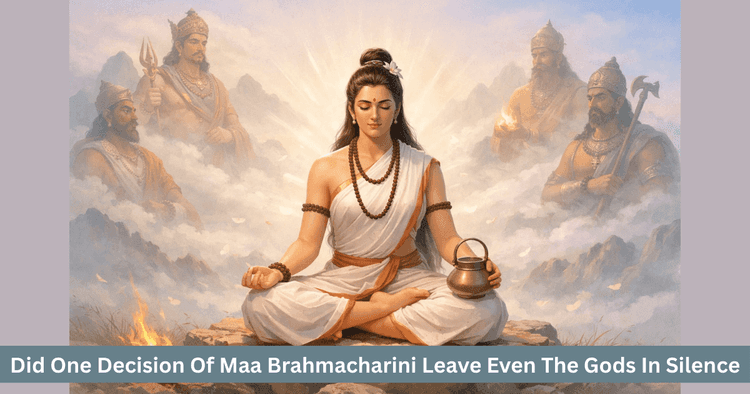
Table of Contents
In the story of Maa Brahmacharini, there comes a moment where words become too small and silence itself becomes the deepest expression. This is not merely an episode of a goddess performing tapas. It is the story of a decision that shook even the gods from within. Power is often imagined in terms of brilliance, force, visible presence, battle, victory and displayed strength. Maa Brahmacharini revealed a form of power that was calm, restrained, steady and yet so profound that even the gods had little left to say before it. That is the greatest mystery of this episode, that what is most silent can also be most influential.
When it is said that the gods fell silent, it does not only mean that they physically stopped speaking. It also means that their familiar understanding, their known way of perceiving divine force and their ordinary framework of power began to change. They had seen the Goddess in many forms. They had witnessed fierceness, radiance, compassion, protection and destruction. But the ascetic form of Maa Brahmacharini was something entirely different. There was no outer display, no loud expression of divine authority, no dramatic miracle. Yet there was a presence so immense that it altered the very atmosphere around it.
What Was There In Her Decision That Brought Everything To A Pause
The path of Maa Brahmacharini was not only the path of austerity. It was the path of self discipline, patience, inner strength and silent resolve. She chose to define herself not through grandeur but through spiritual discipline. This is the point that unsettled even the gods. Before them stood a form of power that could have transformed everything in an instant and yet it chose tapas, waiting and inward transformation over immediate manifestation. Such a choice is not easy to understand through ordinary perception.
From the perspective of the gods, the question itself was natural. If the Goddess holds the power to do everything, why would she place herself upon a difficult path. Why would she not reveal her glory openly. Why would she not move straight toward the result. These questions stirred within them. Some may have seen it as renunciation, some as a profound test and some as preparation for a greater purpose. Yet none could immediately grasp the fullness of that decision. Slowly, thought gave way to silence.
Was The Silence Of The Gods Mere Wonder Or Something Deeper
This silence was not only the silence of astonishment. It also held the quality of deep acceptance. When ordinary understanding comes before a reality that exceeds its limits, reasoning begins to slow down. The gods sensed that this decision was not ordinary. It belonged to a level where power does not diminish by becoming quiet but becomes even stronger by gathering inward. And when power gathers inward, it often becomes more intense than when it is outwardly displayed.
The form of Maa Brahmacharini seemed to declare that power does not always need to prove itself through action. Sometimes its highest state lies in remaining centered within. That is why the silence of the gods was not merely the result of surprise. It was also an acknowledgment that they stood before an aspect of power that could not be understood by appearance alone. It had to be experienced.
Did Her Decision Limit Power Or Refine It Into A Higher Form
From the outer point of view, it may seem that Maa Brahmacharini limited herself. She wore simple garments, chose difficulty, rejected external splendor and entered silent austerity. Yet the truth is the opposite. She did not reduce power, she refined it. A force that could have immediately manifested was transformed through patience, discipline and spiritual focus into something lasting, pure and unshakable.
This is why her form is so powerful. The power that can merely change the outer world is great at one level. But the power that can govern itself, gather all directions inward and live its resolve without noise is greater still. Maa Brahmacharini stands as the symbol of that higher power.
How Did Nature Itself Respond To Her Choice
The narrative suggests that not only the gods but nature itself came under her influence. The movement of air seemed to slow. The flow of water became still. A rare steadiness entered the atmosphere. This is not merely poetic expression. It points toward the inner energy that had become so deeply concentrated that its effect began to radiate outward.
When the consciousness of a tapasvini reaches such intensity, its influence does not remain confined within the individual. It begins to create calm, stillness and a subtle force in the surrounding field. In the case of Maa Brahmacharini, this influence was extraordinary. The power of tapas awakening within her was not only personal discipline. It was also the preparation of a new balance of energy within creation itself. That is why her silence was active and her stillness was transformative.
What Form Of Power Was She Teaching Through This Decision
The decision of Maa Brahmacharini carries a deeply instructive dimension. She was not merely practicing austerity. She was redefining the meaning of power. Usually power is understood as the ability to respond immediately, alter circumstances or assert influence. Maa Brahmacharini taught that the greatest power does not always lie in immediate response. Sometimes the greatest power lies in remaining quiet, staying steady, not scattering one’s inner energy and allowing the right moment to arise while refining resolve within.
This itself became a lesson even for the gods. They were accustomed to seeing power in action but here power was silent without being weak. It was still without being ineffective. For that reason, her decision became an inner teaching. They witnessed that the highest state of power may exist not in outward movement but in complete inward awareness.
Why Does This Episode Remain Relevant Even Today
This story does not remain confined to a divine event of the past. Its message remains deeply meaningful even now. Modern life often creates the impression that one must respond to everything immediately. To react, to assert, to prove strength, to display influence, these are frequently considered signs of success. Maa Brahmacharini challenges that habit of mind.
She teaches that constant reaction is not true power. At times, remaining silent, being inwardly stable, conserving one’s energy and staying centered until the right moment arrives may be the greatest action of all. The one who does not spill outward at every circumstance is the one who gathers greater light within. That is why her story offers an especially important lesson for our time in self restraint, mental steadiness and spiritual patience.
Did The Silence Of The Gods Reveal Their Own Limitations
Yes and this is another deep aspect hidden in the episode. The silence of the gods also shows that they became aware of the limits of their own understanding. They recognized that this form of power was greater than what they had previously known. To admit that one has not fully grasped a truth is itself an act of humility. Therefore their silence was not defeat. It was humble awakening.
The decision of Maa Brahmacharini made it clear that there are forms of power that cannot be measured through intellect alone or understood through external signs. They can only be approached through experience, reverence and inner sensitivity. That is why silence itself becomes one of the deepest symbols in this narrative.
What Does This Secret Of Maa Brahmacharini Ultimately Reveal
In the end, it becomes clear that Maa Brahmacharini’s decision was not merely a private choice of an ascetic goddess. It was a moment that compelled even the gods to change the way they saw power. They realized that the highest form of strength is the one that knows itself, does not become restless to prove itself and carries such completeness within that words naturally come to rest before it.
For this reason, this story teaches that true power does not dwell in noise but in that silence where everything becomes clear. Once a being recognizes the power within, there is no need to prove it at every step. It reveals itself, influences by its own presence and transforms the world without outward strain.
Frequently Asked Questions
Did one decision of Maa Brahmacharini truly leave the gods in silence
Yes. The story indicates that her tapas and her chosen path placed the gods in deep wonder and humility.
Why did the gods become silent
Because they stood before a form of power that could not be understood through familiar logic or ordinary experience.
Was this silence only amazement
No. Along with amazement, it also reflected acceptance, humility and reverence before a higher form of power.
What is the central teaching of Maa Brahmacharini here
She teaches that true power does not always need to appear outwardly. It can remain complete in silence, discipline and tapas.
What does this story mean for life
It teaches that often the greatest decision is not made through noise but through inner steadiness and silence and that becomes the most powerful force of all.
Get your accurate Kundali
Generate KundaliDid you like it?
Author

Pt. Suvrat Sharma (63)
Experience: 20
Consults About: Family Planning, Career
Clients In: Punjab, Haryana, Delhi
Share this article with friends and family
About ZODIAQ
ZODIAQ is an online Vedic Astrology platform. It connects clients seeking astrological advice to experienced astrologers with deep knowledge. Our users also generate kundali and perform kundali milan for free. ZODIAQ also offers services to the Astrologers. Astrologers utilize various offerings by ZODIAQ to serve their clients effectively.
If you are a User
Consult with experienced astrologers and seek their guidance. You can also order handwritten Janm Patrika report with life prediction prepared by experienced astrologers. Generate accurate Kundali, perform Kundali Matching and check horoscope and muhurat. Utilize our online library for all the necessary astrological and spiritual information.
If you are an Astrologer
Create accurate kundali for your clients and perform Kundali Matching for up to 5 people at a time. Write comprehensive Janm Patrika report for your clients with ZODIAQ. Check client details anytime by saving it in client directory. Become more productive by tracking how many clients you guide every day.
WELCOME TO
ZODIAQ
Right Decisions at the right time with ZODIAQ
