Maa Brahmacharini: Suffering or Power of the Universe?
By Pt. Narendra Sharma
Did Maa Brahmacharini Choose Suffering Over Power Though She Could Rule the Universe?
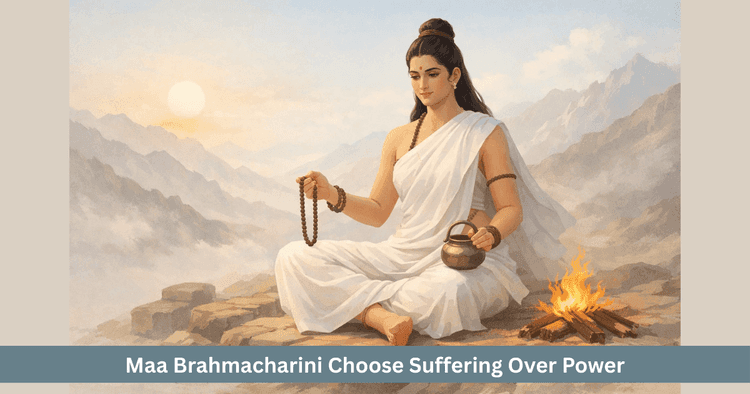
Table of Contents
The form of Maa Brahmacharini raises a profound question at first sight. If she wished, could she not bring the entire universe under her command. Certainly she could. She is the presiding force of power, the peak of tapas and the embodiment of unwavering resolve. Yet her form is not adorned with grandeur. It is marked by simplicity, austerity, discipline and a quiet radiance. In her hands are a rosary and a kamandal, a water vessel of ascetic life. Her feet are bare and her face carries an extraordinary peace. This very contrast makes her form extraordinary. Where ordinary vision looks for authority, Maa Brahmacharini reveals that the highest power often appears in the simplest form.
At first glance, it seems difficult to understand why a goddess who could hold the energy of the entire universe would choose hardship, restraint and tapas. That is the deepest secret of this form. It is not merely a religious sentiment but a revelation about the real nature of power. Many associate power with control, command, conquest and visible dominance. Maa Brahmacharini overturns that understanding. She teaches that the power which can govern others may be great but the power that can govern itself is the supreme power.
Why Does Maa Brahmacharini Appear So Simple
The first impression of Maa Brahmacharini is that there is no external display in her form. There are no royal garments, no glittering ornaments, no weapons meant to proclaim dominance. She walks barefoot and seems to have consciously turned away from all outer glitter. This distancing is not mere renunciation. It is a declaration that true power does not need adornment to prove its presence.
Her form suggests that once power awakens within, outer splendor becomes secondary. A consciousness that has found inner strength no longer seeks display. That is why Maa Brahmacharini appears majestic and silent at once, simple in appearance yet immensely elevated in meaning. She carries the truth that power born from tapas does not need ornaments. It needs only inner steadiness.
Could She Truly Have Ruled The Universe
The answer is clear. If she wished, she could have made even the gods bow to her will. She could have destroyed hostile forces, altered the balance of realms and established her authority across existence. Yet that makes the question even deeper. If it was possible, why did she not do it.
The answer lies in the difference between power and rule. Rule controls outer order, while tapas transforms inner order. Rule may function through fear but tapas functions only through truth. Rule may change with time but power gained through inner discipline never truly declines. Maa Brahmacharini did not reject outer authority because she lacked it. She chose something greater. She chose the power that is born from self mastery and for that reason it remains unbreakable.
Choosing Hardship Was Not Weakness
Many times in life, when a difficult path is seen, the mind assumes that perhaps there was no easier option available. That was not the case with Maa Brahmacharini. Her suffering was not the result of helplessness. It was a fully awakened choice. She did not perform tapas because she was weak. She performed tapas because she knew that power remains incomplete unless it passes through discipline.
Here lies the highest message of the story. Outer strength may become visible quickly but inner strength is built slowly. It is built through austerity, through patience, through waiting and through continual self restraint. Maa Brahmacharini chose exactly that kind of power. She knew that power which has not passed through tapas may give brilliance but it cannot give direction. Power that has not passed through patience may bring victory but it cannot bring balance.
Why Even The Gods May Have Found Her Decision Difficult To Understand
One may imagine that when the gods saw the Divine Mother in the form of Brahmacharini engaged in such intense tapas, they too must have wondered why a being of such immense power would place herself in such hardship. The gods knew the value of power, yet the path taken by Maa Brahmacharini was not only a path of strength. It was also a way of teaching creation itself.
Her tapas was not private effort alone. It was a living message that the highest form of power lies not in issuing commands but in disciplining the self. Very few can understand why a goddess capable of influencing the universe would still choose austerity. The reason is that she values the process more deeply than the result. She does not merely attain the goal. She sanctifies the path by which the goal is reached.
What Is The Real Meaning Of Her Tapasya
Her tapasya should not be seen only as physical hardship. It was a profound inner journey. The body endured but more importantly the mind became still. There was outer renunciation but even more deeply there was inner purification. Day after day she broke the limits within herself. Moment after moment she demonstrated that one can rise above desire, remain luminous in waiting and move toward the goal without wavering even in difficulty.
That is why Maa Brahmacharini is not only an ascetic goddess. She is the very consciousness of sadhana, meaning disciplined spiritual practice. Her form teaches that when the mind becomes completely steady in its purpose, outer hardship begins to lose its force. Tapasya makes a person inwardly so firm that the instability of the world can no longer shake them.
If She Could Attain The Goal Instantly Why Did She Choose The Difficult Path
This is one of the most moving dimensions of her story. If Maa Brahmacharini wished, she could have attained her purpose without prolonged austerity. Her power was so immense that the distance between desire and fulfillment could have disappeared in an instant. Yet she did not choose immediate attainment. She chose the long path of tapas.
Because she did not want only the result. She wanted to live the process that raises consciousness. This is the difference between ordinary attainment and divine attainment. Ordinary attainment reaches the goal. Divine attainment reaches the goal while transforming the seeker. Maa Brahmacharini’s path is great because it contains not only fulfillment but transformation.
How Does This Form Reveal The Link Between Power And Balance
If power manifests only outwardly, imbalance can easily enter it. Where there is influence, there is the possibility of ego. Where there is authority, there is the possibility of misuse. Maa Brahmacharini teaches that the expansion of power becomes benevolent only when it is joined with balance, discernment and restraint.
Through inner discipline she refined the power that might otherwise have remained only outward display. That is why her form is calm but not weak. Silent but not inactive. Simple but never ordinary. The energy within her is balanced power and because it is balanced, it is both lasting and benevolent.
Why Is Maa Brahmacharini So Relevant For Life Today
Her story does not only glorify a goddess. It also offers direction for life. The human mind today often seeks immediate result, quick success and greater reward through lesser effort. Maa Brahmacharini challenges this tendency. She teaches that not everything gained quickly is great and not every difficult path is meaningless.
Very often the path that appears hardest is the very path that awakens the deepest capacity within. Patience, discipline, restraint, waiting and fidelity to one’s inner purpose are becoming rare in modern life. That is why the form of Maa Brahmacharini becomes even more necessary. She teaches that one who has steadied the mind rises far above outer circumstances.
Did Maa Brahmacharini Reject Power Or Choose Its Highest Form
It would not be right to say that she abandoned power. The truth is exactly the opposite. She chose not the lesser form of power but its highest form. She chose inner invincibility over outward influence. She chose restraint over domination. She chose enduring radiance born of tapas over immediate accomplishment.
That is why she is not the goddess of suffering. She is the goddess of that great decision in which one consciously chooses the harder path because that path alone leads to the highest self. Her suffering was not defeat. It was the peak of awakened power.
What Kind Of Awareness Does Maa Brahmacharini Awaken Within
Her form raises an important question. Does choosing the easy path too often keep a person away from their real capacity. Is comfort always the path of growth. Is depth possible without tapas. Maa Brahmacharini’s answer is clear. She teaches that true power does not fear difficulty. It turns difficulty into the very instrument of its making.
That is why her form is not only worthy of worship but deeply inspiring. She reminds seekers of every age that inner strength is not born from comfort. It is born from steady discipline. And the power that arises from discipline is the power that leads a person to their real light.
What Does This Story Ultimately Teach
The story of Maa Brahmacharini reveals that the highest form of power does not lie in display but in steadiness. It does not lie in ruling others but in mastering the self. It does not lie merely in attaining but in becoming worthy of attainment. She did not choose suffering because she lacked power. She chose it because she knew that power which has passed through tapas is the most pure, the most enduring and the most awakened power.
For this reason, Maa Brahmacharini is not only the second form of Navdurga. She is the embodiment of the truth that when there is tapas within, no struggle in the outer world remains impossible. And when there is patience within, even the longest path eventually leads to light.
Frequently Asked Questions
Why is Maa Brahmacharini considered the form of tapasya
Because her entire being symbolizes the power gained through self restraint, patience, renunciation and spiritual discipline.
Could she have attained her goal instantly if she wished
Yes, her power was immense enough for immediate attainment, yet she chose the higher path of tapas.
What do the rosary and kamandal in her hands signify
The rosary symbolizes discipline and focus, while the kamandal signifies simplicity, restraint and the ascetic way of life.
Why is she called powerful when her form appears peaceful
Because her strength lies not in outer display but in inner steadiness, patience and spiritual force.
What is the greatest life message of this story
That the difficult path is often the one that leads a person to their most awakened, enduring and authentic self.
Get your accurate Kundali
Generate KundaliDid you like it?
Author

Pt. Narendra Sharma (63)
Experience: 20
Consults About: Family Planning, Career
Clients In: Punjab, Haryana, Delhi
Share this article with friends and family
About ZODIAQ
ZODIAQ is an online Vedic Astrology platform. It connects clients seeking astrological advice to experienced astrologers with deep knowledge. Our users also generate kundali and perform kundali milan for free. ZODIAQ also offers services to the Astrologers. Astrologers utilize various offerings by ZODIAQ to serve their clients effectively.
If you are a User
Consult with experienced astrologers and seek their guidance. You can also order handwritten Janm Patrika report with life prediction prepared by experienced astrologers. Generate accurate Kundali, perform Kundali Matching and check horoscope and muhurat. Utilize our online library for all the necessary astrological and spiritual information.
If you are an Astrologer
Create accurate kundali for your clients and perform Kundali Matching for up to 5 people at a time. Write comprehensive Janm Patrika report for your clients with ZODIAQ. Check client details anytime by saving it in client directory. Become more productive by tracking how many clients you guide every day.
WELCOME TO
ZODIAQ
Right Decisions at the right time with ZODIAQ
