Maa Brahmacharini: Does Her Power Surpass Shiva?
By Pt. Nilesh Sharma
Maa Brahmacharini’s true identity indicates a power that may transcend Shiva.
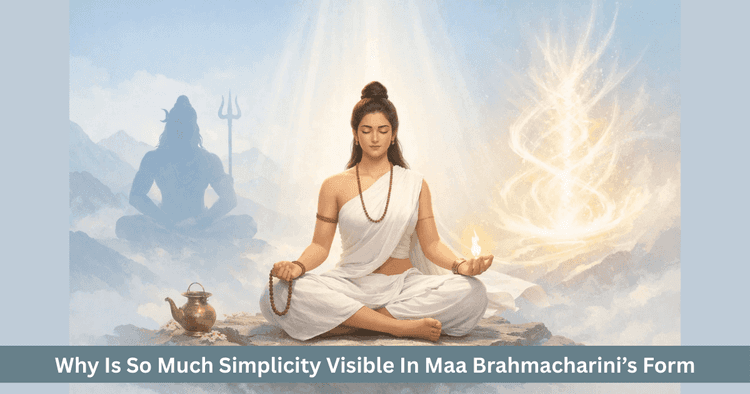
Table of Contents
The form of Maa Brahmacharini appears simple at first sight, yet within that simplicity lies a profound and surprising indication. When she is seen as an ascetic goddess, the mind may naturally assume that this is the stage where power has become quiet, where greatness has stepped away from outer magnificence and where the Divine Mother has restrained herself into a gentle form. But on deeper reflection, this very stage may be understood as the highest expression of power, one that ordinary vision often fails to recognize. Here power has not diminished. It has become so subtle and so elevated that it no longer needs outward demonstration. That is why Maa Brahmacharini represents not merely austerity but the highest power resting in silence.
The question of whether her true identity points toward a force greater than Shiva appears to seek a direct answer, yet its real meaning unfolds only through spiritual understanding. In Indian thought, Shiva is the symbol of supreme consciousness, while Shakti is the dynamic energy that gives that consciousness expression. Without Shakti, Shiva is understood as still and unmanifest. Without Shiva, Shakti would have no anchoring center. This is the point where Maa Brahmacharini’s form becomes deeply meaningful. She is not only the goddess performing tapas to attain Shiva. She is herself the power that makes Shiva complete. For this reason, her form cannot be seen as lesser. It carries the union of primordial energy, austerity, self discipline and living awareness.
Why Is So Much Simplicity Visible In Maa Brahmacharini’s Form
The first thing one notices in Maa Brahmacharini is the absence of outer display. There are no royal garments, no heavy ornaments, no shining weapons and no dramatic form of divine authority. She walks barefoot, holding a rosary and a kamandal, a water vessel used by ascetics. This simplicity can mislead the ordinary mind. People often assume that where there is no display of force, there must be less power. Maa Brahmacharini overturns that assumption. She reveals that true power does not require adornment to establish itself.
Her form indicates that once power awakens within, outer grandeur loses importance. A consciousness that has found inner strength no longer seeks to prove itself through appearance. That is why Maa Brahmacharini seems serene and yet immeasurably elevated. She carries the truth that power born from tapas does not need ornament. It needs only inner steadiness.
Can This Form Of Power Be Understood Apart From Shiva
To understand the mystery of Maa Brahmacharini, one must understand the relationship between Shiva and Shakti. Shiva is not merely a deity in form. He is the symbol of still consciousness. Shakti is not just energy. She is the expression of that consciousness in action. Creation moves only when Shakti becomes active, when time flows, nature changes and life takes form. In this sense, Shakti is not merely supportive. She is essential.
For this reason, many traditional interpretations suggest that in certain states, the influence of Shakti appears even more active and more visible. This does not mean that Shiva and Shakti stand in competition. It means that when manifestation is considered, the role of Shakti becomes especially evident. Maa Brahmacharini represents that awakened and concentrated force which becomes so refined through tapas that even her silence can create a cosmic level of influence.
Was Her Tapasya Only Personal Devotion Or Something More
To see Maa Brahmacharini’s tapasya as only personal devotion or a desire to attain Shiva would be a very narrow reading. Her tapas was a deeply spiritual process. It did not arise only from longing. It arose from the need to stabilize consciousness at its highest level. This is why her form is not merely that of an ascetic but of power transformed into tapas.
It is said that when she was absorbed in austerity, not only the gods but nature itself seemed to come under her influence. The slowing of the wind, the stillness of water and the sense that time itself had paused all suggest that this was not ordinary practice. It was the awakening of the energy that rests at the root of creation. In this form she is not only performing spiritual discipline. She is demonstrating that self mastered power can be far more influential than outward rule.
Does Her True Identity Connect With Adi Shakti
When her form is contemplated deeply, it becomes clear that Maa Brahmacharini is not merely the second form of Navdurga. She represents that dimension of Adi Shakti, the primordial divine power, which chooses inner completion before outer expansion. This is the same power that could bring immediate result, yet chooses process over quick fulfillment. This is not merely strength. It is conscious strength.
Her silence, restraint and uninterrupted tapas indicate that she is not only power but the power that governs power itself. This point is extremely deep. Ordinary power can change something outside. Higher power can govern itself. Maa Brahmacharini is the embodiment of that second kind of power. That is why many seekers feel that she is not only power itself but the final maturity of power.
Could This Form Also Be Seen As A Test Even For Shiva
There is another subtle side to this narrative. The form of Maa Brahmacharini seems meaningful not only for the world but even for the Shiva principle itself. When power chooses to remain restrained, quiet and outwardly unexpressed, can it still be recognized. This is not only a devotional question. It is also a philosophical one. Can that which appears simple on the outside be the most immense within. Maa Brahmacharini answers in the affirmative.
Her tapas may be understood as a phase in which Shakti is not diminishing herself but drawing all her force inward. This inward gathering is not weakness. It is the highest form of energy containment. When such power later manifests, its effect becomes extraordinarily deep. In this sense, her form may also be seen as a subtle revelation of a power that cannot be understood by appearance alone but only through experience.
Why Is She Considered So Powerful When Her Form Is Peaceful
At this point, the common definition of power must change. Power is usually associated with motion, battle, influence, command and visible victory. Maa Brahmacharini teaches that before all of these, there is another power and that one is the most foundational. It is victory over oneself. One who has mastered the mind, disciplined desire and stabilized resolve has attained a power no outer empire can offer.
That is why her strength lies in her peace. She is silent because she does not need noise. She appears simple because she does not need display. She is ascetic because she knows that enduring power is born from tapas, not from possession. This is why her form is deeply inspiring for seekers. It teaches that if the inner center awakens, a person can become a force of transformation without ever seeking outer domination.
Would It Be Right To Say She Was More Powerful Than Shiva
The answer does not lie in comparison but in the unity of principle. To place Shiva and Shakti apart and ask which is greater can become spiritually limiting. Still, it is fair to say that in certain states, the force of Shakti appears more active, more visible and more transformative. Maa Brahmacharini is a striking example of that active yet subtle force.
She is not greater than Shiva by standing apart from him. Rather, she is the energy that completes Shiva. So if one says that her form points toward a power even more influential than Shiva, that should not imply rivalry. It should mean that here power appears in such an awakened form that it stands as the original impulse that even gives expression to consciousness. That is the deeper meaning hidden in this narrative.
What Is The Greatest Message Of Maa Brahmacharini For Life
Her form reminds us that real power is born within. Modern life often focuses on achievement, visibility, recognition and outward influence. In such a world, Maa Brahmacharini’s austerity asks a difficult question. Can outer power remain stable without inner grounding. Can influence remain beneficial without self knowledge. Can achievement remain pure without patience.
Her answer is clear. Quiet power is the deepest power. Disciplined awareness is the most enduring power. Silent tapas is the purest power. She teaches that if a person learns to gather energy inwardly, that same energy later becomes light in every area of life.
The Final Indication Of This Form
Maa Brahmacharini’s form reveals that the highest power is not the one that conquers the world but the one that gathers every inner force into a single unwavering center. From that center, the world itself can be influenced. That is why her simple form should never be mistaken for smallness. Its simplicity is its magnificence. Its silence is its radiance. Its tapas is its invincibility.
For this reason, it is not enough to describe Maa Brahmacharini only as an ascetic goddess. She is the living truth that the power awakened within is always the deepest, the most enduring and the most universal. That is what makes her form extraordinary.
Frequently Asked Questions
Is Maa Brahmacharini truly a very powerful form
Yes. Her quiet and ascetic form itself proves her deep power. She presides over self discipline and awakened inner energy.
Can she be called more powerful than Shiva
Not in a comparative sense but her form does indicate an active and transformative force of immense depth.
What is the spiritual meaning of her simplicity
It shows that real power does not need outer display. It arises from inner steadiness.
Why is her tapasya considered so important
Because it is not merely personal discipline but the awakening of power in its purest and highest form.
What is the greatest message of this story
That the power which remains quiet, disciplined and inwardly centered is the deepest and most enduring power of all.
Get your accurate Kundali
Generate KundaliDid you like it?
Author

Pt. Nilesh Sharma (63)
Experience: 20
Consults About: Family Planning, Career
Clients In: Punjab, Haryana, Delhi
Share this article with friends and family
About ZODIAQ
ZODIAQ is an online Vedic Astrology platform. It connects clients seeking astrological advice to experienced astrologers with deep knowledge. Our users also generate kundali and perform kundali milan for free. ZODIAQ also offers services to the Astrologers. Astrologers utilize various offerings by ZODIAQ to serve their clients effectively.
If you are a User
Consult with experienced astrologers and seek their guidance. You can also order handwritten Janm Patrika report with life prediction prepared by experienced astrologers. Generate accurate Kundali, perform Kundali Matching and check horoscope and muhurat. Utilize our online library for all the necessary astrological and spiritual information.
If you are an Astrologer
Create accurate kundali for your clients and perform Kundali Matching for up to 5 people at a time. Write comprehensive Janm Patrika report for your clients with ZODIAQ. Check client details anytime by saving it in client directory. Become more productive by tracking how many clients you guide every day.
WELCOME TO
ZODIAQ
Right Decisions at the right time with ZODIAQ
