Maa Brahmacharini and Shiva: What If Creation’s Balance Changed?
By Pt. Sanjeev Sharma
What If Maa Brahmacharini Had Not Married Shiva and Creation’s Balance Had Shifted?
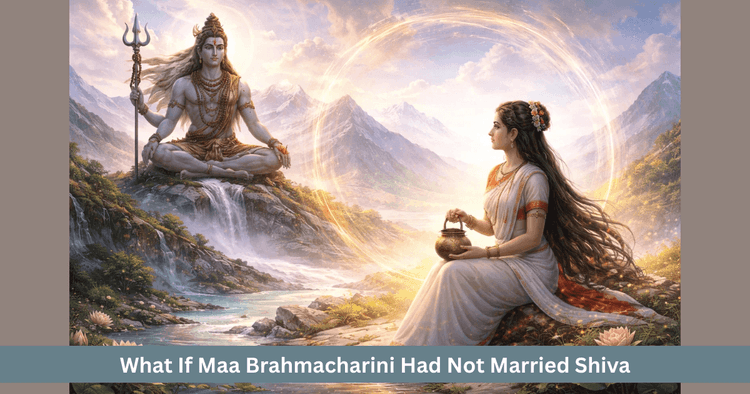
Table of Contents
This is not merely a question of imagination. It is a thought that touches the deepest principles of creation itself. When the tapas, resolve and union of Maa Brahmacharini with Shiva are contemplated, it becomes clear that this was not only a personal decision of a goddess. It was something far more vast. If that union had not taken place, would only one divine relationship have remained incomplete or would the entire movement of creation, its balance and its inner order have shifted in another direction. This question carries a deep unease within it, because the union of Shiva and Shakti is not merely a matter of love. It is the heartbeat of creation.
The form of Maa Brahmacharini is regarded as the embodiment of tapas, patience, discipline and unwavering devotion. She is not only a goddess engaged in austerity but the representation of that power which recognizes its purpose and dedicates itself fully to it. If this form is seen only as the state of a tapasvini before marriage, the story remains incomplete. In truth, this is the stage in which Shakti prepares herself so that the divine union of consciousness and energy may become possible, the very union without which the flow of creation cannot remain balanced.
Why Is The Union Of Shiva And Shakti Considered So Essential For Creation
In Indian spiritual thought, Shiva is understood as supreme consciousness. He is still, formless, meditative and complete in himself. Shakti, on the other hand, is the energy that gives movement, creates forms and activates nature. If Shiva alone is present, there is consciousness but no expression. If Shakti alone is present, there is energy but no direction. That is why the union of Shiva and Shakti is not only the coming together of two divine beings but the harmony of the two fundamental principles of existence.
This harmony sustains creation. When consciousness and energy move in mutual alignment, creation unfolds in order, life finds direction, destruction also occurs at the right time and renewal becomes possible. If this union were absent, the stream of existence would not necessarily stop but it would lose its natural balance. This is why the union of Maa Brahmacharini with Shiva is not merely a marital event. It is a cosmic necessity.
What Kind Of Universe Would Exist If This Marriage Had Not Happened
Imagine a universe in which Shiva remains absorbed in meditation, yet without the energy that can give his consciousness movement in creation. There would be silence but no living flow. There would be depth but no expression. On the other side, there would be Shakti but if she were not joined with Shiva, there could be vast force without stable direction.
In such a state, creation would neither fully unfold nor fully settle. Things would begin but not become complete. Things would move toward dissolution but never reach fulfillment. It would be a world in which everything seems suspended in between. The process of change would continue, yet without balance. This would not be mere instability. It would be the condition of an incomplete existence.
Was Maa Brahmacharini’s Tapasya Truly For Cosmic Balance
To assume that Maa Brahmacharini performed tapas only to attain Shiva as her husband would be too narrow a reading of this narrative. Her tapas was much deeper. Personal love was present within it but so was the call of cosmic balance. She was making possible the union that was essential for the gods, the worlds, nature and the flow of consciousness itself.
Through tapasya she was not merely becoming worthy. She was stabilizing the power that would later unite with Shiva and become the foundation of a larger harmony. If this tapas had not taken place, it is possible that the balance between the gods and forces of disorder would also have weakened. The strength of the divine could gradually diminish and lower forces could rise unchecked. If power were to manifest without proper harmony, it could also become unrestrained. Thus her tapas was not only a personal attainment but power refined for the welfare of creation.
What Effect Would This Have Had On The Balance Between Gods And Asuras
At the cosmic level, the gods do not merely represent divine persons. They symbolize light order, protection, wisdom, discipline and upward moving consciousness. The asuras do not only stand for outer enemies. They also symbolize disorder, excess, ego, imbalance and downward moving energy. When the balance of Shiva and Shakti is intact, divine tendencies receive their sustaining foundation and disruptive tendencies remain limited.
If Maa Brahmacharini had not married Shiva, this balance could have been disturbed at a subtle level. Divine order would lose stability and forces of disorder could gain greater space. This would not remain limited to one war or one story. Its effect would extend across many realms, many ages and many layers of awareness. From this perspective, her decision was not merely personal but deeply linked with the protection of dharma, meaning sacred order.
Is This Union Only Outer Or Does It Also Exist Within Every Being
One of the most beautiful aspects of this narrative is that the union of Shiva and Shakti is not only a divine story outside us. It also unfolds within every living being. Within each person there is a side of Shiva, silent, witnessing, conscious and deep. Within each person there is a side of Shakti, active, creative, emotional and dynamic. When these two remain in harmony, life gains clarity, peace, action, love and purpose together.
When this balance breaks, the individual begins to feel divided within. One may become trapped in thought and lose action or become trapped in restlessness and lose inner stillness. The union of Maa Brahmacharini with Shiva symbolizes this inner truth as well. She teaches that energy alone is not enough and consciousness alone is not enough. Their harmony is what creates wholeness.
What Effect Would This Have Had On Time And The Direction Of Change
If this union had not happened, even the movement of time could have unfolded differently. Time here does not mean only measured moments but the order of transformation within creation. When Shakti and consciousness are aligned, change moves in a meaningful direction. Ages evolve, life develops, the soul passes through experience and creation continuously renews itself.
But if this balance weakens, the process of transformation can either slow down or lose its direction. Growth can become distorted. Stagnation and disorder can arise together. This is why the tapas of Maa Brahmacharini and her union with Shiva may also be understood as connected with the flow of time itself. She becomes the basis of that essential union without which movement and direction cannot remain together.
Was Her Choice Only Love Or Something Far Greater
The story of Maa Brahmacharini cannot be reduced to a love narrative alone. Love is certainly present within it but so are responsibility, dharma, tapas, cosmic awareness and a sense of wider welfare. She did not merely follow the call of her heart. She chose the path necessary for a larger order of existence. That is what makes her form so exalted.
Her decision shows that what appears personal may in fact be profoundly universal. Some choices do not affect only the one who makes them. They influence the entire world around them. Maa Brahmacharini’s union with Shiva was one such decision. It was a choice of love but equally a choice of cosmic responsibility.
What Does This Story Mean For Human Life
This narrative is not only a divine tale. It is also a mirror for life. In human experience too, some decisions are not merely private. They affect family, relationships, the flow of time and one’s inner evolution. At the time, they may seem purely personal but later their wider impact becomes clear.
Maa Brahmacharini teaches that balance is the basis of life. If inner balance is broken, outer success does not bring peace. If relational balance is broken, power itself may become insecurity. If the balance between purpose and patience is broken, effort loses direction. That is why her form is not only the form of tapas but of balanced power.
What Would Have Been The Greatest Loss If This Union Had Not Taken Place
The greatest absence would not simply have been the absence of a marriage. The greatest absence would have been the absence of wholeness. Shiva would remain in silence, Shakti in motion but the harmony that keeps existence in rhythm would remain unformed. The world would continue, yet without that deep inner cadence which gives life meaning.
It is important to understand that creation is not merely existence. It is balanced existence. Among all divine unions necessary for that balance, the union of Shiva and Shakti is regarded as the most essential. Maa Brahmacharini made that harmony possible.
What Does This Question Ultimately Make Us Reflect Upon
This story finally compels us to ask whether some decisions in life may appear small outwardly while carrying immense consequences at a deeper level. Can certain acts of patience, tapas and resolve be more than personal choices. Can one right decision establish balance on many unseen levels. The answer given by Maa Brahmacharini’s story is yes.
She teaches that behind every decision there may be a deeper design, even if it is not immediately visible. Her marriage to Shiva was not only a divine union but a point of balance that helped keep creation aligned upon its axis. That is the profound secret hidden in this narrative.
Frequently Asked Questions
Was Maa Brahmacharini’s marriage to Shiva necessary for creation
Yes, this union is understood as essential for the balance between consciousness and energy.
What might have happened if this marriage had not occurred
The harmony of creation could have weakened and a larger instability might have emerged in existence.
Is this story only about love
No, along with love it carries tapas, responsibility, dharma and the balance of creation.
Does the union of Shiva and Shakti also exist within us
Yes, it exists within every person as the harmony of still consciousness and active energy.
What is the greatest message of this story
That balance is the foundation of life and creation and some decisions can influence the direction of existence itself.
Get your accurate Kundali
Generate KundaliDid you like it?
Author

Pt. Sanjeev Sharma (63)
Experience: 20
Consults About: Family Planning, Career
Clients In: Punjab, Haryana, Delhi
Share this article with friends and family
About ZODIAQ
ZODIAQ is an online Vedic Astrology platform. It connects clients seeking astrological advice to experienced astrologers with deep knowledge. Our users also generate kundali and perform kundali milan for free. ZODIAQ also offers services to the Astrologers. Astrologers utilize various offerings by ZODIAQ to serve their clients effectively.
If you are a User
Consult with experienced astrologers and seek their guidance. You can also order handwritten Janm Patrika report with life prediction prepared by experienced astrologers. Generate accurate Kundali, perform Kundali Matching and check horoscope and muhurat. Utilize our online library for all the necessary astrological and spiritual information.
If you are an Astrologer
Create accurate kundali for your clients and perform Kundali Matching for up to 5 people at a time. Write comprehensive Janm Patrika report for your clients with ZODIAQ. Check client details anytime by saving it in client directory. Become more productive by tracking how many clients you guide every day.
WELCOME TO
ZODIAQ
Right Decisions at the right time with ZODIAQ
